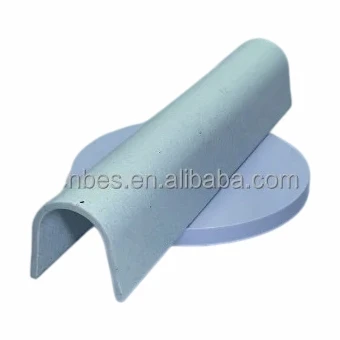


Henan Enbuess Composite Materials Co., Ltd. is one of the leading manufacturers and suppliers of fiberglass u channel in China. We are committed to providing high quality customized service for global clients. If you're going to buy high strength fiberglass u channel made in China, welcome to get free sample from our factory.
Fiberglass U Channel for Cable Runs, Drainage and Edge Framing
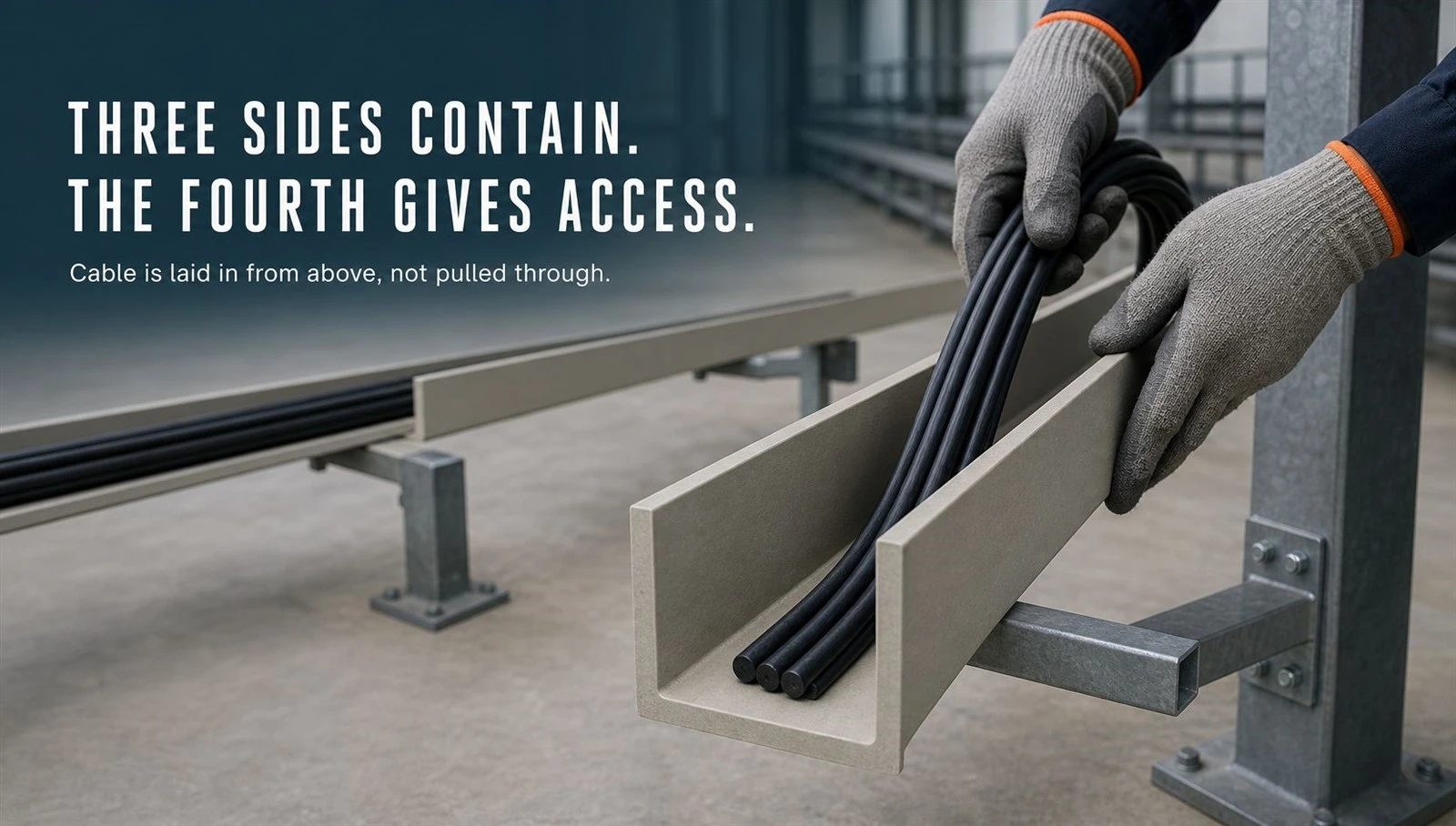
A channel gives you three sides of a box and leaves the fourth open. That open face is the whole point: cable can be laid in rather than pulled through, water can run along it, and anything inside stays reachable without dismantling the run.
We hold 47 channel dies from 25 mm to 182 mm deep. It is our second-largest family, and it is the profile where the open face causes the most problems when it is not accounted for.
Standard sizes
Shown as depth × width × thickness. All rows run on tooling we already hold.
|
Depth × width × thickness (mm) |
Weight (kg/m) |
Tooling |
|
25 × 25 × 3 |
0.43 |
Existing |
|
30 × 7.5 × 2.5 |
0.19 |
Existing |
|
30 × 10 × 2 |
0.19 |
Existing |
|
35 × 15 × 2.5 |
0.4 |
Existing |
|
35 × 25 × 2.5 |
- |
Existing |
|
40 × 7 × 2.5 |
- |
Existing |
|
46 × 15 × 2.5 |
0.57 |
Existing |
|
50 × 25 × 5 |
0.95 |
Existing |
|
50 × 30 × 2.5 |
0.66 |
Existing |
|
50 × 30 × 3 |
0.64 |
Existing |
|
50 × 65 × 5 |
1.67 |
Existing |
|
53 × 43 × 5 |
1.34 |
Existing |
|
53 × 43.8 × 5 |
1.38 |
Existing |
|
56 × 32.5 × 2.5 |
0.53 |
Existing |
|
60 × 40 × 3 |
1.3 |
Existing |
|
60 × 45 × 6 |
- |
Existing |
|
63 × 40 × 5 |
1.38 |
Existing |
|
63 × 41 × 4 |
- |
Existing |
|
64 × 56 × 6 |
1.97 |
Existing |
|
68 × 30 × 3.5 |
0.89 |
Existing |
|
70 × 55 × 4 |
1.46 |
Existing |
|
76 × 32.5 × 2.2 |
0.68 |
Existing |
|
79 × 56 × 5 |
- |
Existing |
|
80 × 15 × 3 |
- |
Existing |
|
80 × 30 × 3 |
0.8 |
Existing |
|
80 × 32.5 × 2.2 |
0.68 |
Existing |
|
80 × 40 × 12 |
3.32 |
Existing |
|
80 × 43 × 5 |
1.5 |
Existing |
|
85 × 41 × 2.5 |
0.97 |
Existing |
|
96 × 32.5 × 2.5 |
0.8 |
Existing |
|
100 × 20 × 5.3 |
1.37 |
Existing |
|
100 × 25 × 5.3 |
1.47 |
Existing |
|
100 × 35 × 6 |
1.95 |
Existing |
|
100 × 37 × 40 × 6 |
- |
Existing |
|
100 × 50 × 5 |
2 |
Existing |
|
102 × 35 × 6 |
1.95 |
Existing |
|
120 × 80 × 5 |
2.77 |
Existing |
|
125 × 65 × 8 |
- |
Existing |
|
127 × 40 × 6.35 |
2.42 |
Existing |
|
144.5 × 40 |
1.87 |
Existing |
|
180 × 50 × 8 |
4.4 |
Existing |
|
182 × 63 × 5 |
- |
Existing |
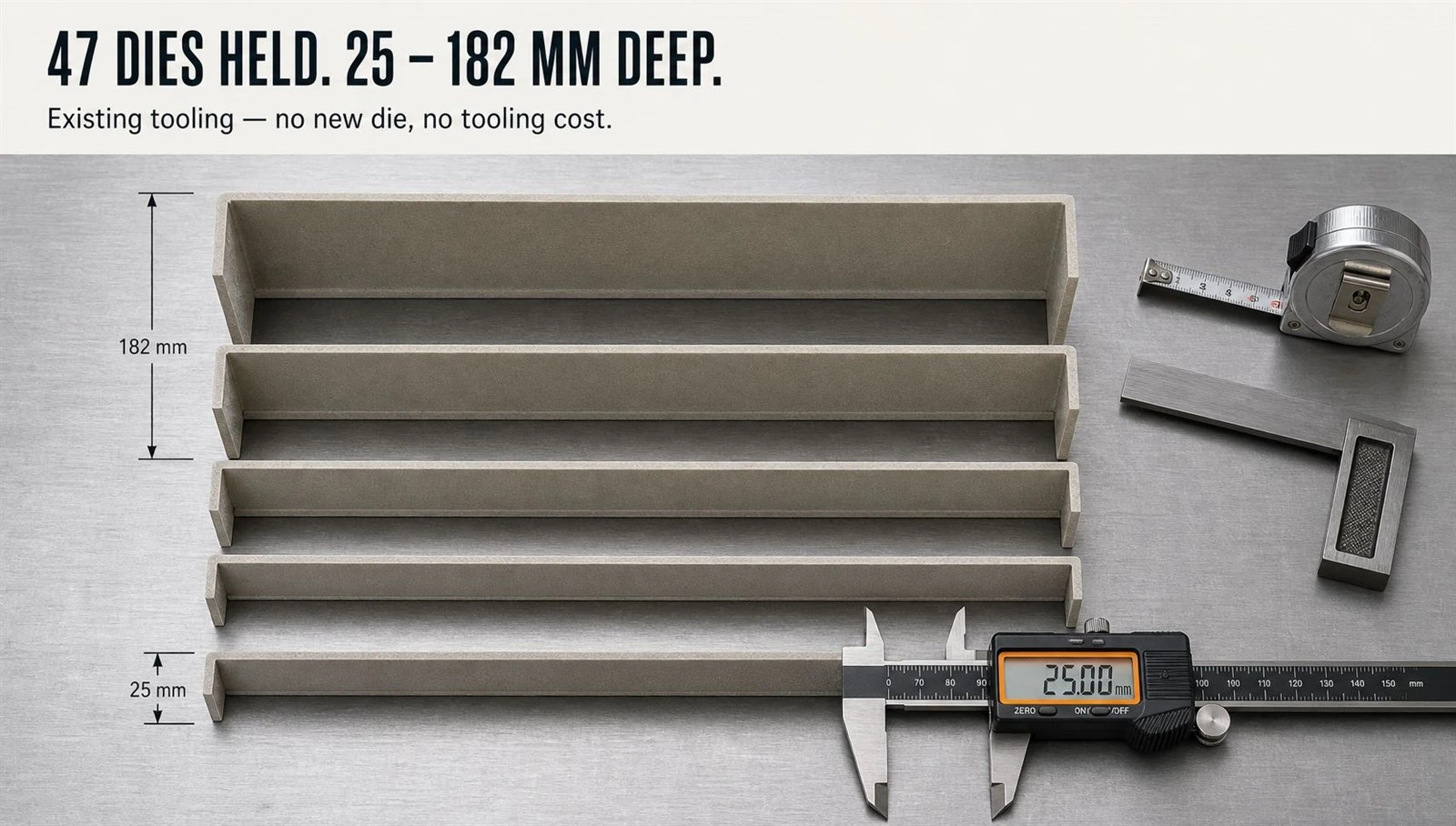
Channel sizes with four dimensions have a stepped or unequal flange. Ask if the section you need does not appear - with 47 dies held, a size close to yours often exists under a slightly different notation.
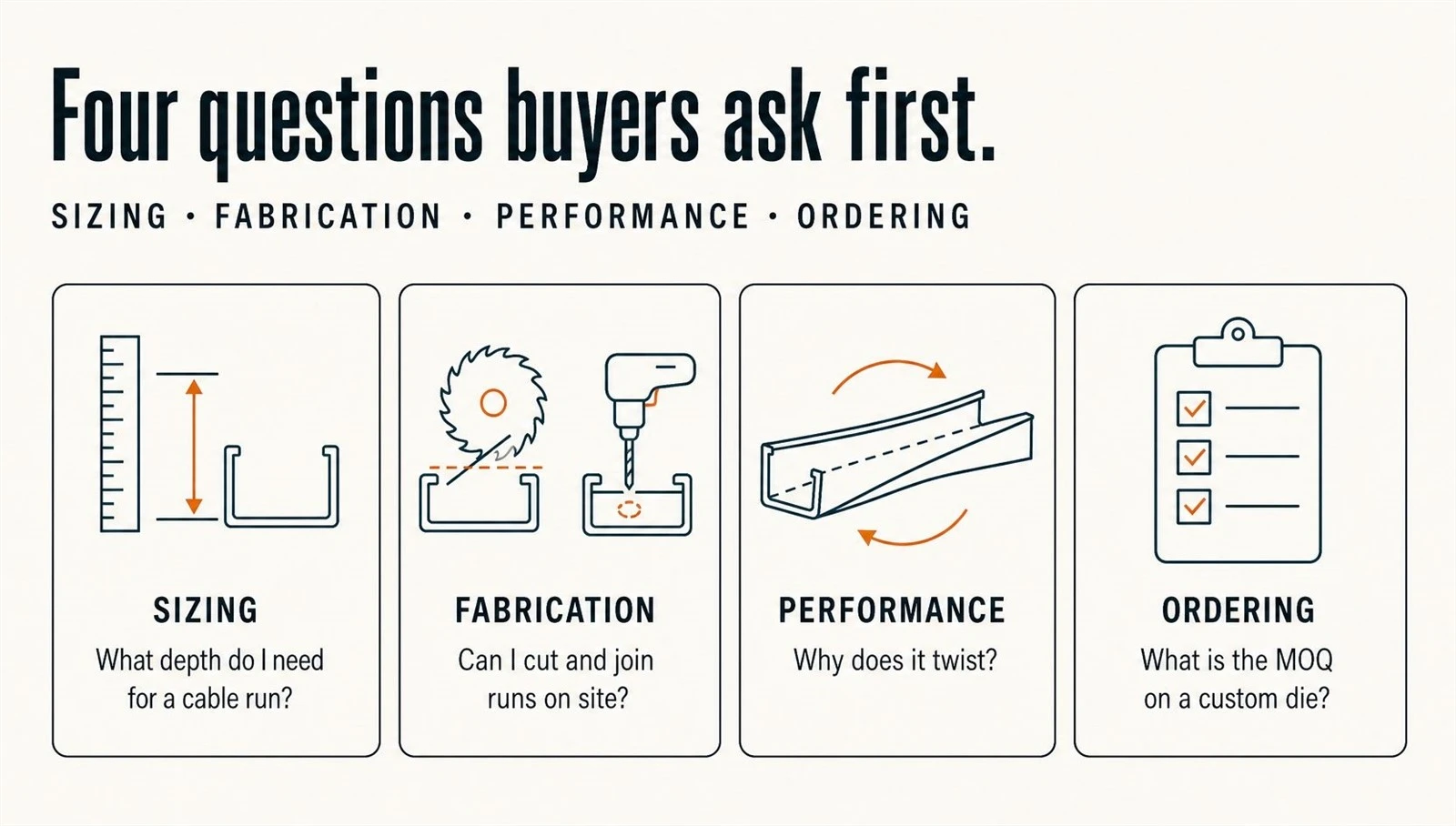
What buyers ask about this profile
Four groups. Each one is answered on this page.
Sizing
What depth do I need for a cable run?
Can the channel carry water?
Is my size held or does it need a die?
Do you supply a matching cover?
Fabrication
Can I cut and join runs on site?
How do I make a corner or a tee?
Will the open face deform?
Can I drill the web?
Performance
Why does it twist?
Will it sag along a long run?
Does water freeze in it?
Can I use it outdoors?
Ordering
How does it compare with steel channel?
Can I get a sample length?
Do you supply test certificates?
What is the MOQ on a custom die?
Why a U channel
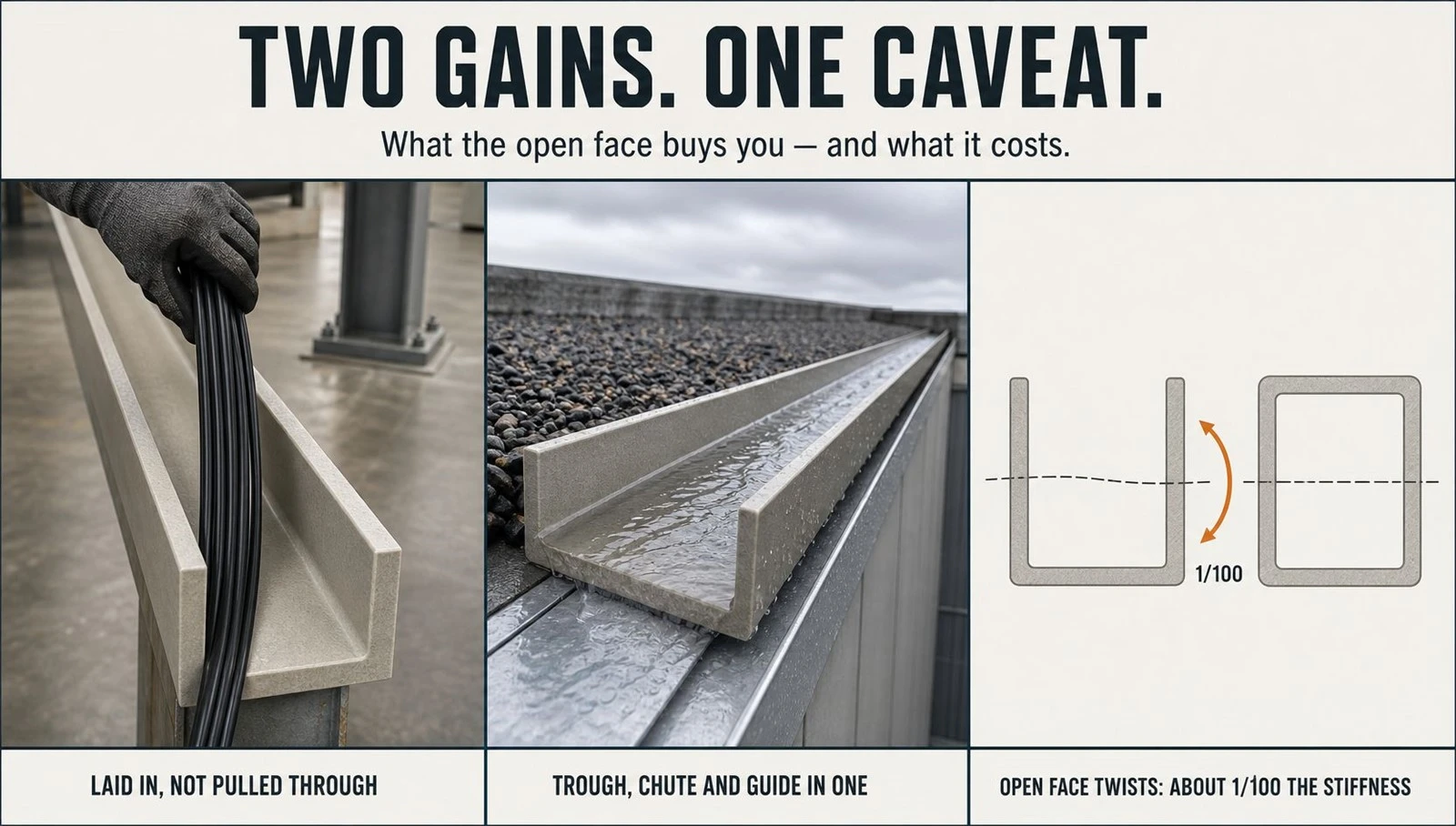
Two reasons the open face is worth having, and one reason it needs a detail.
|
Cable goes in from the top, not through the end |
|
Running cable through a closed conduit means pulling it, with all the friction, draw-pit and access problems that come with a long pull. In an open channel the cable is laid in along the whole run, added to later, inspected at any point, and lifted out again without dismantling anything. On a tray or a trough this is the difference between a half-day and a two-day job, and it is why channel rather than tube is specified for most industrial cable work. |
|
It is a trough, a chute and a guide in one section |
|
The same profile that carries cable will carry water off a roof edge, guide a sliding panel, or chute material from one point to another. Three sides contain; the fourth gives access. For drainage and for any gravity-fed run this is the natural shape, and it is why we hold more channel dies than almost any other family. |
|
The open face has almost no torsional stiffness |
|
This is the price of the open face and it is not small: an open channel resists twist with roughly one hundredth of the stiffness of a closed tube of comparable size. A long channel loaded off-centre, or a long run of channel fixed only at its base, will roll and twist visibly. The fix is cheap and there are three options - close the section with a cover plate, add cross braces at intervals, or use a square or rectangular tube where the run is long and exposed to torsion. Which one depends on whether you need the open face for its own sake. |
Where it gets specified
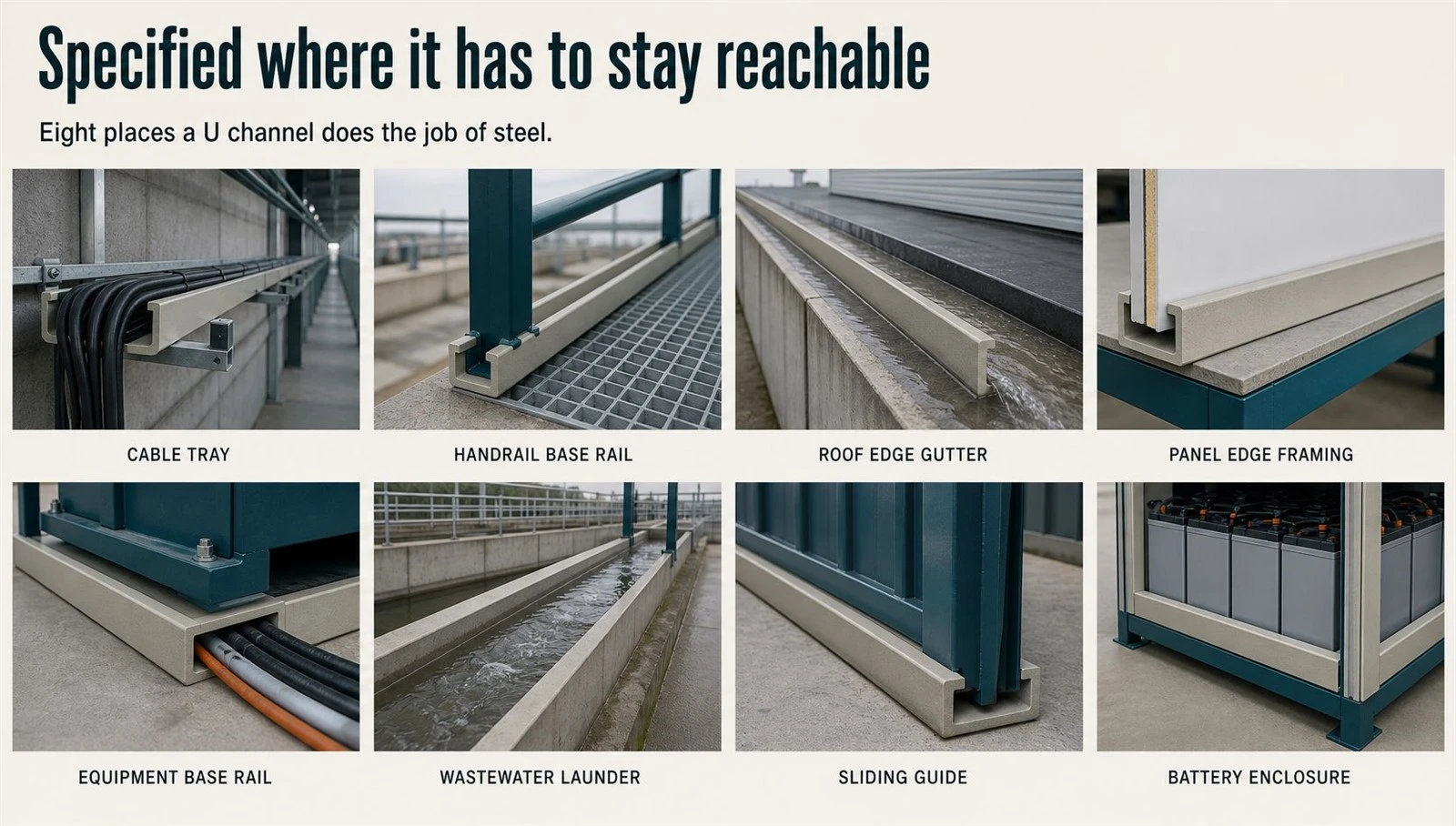
Channel is bought where something has to be contained but stay reachable.
Cable tray and troughing
Laid in rather than pulled through, and inspectable at any point.
Handrail base rails
Top-fix rail systems use a channel base with a clamp.
Drainage and roof edge gutters
Three sides contain, and the open face is the inlet.
Panel and board edge framing
The open face accepts a panel edge directly.
Equipment frames and base rails
Open face lets services enter and exit anywhere along the run.
Water and wastewater launders
Channels in treatment plant, where steel needs coating renewal it never gets.
Sliding guides and chutes
The channel form guides material without a separate track.
Battery and equipment enclosures
Insulating, non-magnetic, and no earthing requirement.
Against the metals you are replacing
Channel is most often bought to replace galvanised steel cable tray or steel channel framing.
|
Property |
Pultruded composite |
Carbon steel |
Galvanised steel |
Stainless 304 |
Stainless 316 |
Aluminium 6061-T6 |
|
Density (g/cm³) |
1.8–2.2 |
7.85 |
7.85 |
8 |
8 |
2.7 |
|
Tensile strength (MPa) |
≥ 800 |
370–500 |
370–500 |
515 |
515 |
310 |
|
Specific strength |
≈ 400 |
≈ 51 |
≈ 51 |
≈ 64 |
≈ 64 |
≈ 115 |
|
Internal surface corrosion |
No mechanism |
Rusts, damages cable |
Rusts at cut and weld |
Sound |
Sound |
Oxidation |
|
Rust scale on cable |
None |
Yes |
Yes when coating fails |
No |
No |
No |
|
Eddy current loss (single-core) |
None |
Significant |
Significant |
Significant |
Significant |
Significant |
|
Electrical |
Insulating |
Conductive |
Conductive |
Conductive |
Conductive |
Conductive |
|
Modulus (GPa) |
≥ 40 |
~200 |
~200 |
~193 |
~193 |
~69 |
|
Torsional stiffness |
Very low, open |
Very low, open |
Very low, open |
Very low, open |
Very low, open |
Very low, open |
|
Cut and drill on site |
Hand tools |
Grinder, hot work |
Grinder, re-protect |
Grinder |
Grinder |
Hand tools |
|
Maintenance, 25 yrs |
None |
Paint 3–4 times |
1–2 times |
Inspect in chloride |
Low |
Oxidation control |
|
Scrap value at end |
Low |
High |
High |
Very high |
Very high |
High |
Why galvanised tray is a short-term answer
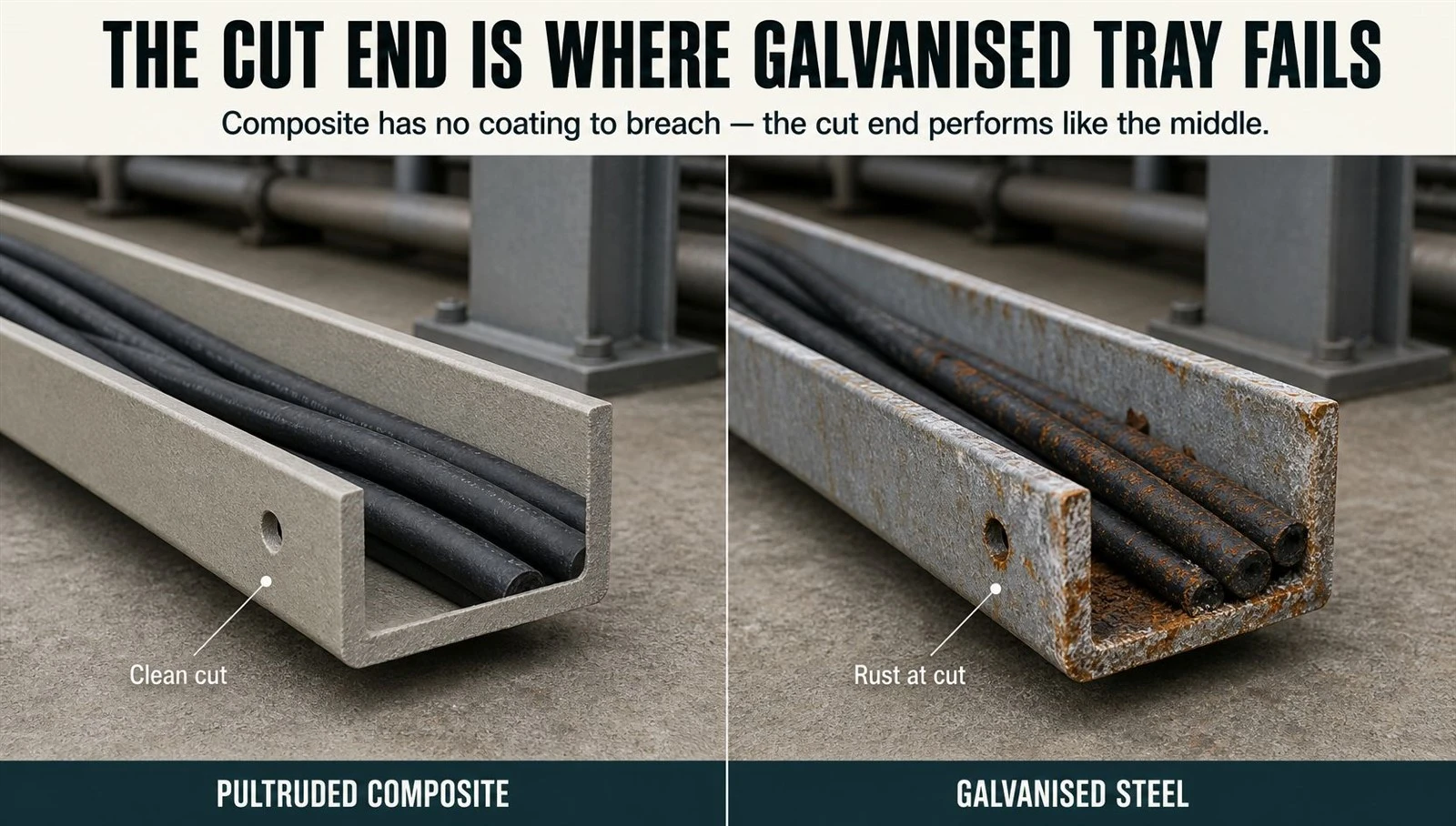
A galvanised cable tray is cut to length on site, and every cut end and every drilled hole exposes bare steel. The zinc around the cut is consumed first, rust forms there, and rust scale ends up in the tray and on the cable. In a humid or coastal plant this starts within a few years, and the tray is the last thing anyone thinks to inspect. Composite tray has no coating to breach, so the cut end performs exactly as the middle does.
The eddy current row is worth reading twice
A metallic tray carrying single-core cables develops circulating currents in the tray itself, which heat it and derate the cables. The standard remedies - non-magnetic clamps, phase arrangement, slotting the tray - all add cost. A non-conductive tray removes the mechanism entirely, which is why composite is specified on high-current single-core runs even where corrosion is not a concern at all.
What the metals do better. Stiffness - steel is around five times stiffer. Fire performance in a cable run, where a metallic tray will not contribute fuel and a resin-based one can, which is a real consideration for indoor runs with a fire rating. Temperature, where metal is unlimited. And scrap value at end of life.
Material data
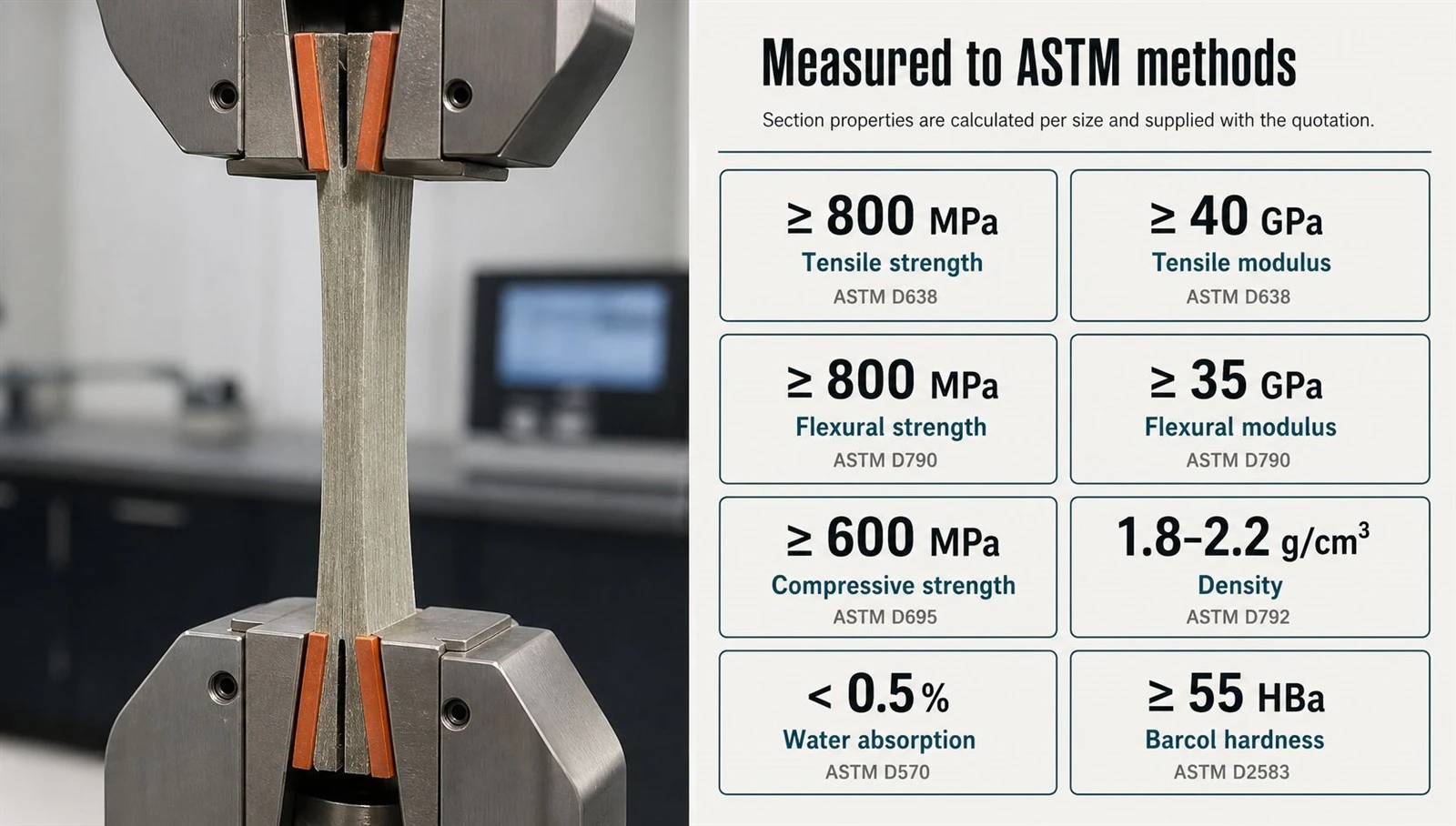
Measured to ASTM methods on the pultruded section. Values are for the composite material; section properties depend on the size you order.
| Tensile strength, longitudinal | ≥ 800 MPa · ASTM D638 | Compressive strength, longitudinal | ≥ 600 MPa · ASTM D695 |
| Tensile modulus, longitudinal | ≥ 40 GPa · ASTM D638 | Density | 1.8–2.2 g/cm³ · ASTM D792 |
| Flexural strength, longitudinal | ≥ 800 MPa · ASTM D790 | Water absorption | < 0.5% · ASTM D570 |
| Flexural modulus, longitudinal | ≥ 35 GPa · ASTM D790 | Barcol hardness | ≥ 55 HBa · ASTM D2583 |
For a channel, section modulus and second moment of area both depend on the flange width and the thickness you order. We calculate them per size and supply them with the quotation rather than publishing a generic table.
Custom, cut to length, ordering
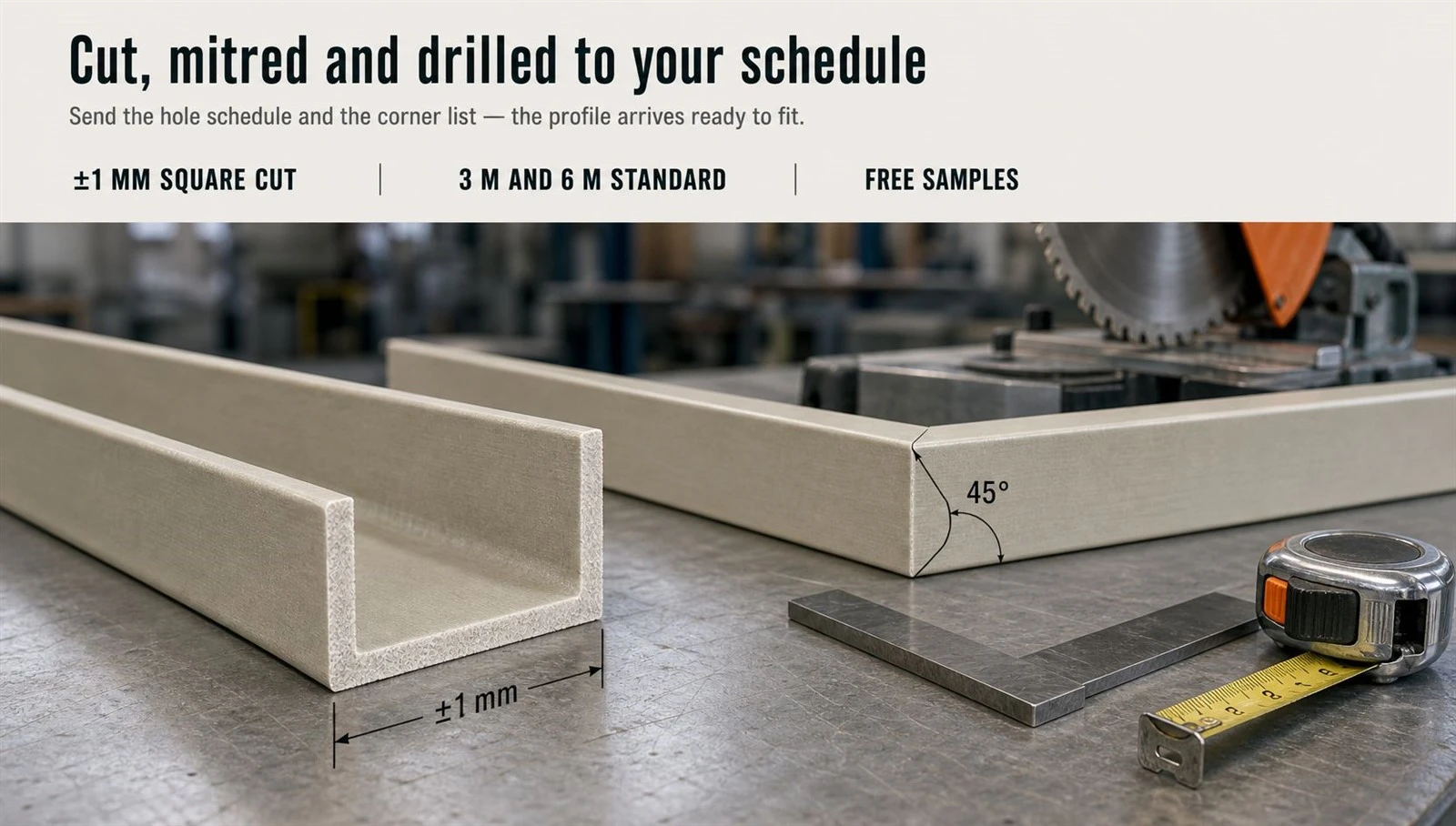
| Cut to length | ±1 mm, square cut | Standard lengths | 3 m / 6 m |
| Drilling and slotting | To your hole schedule | Tooling lead time | 4–6 weeks |
| Mitring | For corners and tees | Custom die MOQ | 1,000 m |
| Cover plates | Supplied to close the section | Samples | Free samples |
| Colour | Integral pigment, RAL matched | Certificates | ISO 9001; test reports available on request |
Production Process


FAQ
Why does my channel twist?
Because an open section has very little torsional stiffness - roughly one hundredth of a comparable closed tube. Anything loaded off-centre, or any long run held only at the base, will roll. Three fixes: fit a cover plate to close the section, add cross braces at intervals, or switch to square or rectangular tube. Tell us the run length and the load and we will tell you which.
What depth do I need for a cable run?
Send the cable schedule, the support spacing and the total weight per metre. Depth is usually driven by how much cable has to sit in the channel with room to spare rather than by strength. As a starting point, most industrial runs sit between 50 mm and 100 mm deep at 1–2 m support centres.
Can it carry water?
Yes, and it is a common use. Seal the joints if the run has to be watertight rather than merely a chute, and on an outdoor run allow for thermal movement along the length. In a freezing climate, a flat-bottomed channel holding standing water can split when it freezes, so specify a fall or drain points.
How do I make a corner or a tee?
Mitre both sections at 45° and join with a moulded corner plate or a bonded internal gusset. For a tee, notch the web of the through-run and butt the branch, then bond or bolt with a backing plate. Both are standard fabrication operations and we can supply the channel cut and mitred to your schedule.
Do you supply a matching cover?
Yes for several sizes. A cover plate does two jobs: it keeps debris out of a cable run, and it closes the section, which raises torsional stiffness dramatically. If you need both, specify the cover at the outset rather than as an afterthought.
Will the open face deform under load?
The two free edges of the flanges are unrestrained, so under a load that pushes the flanges apart - a clamp, a heavy bundle, or a concentrated load on one flange - they will splay. A cross brace or a cover plate at the load point prevents it. This is the most common damage we see on channel installations.
How does it compare with steel channel?
On stiffness and price per metre, steel wins. On corrosion at cut ends, on rust scale contaminating cable, on eddy current losses for single-core runs, and on weight, composite wins. On an indoor cable run in a dry building with easy access, steel is often the right choice. In a coastal plant, a treatment works, or anywhere single-core cables run, it usually is not.
What is the largest channel you hold?
182 mm deep is the largest on existing tooling, with 180 × 50 × 8 mm the heaviest at 4.40 kg/m. Beyond that it needs a new die - and because a channel die is simpler than a hollow section, a custom channel is often quicker to tool than a custom tube.
Tell us what has to run through it, or along it
Channel is specified by what it carries. Send the cable schedule, the flow, or the frame layout, and we will come back with a size, whether it needs closing or bracing, and a price. If a tube or an angle would serve better, we will say that.
Hot Tags: fiberglass u channel, China fiberglass u channel manufacturers, suppliers, factory