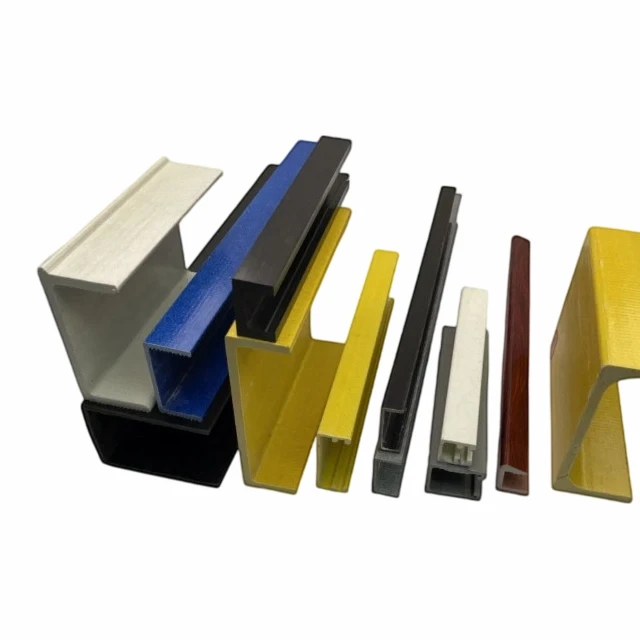


Henan Enbuess Composite Materials Co., Ltd. is one of the leading manufacturers and suppliers of fiberglass c channel in China. We are committed to providing high quality customized service for global clients. If you're going to buy high strength fiberglass c channel made in China, welcome to get free sample from our factory.
Fiberglass C Channel for Solar Rails, Strut and Adjustable Framing
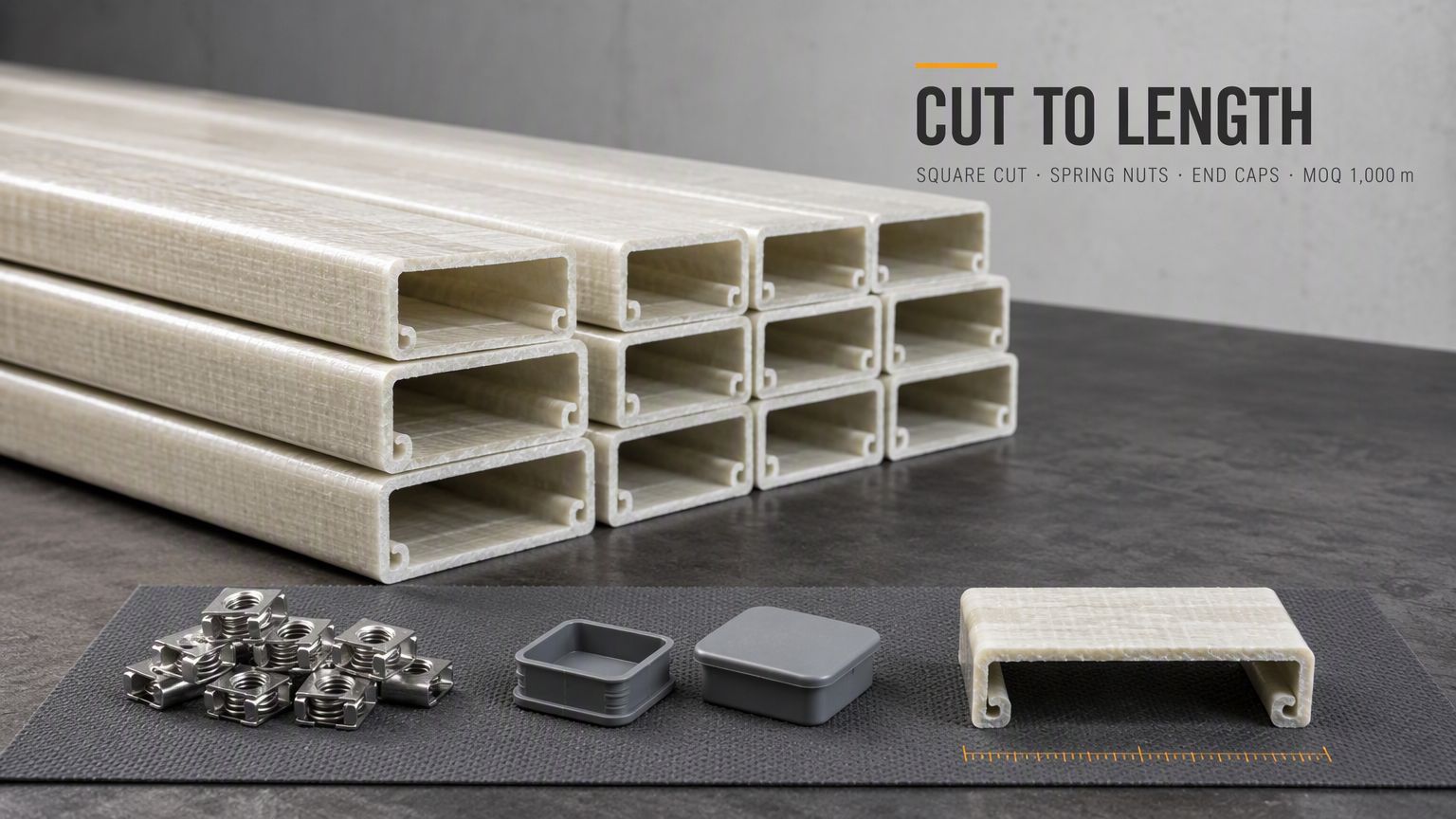
A C channel is a U channel with the open face turned back on itself. That rolled lip is what turns the section from a trough into a fixing system: it gives a spring nut or a slider something to bear against, so anything bolted to the run can be positioned and repositioned without drilling a single hole.
We hold ten C channel dies. It is our smallest structural family, which means the sizes are what they are - if yours is not on the list, tell us early, because a C channel die is a real tooling decision.

Standard sizes
Shown as depth × width × thickness, or depth × width × lip × thickness where the lip is dimensioned. All ten rows run on tooling we already hold.
|
Depth × width × thickness (mm) |
Weight (kg/m) |
Tooling |
|
40 × 15 × 2 |
0.29 |
Existing |
|
40 × 20 × 3 |
- |
Existing |
|
41 × 41 × 3 |
0.88 |
Existing |
|
41.3 × 62 × 4 |
1.43 |
Existing |
|
42 × 42 × 3 |
0.91 |
Existing |
|
60 × 40 × 4 |
1.19 |
Existing |
|
85 × 50 × 4 |
1.68 |
Existing |
|
85 × 60 × 15 × 4 |
1.89 |
Existing |
|
160 × 55 × 40 × 8 |
- |
Existing |
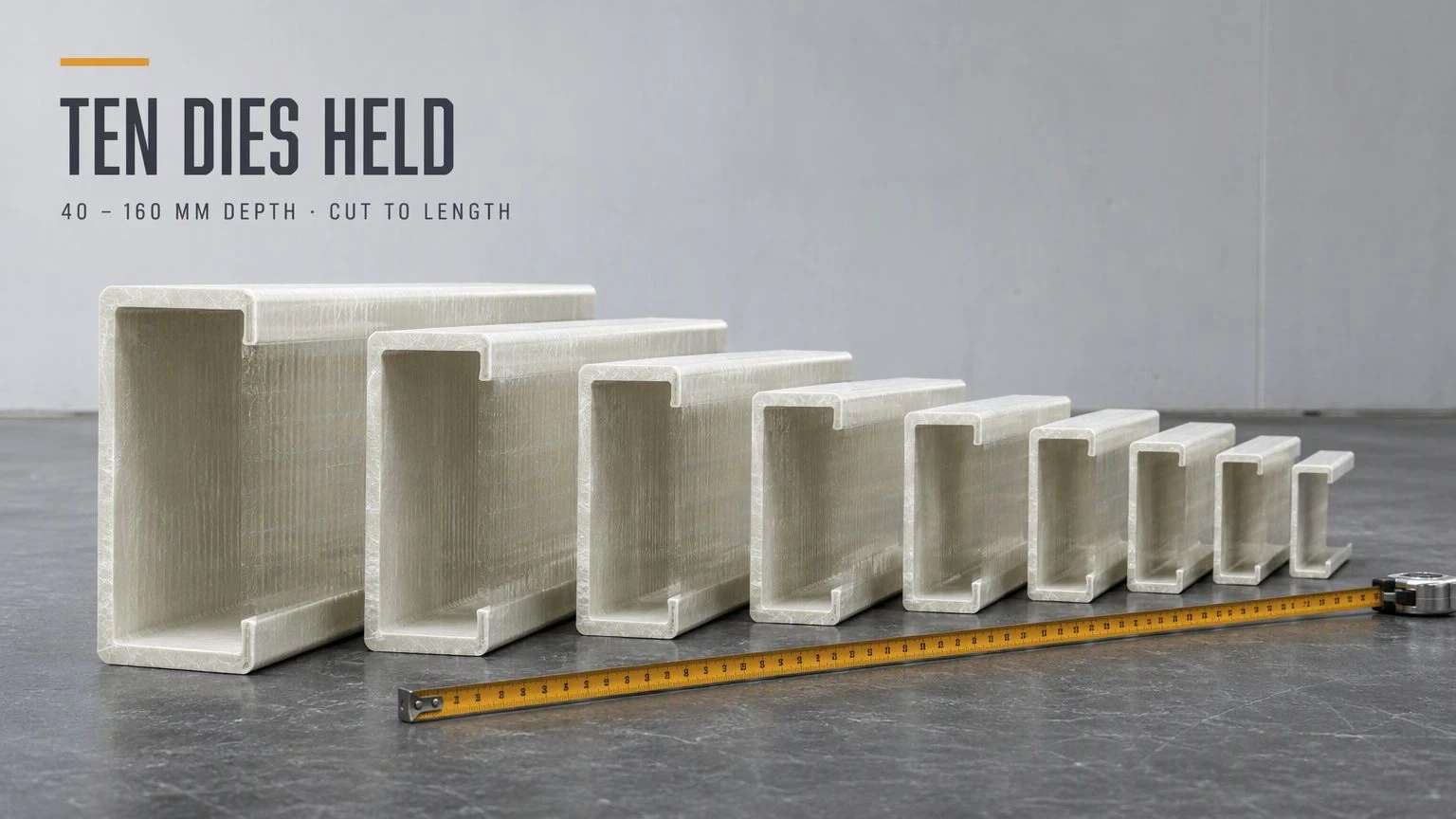
With ten dies held, this is the family where a near-match is most likely to save you tooling cost. Send the section you are using now and we will tell you whether one of these works, or whether a U channel in a closer size would serve better.
What buyers ask about this profile
Four groups. Each one is answered on this page.
Sizing
What size do I need for a solar rail?
What spring nut fits the lip?
Is my size held or does it need a die?
Can it span what I need?
Fabrication
Do I need to drill it at all?
Can I cut it on site?
How do I make a corner?
Can I join two lengths?
Performance
Will the lip deform under a nut?
Will it sag along a long rail?
How much wind uplift will it take?
Can I use it outdoors?
Ordering
How does it compare with aluminium solar rail?
Can I get a sample length?
Do you supply test certificates?
What is the MOQ on a custom die?

Why a C channel
The lip is the whole point. Three things it buys you.
|
Position without drilling |
|
A spring nut or a slider drops into the channel mouth anywhere along the run and bears against the rolled lip. That means a clamp, a bracket or a pipe support can be placed at any position, moved later, and added to after commissioning - with no holes, no swarf, and no loss of section at a fixing point. On a solar array where module positions shift with the layout, or on a frame that gets modified during installation, this is worth more than the material saving. |
|
The lip stiffens the free edges |
|
A plain U channel has two unrestrained flange edges that splay under load. Turning the lip inward gives each flange a stiffened edge, which raises both the local bearing capacity where a nut sits and the section's resistance to the flanges opening up. It is the cheapest stiffness you can add to an open section. |
|
It is the section the solar industry already designs around |
|
Module clamps, end clamps, grounding washers and pipe clips are all made to fit a standard strut profile. Choosing C channel means the hardware catalogue already works, and it means a composite rail can replace an aluminium one without redesigning every attachment. |
Where it gets specified
C channel is bought as a fixing system as much as a structural section.
Solar array rails
Module clamps and end clamps fit the lip; no drilling through the rail.
Battery and inverter enclosures
Non-conductive framing with no earthing requirement.
Strut framing and equipment racks
Adjustable, reconfigurable, and no hot work to install.
Water treatment plant frameworks
Adjustable supports in permanently humid conditions.
Pipe and conduit supports
Clips position anywhere along the run and move later.
Marine and jetty service runs
Salt spray with no coating to maintain.
Curtain wall and facade subframes
Where an insulating, thermally broken subframe is required.
Clean room and laboratory rigs
Non-magnetic, non-outgassing, and easy to reconfigure.
Against the metals you are replacing
C channel is most often bought to replace aluminium solar rail or galvanised steel strut.
|
Property |
Pultruded composite |
Carbon steel |
Galvanised steel |
Stainless 304 |
Stainless 316 |
Aluminium 6061-T6 |
|
Density (g/cm³) |
1.8–2.2 |
7.85 |
7.85 |
8 |
8 |
2.7 |
|
Tensile strength (MPa) |
≥ 800 |
370–500 |
370–500 |
515 |
515 |
310 |
|
Specific strength |
≈ 400 |
≈ 51 |
≈ 51 |
≈ 64 |
≈ 64 |
≈ 115 |
|
Earthing and bonding required |
No |
Yes |
Yes |
Yes |
Yes |
Yes |
|
Galvanic corrosion with steel bolts |
Not a failure mode |
Yes |
Yes |
Yes |
Yes |
Yes - common problem |
|
Thermal conductivity (W/m·K) |
0.3–0.5 |
~50 |
~50 |
~16 |
~16 |
~167 |
|
Expansion, longitudinal (10⁻⁶/°C) |
6–10 |
~12 |
~12 |
~17 |
~16 |
~23.6 |
|
Salt / chloride |
No mechanism |
Rusts through |
Zinc gone in 2–3 yrs |
Pitting, SCC |
Good |
Pitting |
|
Modulus (GPa) |
≥ 40 |
~200 |
~200 |
~193 |
~193 |
~69 |
|
Weight for equal section |
Lightest |
Heaviest |
Heavy |
Heavier |
Heavier |
Light |
|
Maintenance, 25 yrs |
None |
Paint 3–4 times |
1–2 times |
Inspect in chloride |
Low |
Oxidation control |
|
Scrap value at end |
Low |
High |
High |
Very high |
Very high |
High |
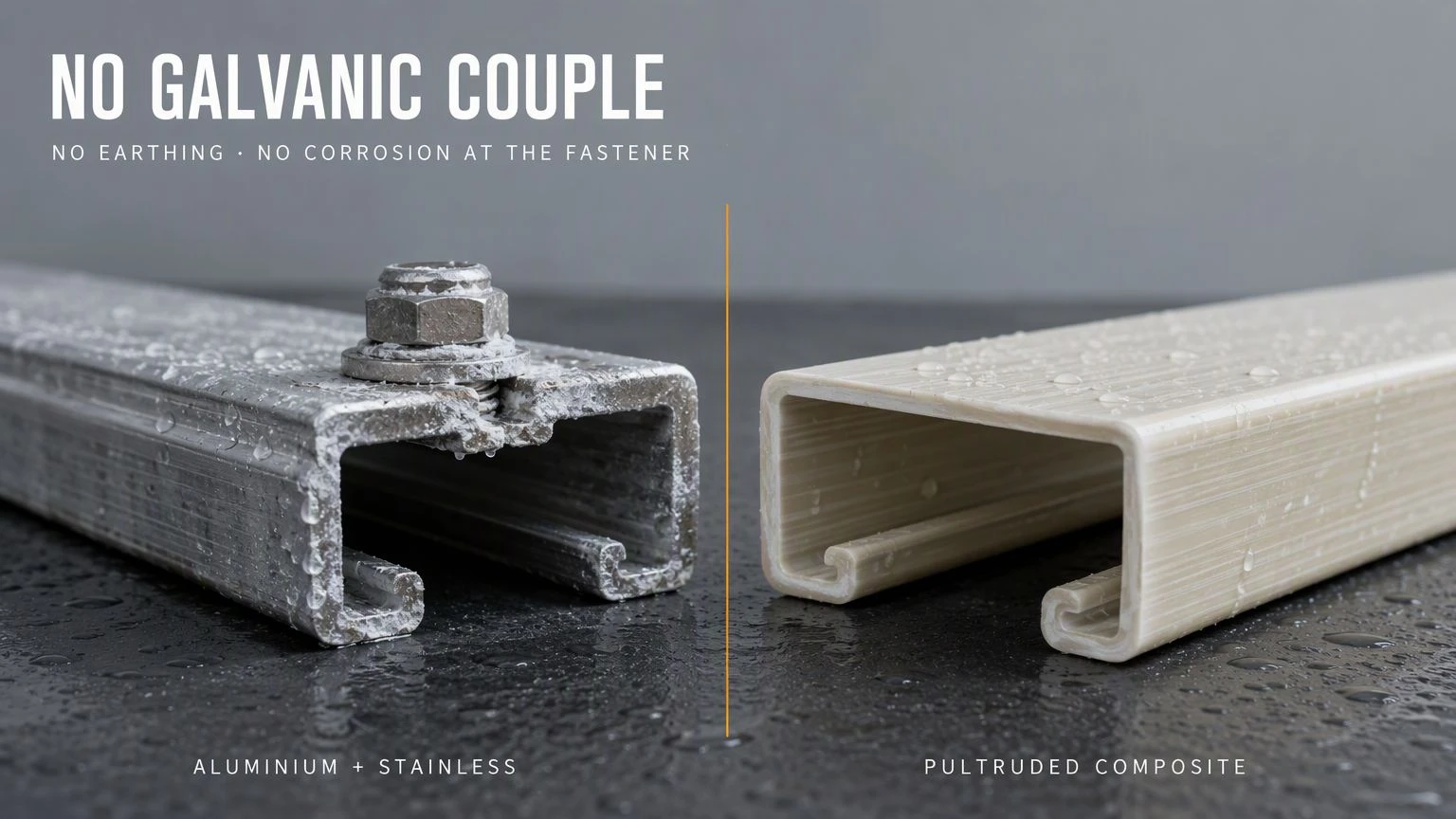
Aluminium rail and stainless bolts are a galvanic pair
This is the most common failure in metal solar mounting. An aluminium rail with a stainless bolt is a galvanic couple, and in a wet or coastal atmosphere the aluminium corrodes at the fastener. The usual mitigations - isolating washers, coated fasteners, sacrificial hardware - all add parts and all eventually fail. A non-conductive rail removes the mechanism: there is no circuit, so there is no couple.
Thermal movement is the overlooked one
An aluminium rail expands at about 23.6 × 10⁻⁶/°C. On a long array in a climate with a wide daily swing, that is real movement at every joint, and it is why aluminium rails need expansion joints and slotted fixings. A composite rail runs at 6–10 × 10⁻⁶/°C along the pultrusion direction - closer to steel than to aluminium - so the detailing is simpler and the joints stay tight.
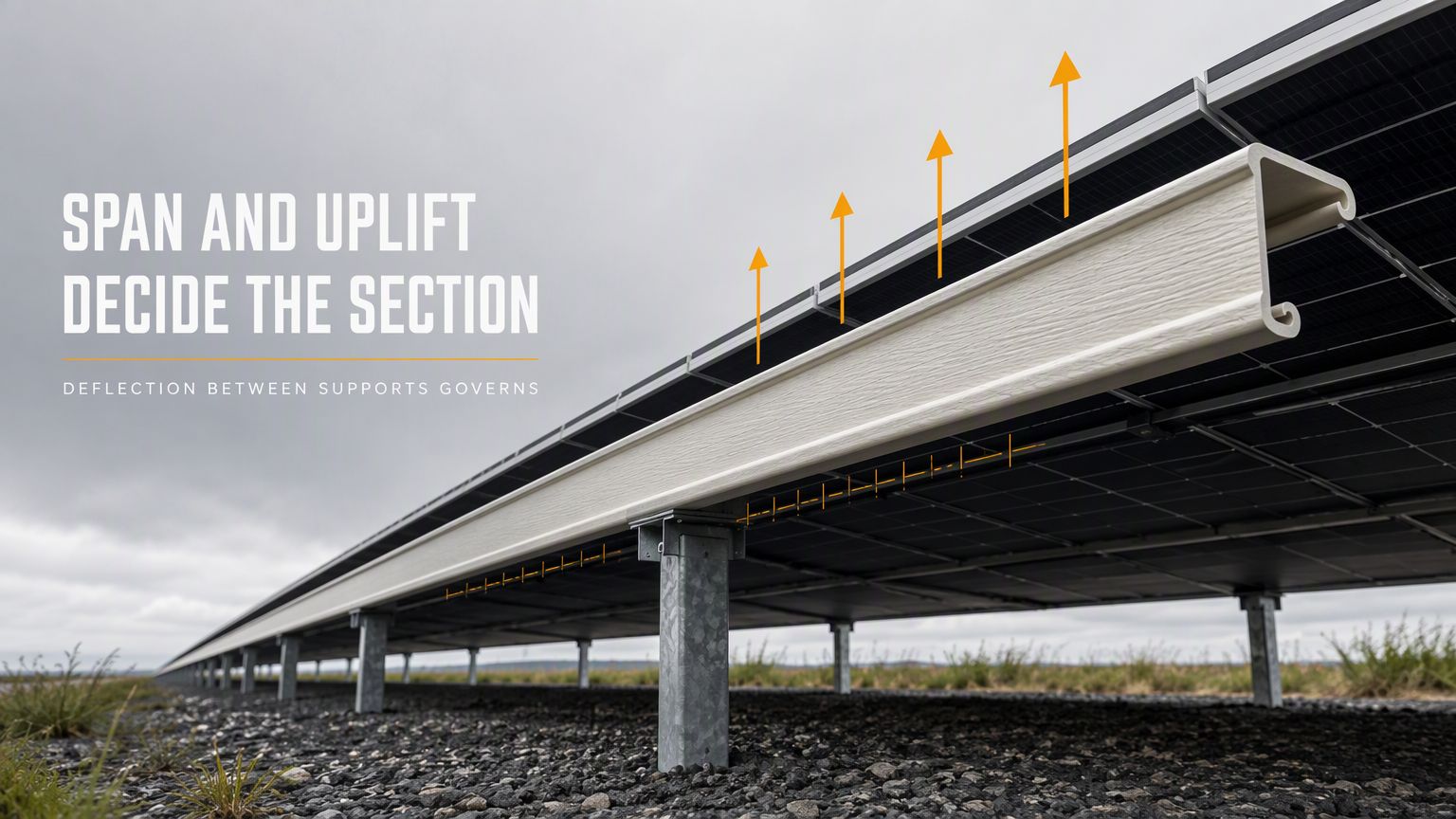
Where aluminium still wins. Stiffness: aluminium's modulus is about 69 GPa against composite's 40, so an aluminium rail of the same depth spans further. That matters most on wide rafter or purlin spacings. It also carries meaningful scrap value. If your span is long and the section depth is fixed, ask us to run both - sometimes the answer is aluminium, and we would rather tell you.
Material data
Measured to ASTM methods on the pultruded section. Values are for the composite material; section properties depend on the size you order.
| Tensile strength, longitudinal | ≥ 800 MPa · ASTM D638 | Compressive strength, longitudinal | ≥ 600 MPa · ASTM D695 |
| Tensile modulus, longitudinal | ≥ 40 GPa · ASTM D638 | Density | 1.8–2.2 g/cm³ · ASTM D792 |
| Flexural strength, longitudinal | ≥ 800 MPa · ASTM D790 | Water absorption | < 0.5% · ASTM D570 |
| Flexural modulus, longitudinal | ≥ 35 GPa · ASTM D790 | Barcol hardness | ≥ 55 HBa · ASTM D2583 |
For a rail, the governing checks are usually deflection under wind uplift and the bearing capacity at the clamp. Both depend on the exact section and wall you order, and both are supplied with the quotation.
Custom, cut to length, ordering
| Cut to length | ±1 mm, square cut | Standard lengths | 3 m / 6 m |
| Drilling | Only where you specify it | Tooling lead time | 4–6 weeks |
| Spring nuts and sliders | To suit the lip, M8 spring nuts available | Custom die MOQ | 1,000 m |
| End caps | Supplied to close the section | Samples | Free samples |
| Colour | Integral pigment, RAL matched | Certificates | ISO 9001; test reports available on request |
Production Process


FAQ
What spring nut fits the lip?
The lip geometry varies between dies, so the nut is matched to the section rather than bought generically. Tell us which size you are ordering and we will supply or specify the nut and slider that fit it. Getting this wrong is the most common reason a C channel installation goes badly, so confirm it before ordering hardware separately.
Do I need to drill it at all?
Usually not. That is the point of the section. A spring nut or slider bears against the rolled lip, so a bracket can be fixed, moved and refixed without a hole. Drill only where a fixing must be positively located - and when you do, back the exit face with a scrap block.
Will the lip deform under a nut?
It will if the nut is over-torqued. The lip carries the load in bearing, and composite relaxes slowly under a sustained clamp, so preload drops over time. Use a serrated flange nut or a wedge-lock washer, torque to the figure we specify for the section, and plan a re-torque interval on anything subject to vibration or thermal cycling.
What size do I need for a solar rail?
Send the module dimensions, the rafter or purlin spacing, and the design wind uplift for the site. The governing check is usually deflection between supports rather than strength, because the modulus is lower than aluminium's. If your support spacing is wide, tell us - that is the number that decides whether composite rail works or whether you should stay with aluminium.
How does it compare with aluminium solar rail?
Composite is lighter, needs no earthing or bonding, has no galvanic couple with stainless fasteners, and expands at roughly a third of aluminium's rate. Aluminium is stiffer, so it spans further at the same depth, and it carries scrap value. On a coastal or high-humidity array, composite usually wins on lifecycle. On a long span with a fixed rail depth, aluminium often wins on stiffness.
Can I join two lengths?
Yes. An internal splice bonded into the channel is the usual method, and it keeps the outside clear so a clamp can still pass over the joint. A moulded splice plate bolted through the web is the alternative where the joint must be demountable.
How many sizes do you hold?
Ten. It is our smallest structural family, so if your size is not among them, tell us at enquiry stage rather than after the design is fixed. A C channel die is a real investment and the lead time is longer than for a simple flat or angle die.
Can it be used vertically as well as horizontally?
Yes. Orientation does not affect the section, only the load case. Tell us the orientation and the load and we will check it either way.
Send us the rail span and the design wind uplift
Those two numbers decide the section. We will come back with a size, the deflection figures, and whether composite or aluminium is the better call for your support spacing. If it is aluminium, we will say so.
Hot Tags: fiberglass c channel, China fiberglass c channel manufacturers, suppliers, factory