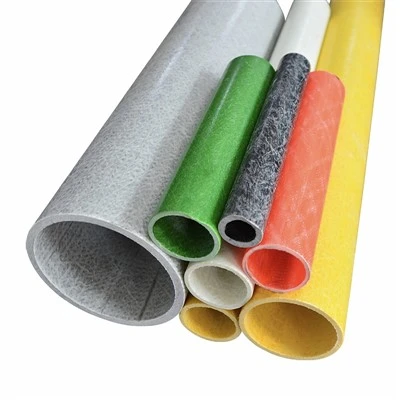
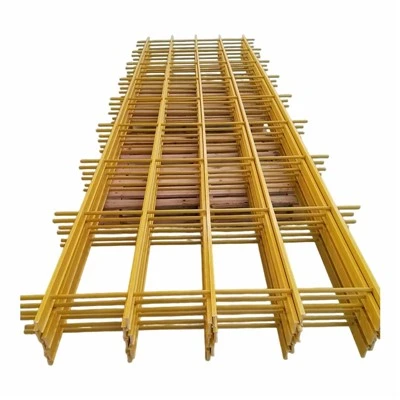
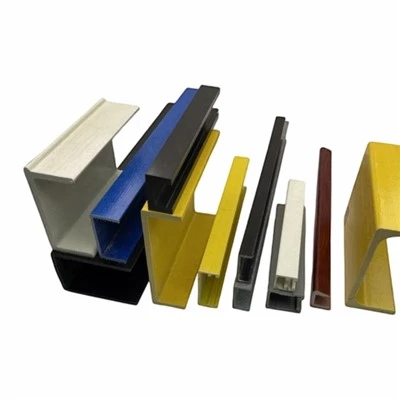
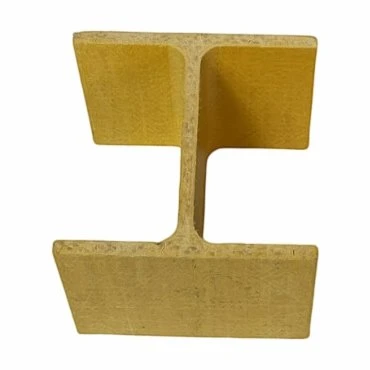
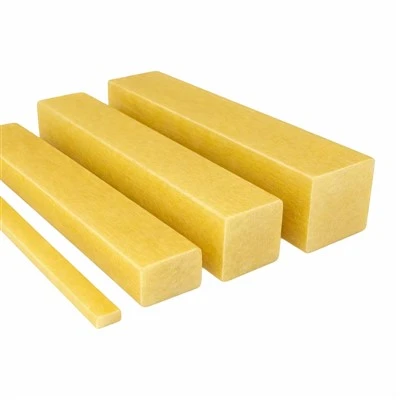
Henan Enbuess Composite Materials Co., Ltd. is one of the leading manufacturers and suppliers of fiberglass square tube in China. We are committed to providing high quality customized service for global clients. If you're going to buy high strength fiberglass square tube made in China, welcome to get free sample from our factory.
01 Standard sizes
Every row below runs on tooling we already hold - no die charge, no tooling lead time. Sizes outside this table need a new die.
|
Nominal (mm) |
Wall (mm) |
Weight (kg/m) |
Resin |
Tooling |
|
16 × 16 |
2 |
0.22 |
Polyester |
Existing |
|
19 × 19 |
2 |
0.27 |
Polyester |
Existing |
|
25 × 25 |
2 |
0.35 |
Polyester |
Existing |
|
25.4 × 25.4 |
1.8 |
0.37 |
Polyurethane |
Existing |
|
28 × 28 |
2 |
0.33 |
Polyester |
Existing |
|
30 × 30 |
3 |
0.64 |
Polyester |
Existing |
|
30 × 30 |
3.1 |
0.71 |
Polyurethane |
Existing |
|
32 × 32 |
2 |
0.45 |
Polyester |
Existing |
|
34 × 34 |
2 |
- |
Polyester |
Existing |
|
38 × 38 |
3.5 |
1.02 |
Polyester |
Existing+ walls |
|
40 × 40 |
3 |
0.9 |
Polyester |
Existing+ walls |
|
40 × 40 |
4 |
1.14 |
Polyester |
Existing |
|
45 × 45 |
4 |
- |
Polyester |
Existing |
|
50 × 50 |
3 |
1.17 |
Polyester |
Existing+ walls |
|
50 × 50 |
4 |
1.52 |
Polyester |
Existing |
|
50 × 50 |
8 |
2.83 |
Polyester |
Existing |
|
58 × 58 |
4 |
1.75 |
Polyester |
Existing |
|
60 × 60 |
4 |
1.75 |
Polyester |
Existing+ walls |
|
63 × 63 |
5 |
2.39 |
Polyester |
Existing+ walls |
|
70 × 70 |
4 |
2.2 |
Polyester |
Existing |
|
75 × 75 |
6 |
3.4 |
Polyester |
Existing |
|
75 × 75 |
6 |
3.66 |
Polyurethane |
Existing |
|
80 × 80 |
3 |
1.79 |
Polyester |
Existing+ walls |
|
90 × 90 |
6.35 |
4.44 |
Polyester |
Existing |
|
100 × 100 |
3 |
2.13 |
Polyester |
Existing |
|
100 × 100 |
5 |
3.83 |
Polyester |
Existing |
|
102 × 102 |
4 |
3.19 |
Polyester |
Existing |
|
115 × 115 |
5 |
4.6 |
Polyester |
Existing |
|
120 × 120 |
4 |
3.8 |
Polyester |
Existing+ walls |
|
150 × 150 |
3.5 |
4.2 |
Polyester |
Existing |
|
200 × 200 |
4 |
6.37 |
Polyester |
Existing |
|
260 × 260 |
2.5 |
- |
Polyester |
Existing |

+ walls means we hold further tooling at that outside dimension in a wall thickness not listed. Tell us the wall you need and we will confirm it.
Section properties - second moment of area and section modulus - are calculated for the specific size and wall you order and supplied with the quotation. We do not publish a generic table, because the figure changes with the wall you actually buy.
02 The questions buyers actually ask
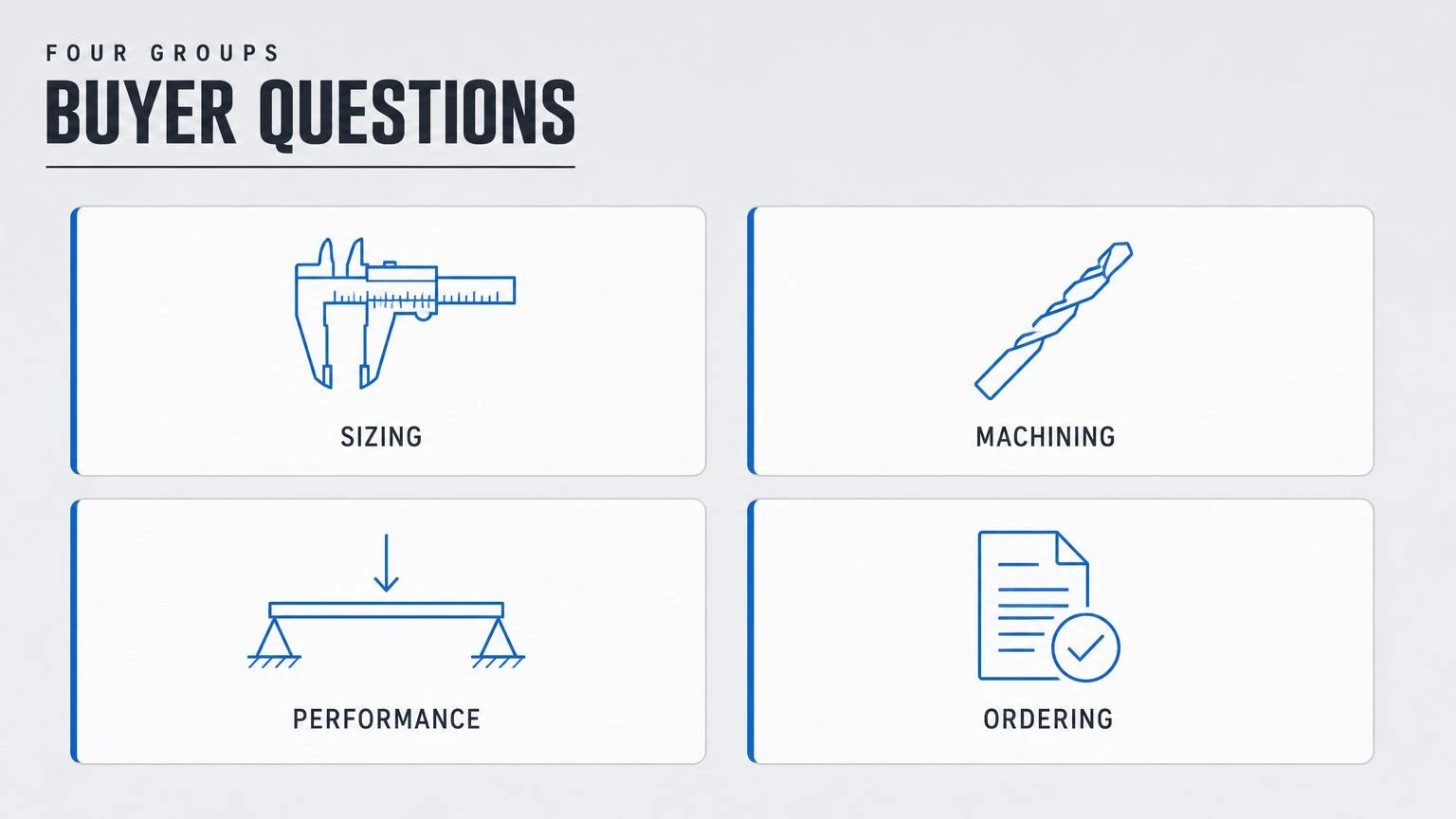
Four groups. Everything here is answered on this page - jump to the section you came for.
Sizing
What size do I need for a given span?
Is this size in stock or made to order?
What is the tolerance on straightness?
How much does it weigh per metre?
Machining
What blade should I use?
Will it split when I drill it?
Can I tap a thread into it?
How do I join two lengths?
Performance
What about load across the tube, not along it?
Will it sag under a constant load?
Does it go brittle in the cold?
Does the surface fray after a few summers?
How does it beat steel, stainless and aluminium?
Ordering
How does the price compare with aluminium?
Can I get a sample length?
Do you supply test certificates?
What is the MOQ on a custom die?
03 Along the tube vs across it
The part most suppliers skip, and the part that decides whether the profile works in your application.
Pultrusion pulls continuous glass roving lengthwise through the die. Strength follows the fibre direction. On a high-specification section - multilayer roving with continuous filament mat and multi-axial reinforcement across the wall:
Longitudinal tensile strength
≥ 800 MPa
Along the pultrusion direction. Compression ≥ 600 MPa.
Transverse tensile strength
≥ 50 MPa
Across the direction of pull. Compression ≥ 100 MPa.
≈ 6% OF LONGITUDINAL
That gap is not a defect - it is how the process works, and it is true of every pultruded profile on the market. On a standard section without multi-axial reinforcement the transverse figure can fall to around 3% of the longitudinal one, so the layup matters as much as the outside dimension. What the gap means for your design:
- Load along the tube: excellent. Posts, columns, chord members, long spans.
- Load across the tube: weak. Anything bearing on the wall - a bolt, a clamp, a point load - works against the weak direction.
- Concentrated loads crush the wall locally before the section reaches its bending capacity. In three-point bending tests on pultruded square sections, ultimate capacity was governed by local crushing of the web under the load point, not by the section's bending strength.

The fix is simple and cheap: spread point loads with a backing plate or saddle, and size bolted joints for bearing rather than for the bolt's shear capacity. Bearing values for each wall thickness are available on request.
04 Cutting, drilling and joining
| Cutting |
|
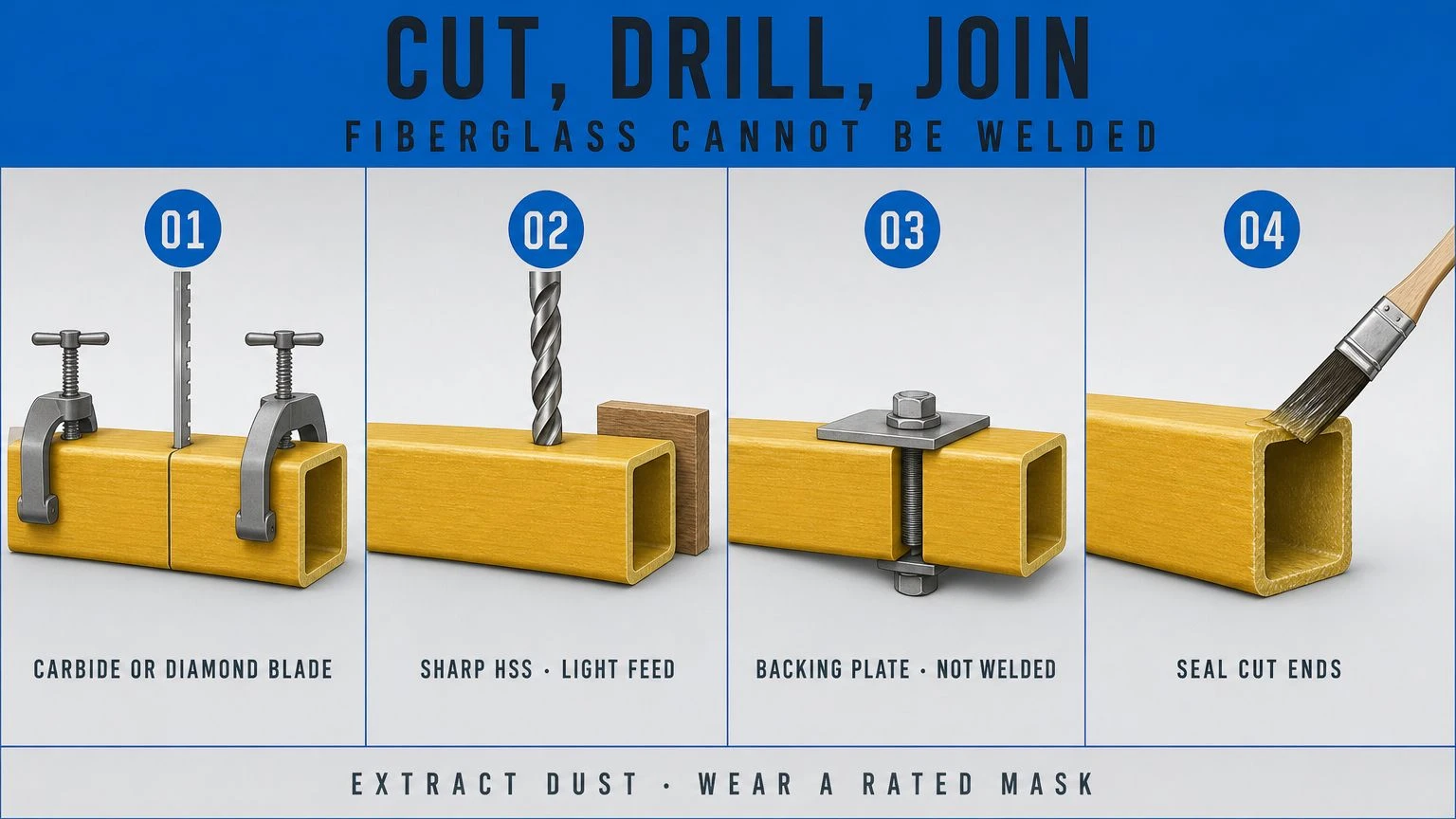
Use a carbide-tipped or diamond blade. A standard wood blade tears the fibres and leaves a ragged edge; an abrasive disc overheats the resin and glazes the cut face. Support the profile on both sides of the kerf so the offcut does not break away and split back along the tube.
Extract the dust and wear a rated mask. Glass dust is not something you want in your lungs, and that applies to every supplier's product, not just ours. |
| Drilling |
|
Drill with a sharp HSS bit at moderate speed and light feed. Heavy feed is what breaks out the far wall and causes the splitting people complain about. Back the exit face with a scrap block and the problem largely disappears.
Hole diameter should run 1–2 mm over the fastener, and holes should sit at least two diameters from the edge. Do not tap threads directly into the wall - the transverse strength is not there to hold a thread. Use a threaded insert, a through-bolt, or a rivet nut. |
| Joining - it cannot be welded |
|
Mechanical. 316 stainless or hot-dip galvanised bolts, with a backing plate or large-diameter washer to spread the bearing load. Preload drops over time because the material relaxes under a clamped joint, so serrated flange nuts or wedge-lock washers hold better on anything subject to vibration.
Adhesive. Two-part epoxy or MMA. The strongest route for permanent joints, and the one used for bonded multi-tube assemblies. Surface preparation matters more than adhesive choice: abrade, degrease, then bond.
Moulded connectors. FRP gussets, corner plates and internal splices keep the whole assembly non-conductive and corrosion-free. This is what we recommend for handrail and platform work. |
| Sealing cut ends |
| Cut ends expose the fibre architecture to moisture. For outdoor or wet installations, seal the cut face with the same resin system or a compatible paint. End caps are available for exposed terminations. |
05 Against the metals you are replacing
You are probably holding a steel or aluminium specification and wondering whether to switch. This section goes through each metal, what you gain, and where you give something up.
The full comparison
|
Property |
Pultruded composite |
Carbon steel Q235 |
Galvanised steel |
Stainless 304 |
Stainless 316 |
Aluminium 6061-T6 |
|
Density (g/cm³) |
1.8–2.2 |
7.85 |
7.85 |
8 |
8 |
2.7 |
|
Weight, same section |
~25% of steel |
Baseline |
Baseline |
~102% |
~102% |
~34% |
|
Tensile strength (MPa) |
≥ 800 |
370–500 |
370–500 |
515 |
515 |
310 |
|
Specific strength |
≈ 400 |
≈ 51 |
≈ 51 |
≈ 64 |
≈ 64 |
≈ 115 |
|
Modulus (GPa) |
≥ 40 |
~200 |
~200 |
~193 |
~193 |
~69 |
|
Salt / chloride |
No mechanism |
Rusts through |
Zinc gone in 2–3 yrs |
Pitting, SCC |
Good |
Pitting |
|
Acid and alkali |
Resin-dependent, excellent |
Poor |
Poor |
Fair |
Good |
Poor in alkali |
|
Galvanic corrosion |
Not a failure mode |
Yes |
Yes |
Yes |
Yes |
Yes |
|
Electrical |
Insulating |
Conductive |
Conductive |
Conductive |
Conductive |
Conductive |
|
Thermal conductivity (W/m·K) |
0.3–0.5 |
~50 |
~50 |
~16 |
~16 |
~167 |
|
Expansion, longitudinal (10⁻⁶/°C) |
6–10 |
~12 |
~12 |
~17 |
~16 |
~23.6 |
|
Magnetic / RF |
Non-magnetic, RF transparent |
Magnetic |
Magnetic |
Near non-magnetic |
Near non-magnetic |
Non-magnetic |
|
Site work |
Cut, drill, no hot work |
Weld, hot work |
Weld, then re-protect |
Weld |
Weld |
Weld or bolt |
|
Maintenance, 25 yrs |
None |
Paint 3–4 times |
1–2 times |
Inspect in chloride |
Low |
Oxidation control |
|
Scrap value at end |
Low |
High |
High |
Very high |
Very high |
High |
Where it wins by the widest margin: strength per kilogram
Strength on its own does not mean much - a steel beam is strong because it is heavy. Divide tensile strength by density and the picture changes. This is the number that matters wherever weight is a cost: transport, lifting, foundations, rooftops, anything a person has to carry.
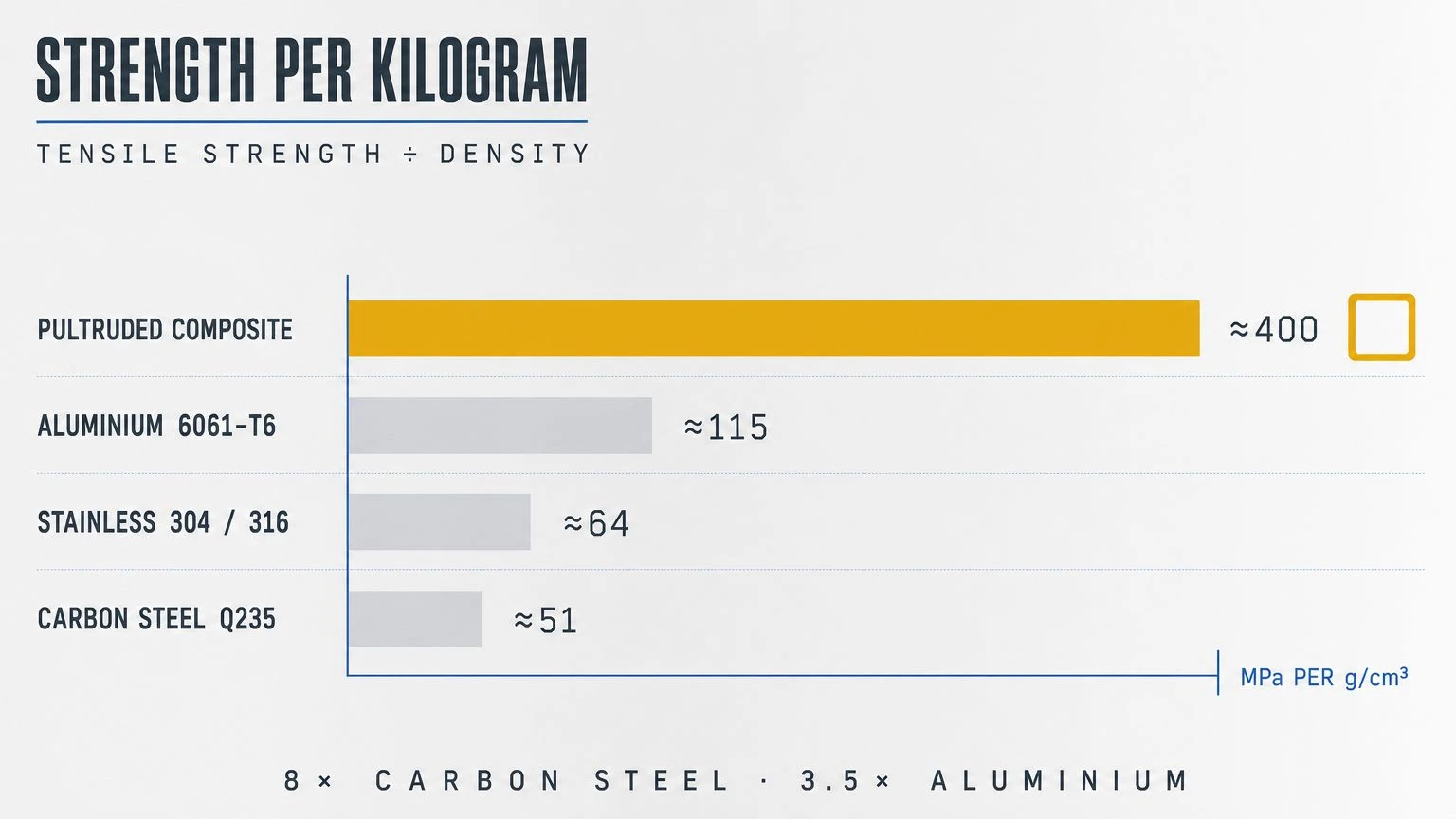
Pultruded composite
≈ 400
MPa per g/cm³
Aluminium 6061-T6
≈ 115
MPa per g/cm³
3.5× lower
Stainless 304 / 316
≈ 64
MPa per g/cm³
6× lower
Carbon steel Q235
≈ 51
MPa per g/cm³
8× lower
Kilogram for kilogram, the profile carries roughly eight times what mild steel carries and three and a half times what aluminium carries. Steel still wins on stiffness and on price per metre, which is why the section below matters more than this table.
One metal at a time
| vs carbon steel Q235 Clear win in corrosive service |
|
What you gain
What you give up
When not to switch |
| vs galvanised steel Clear win in coastal and industrial air |
|
What you gain Composite has no coating to damage. Cut it and the remaining length performs exactly as it did before - the only recommendation is sealing the cut face against moisture on outdoor work.
What you give up |
| vs stainless 304 and 316 Depends entirely on chloride |
|
Where the assumption breaks Grade 316 adds molybdenum and handles chloride properly. It also costs roughly five to eight times what carbon steel costs per kilogram.
What you gain
What you give up
When not to switch |
| vs aluminium 6061 and 6063 Clear win, with one real exception |
|
What you gain Composite removes all four: no alkali attack, no galvanic couple, no earthing, no thermal bridge, and roughly a third less thermal movement to design for.
What you give up - this is the real one
When not to switch |
What it costs over 25 years
Purchase price is one line in a 25-year budget. This is where the comparison usually turns:
|
Cost line |
Composite |
Carbon steel |
Galvanised |
304 |
316 |
Aluminium |
|
Initial material |
Medium |
Lowest |
Low |
High |
Very high |
Medium-high |
|
Transport and lifting |
Low |
High |
High |
High |
High |
Medium |
|
Installation labour |
Low |
High |
High |
High |
High |
Medium |
|
Repainting cycles |
None |
3–4 times |
1–2 times |
None |
None |
None |
|
Inspection and repair |
None |
Periodic |
Periodic |
Needed in chloride |
Low |
Oxidation control |
|
Replacement within 25 yrs |
No |
Likely |
Likely |
Possible in chloride |
Unlikely |
Unlikely |
|
Production downtime |
None |
Painting needs shutdown |
Painting needs shutdown |
- |
- |
- |
On a plant where repainting means a shutdown, or on a structure where access requires scaffolding or a boat, the maintenance line usually outweighs the purchase price difference within the first two cycles. On an indoor frame in a dry building with easy access, it never does. That distinction, not the datasheet, is what decides it.
A correction on thermal expansion
You will see figures around 25×10⁻⁶/°C quoted for this material. That is the transverse value, or a blend of the two. Along the pultrusion direction the coefficient is typically 6–10×10⁻⁶/°C - closer to steel than to aluminium. The distinction matters in practice: a long run of tube expands along its length, so use the longitudinal figure for expansion joints and the transverse figure only for across-width clearance.
What the metals do better, stated plainly. Three things. Steel and stainless are far stiffer, so a stiffness-governed design needs a deeper composite section. Steel yields visibly before it fails - it sags and buckles and gives you warning - whereas composite fails in a more brittle mode with less visible warning, which is why we insist on the safety factors in section 07. And every metal on this table has a scrap value at end of life while composite does not. If your project books recycling revenue, that is real money we cannot match.
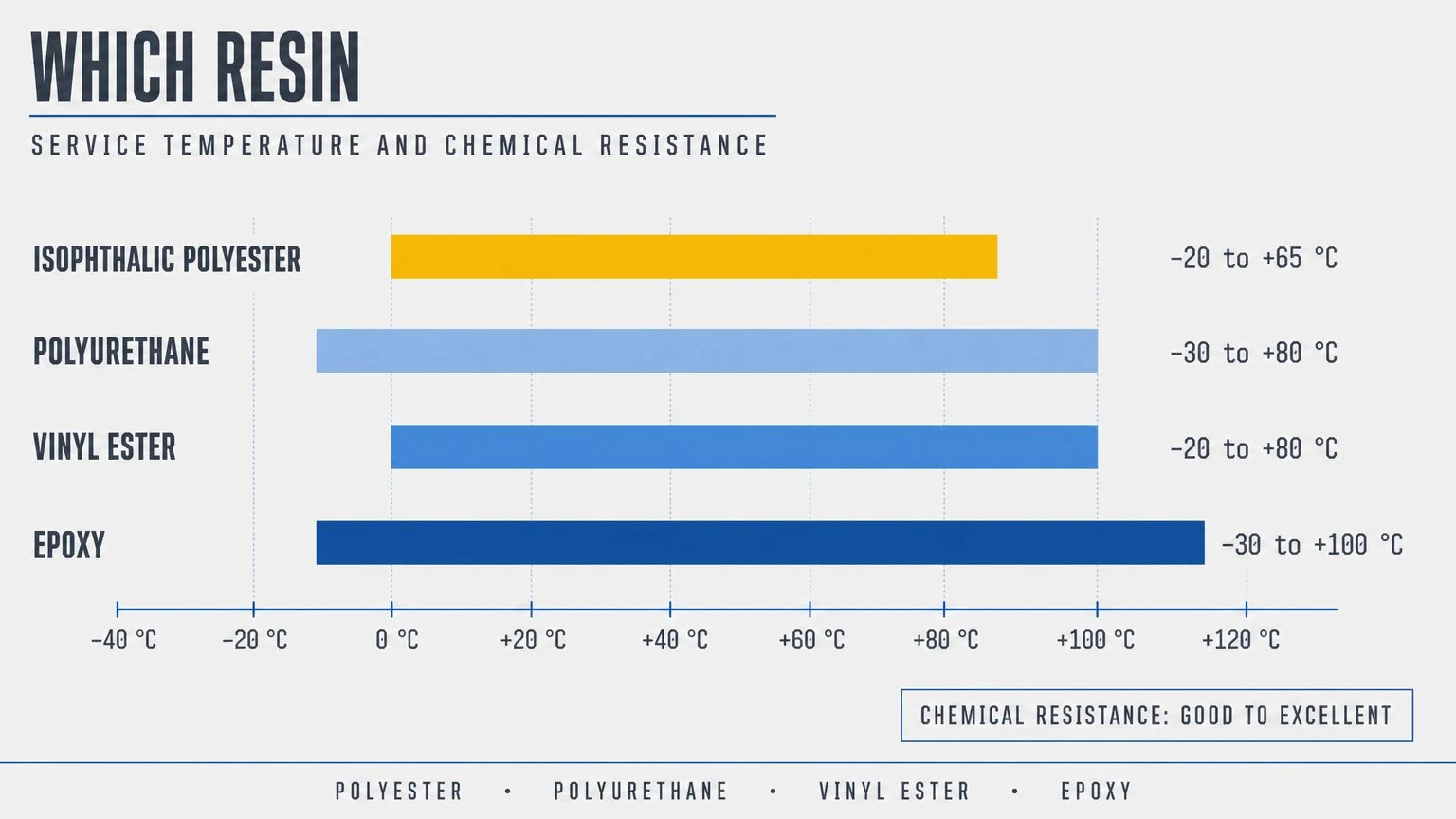
06 Which resin
|
Resin |
Chemical resistance |
Service temp |
UV |
Cost |
Specify for |
|
Isophthalic polyester |
Good |
−20 to +65 °C |
Moderate |
Lowest |
General framing, indoor, dry |
|
Polyurethane |
Good |
−30 to +80 °C |
Good |
Medium |
Higher stiffness and toughness |
|
Vinyl ester |
Excellent |
−20 to +80 °C |
Good |
Medium |
Chemical plants, marine splash zone |
|
Epoxy |
Excellent |
−30 to +100 °C |
Good |
Highest |
High stiffness, higher temperature |
What is actually on the tooling. Our existing square-tube tooling runs isophthalic polyester as standard, with polyurethane held on selected sizes - 25.4 mm, 30 mm and 75 mm. Vinyl ester and epoxy are produced to order on the same profiles. If your specification calls for vinyl ester or epoxy, tell us at enquiry stage and we will confirm the size and the run length.
On UV and cheap quotes
UV protection comes from a surface veil and resin-integrated stabiliser, not a paint layer. It is what prevents fibre bloom - the whitening and surface fraying you see on cheap pultrusions after a couple of summers. If one quote comes in noticeably below the others, ask whether a surface veil is included. It usually is not.
07 Load data and how to use it
| Tensile strength, longitudinal | ≥ 800 MPa · ASTM D638 | Compressive strength, longitudinal | ≥ 600 MPa · ASTM D695 |
| Tensile modulus, longitudinal | ≥ 40 GPa · ASTM D638 | Interlaminar shear | ≥ 40 MPa · ASTM D2344 |
| Tensile strength, transverse | ≥ 50 MPa · ASTM D638 | Density | 1.8–2.2 g/cm³ · ASTM D792 |
| Flexural strength, longitudinal | ≥ 800 MPa · ASTM D790 | Water absorption | < 0.5% · ASTM D570 |
| Flexural modulus, longitudinal | ≥ 35 GPa · ASTM D790 | Barcol hardness | ≥ 55 HBa · ASTM D2583 |
Do not design against the table above
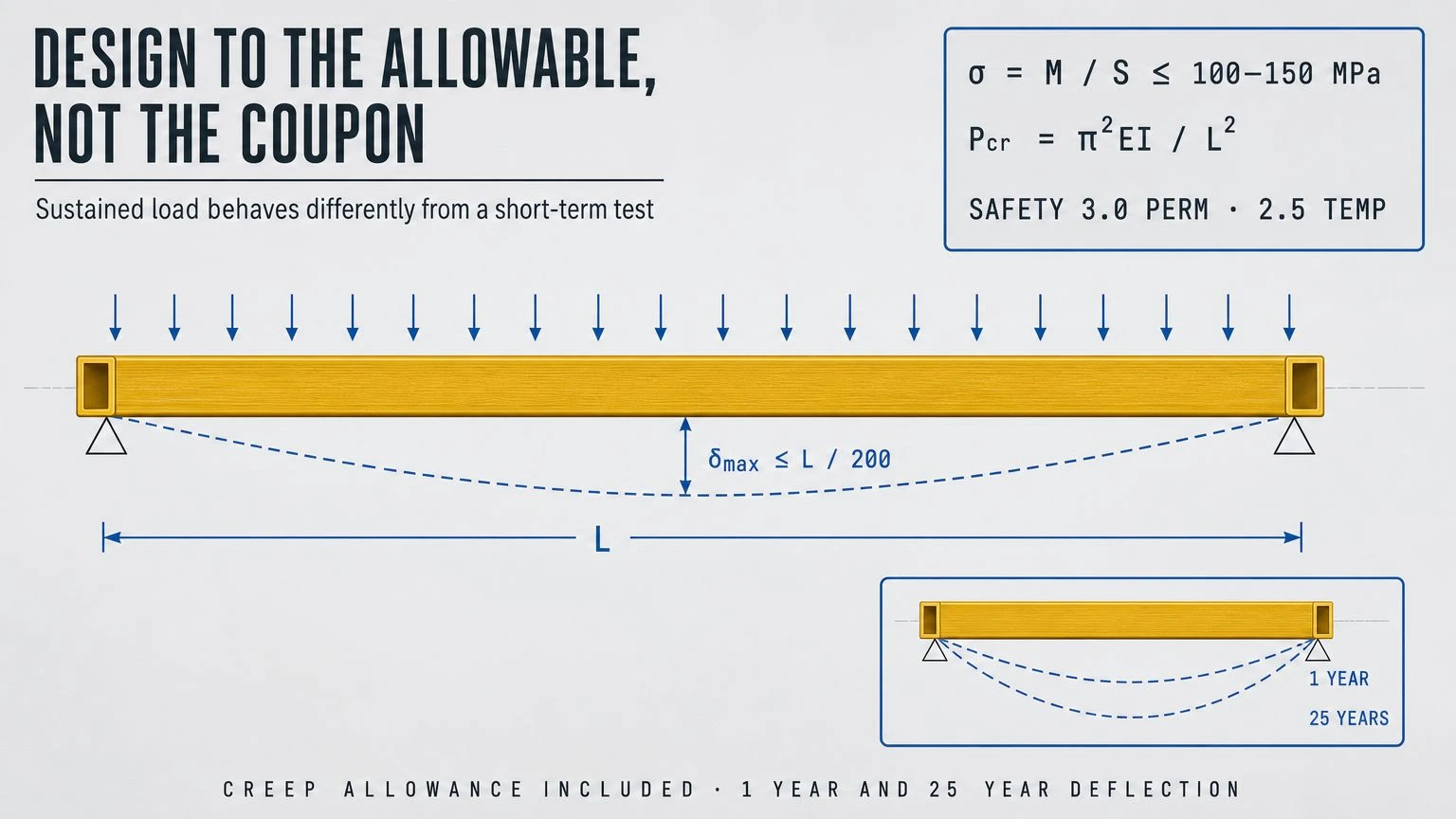
Those are short-term coupon values measured in a test machine. A structure carrying load for 25 years behaves differently, so design against these instead:
Bending stress σ = M / S ≤ F_allowable ≈ 100–150 MPa continuous
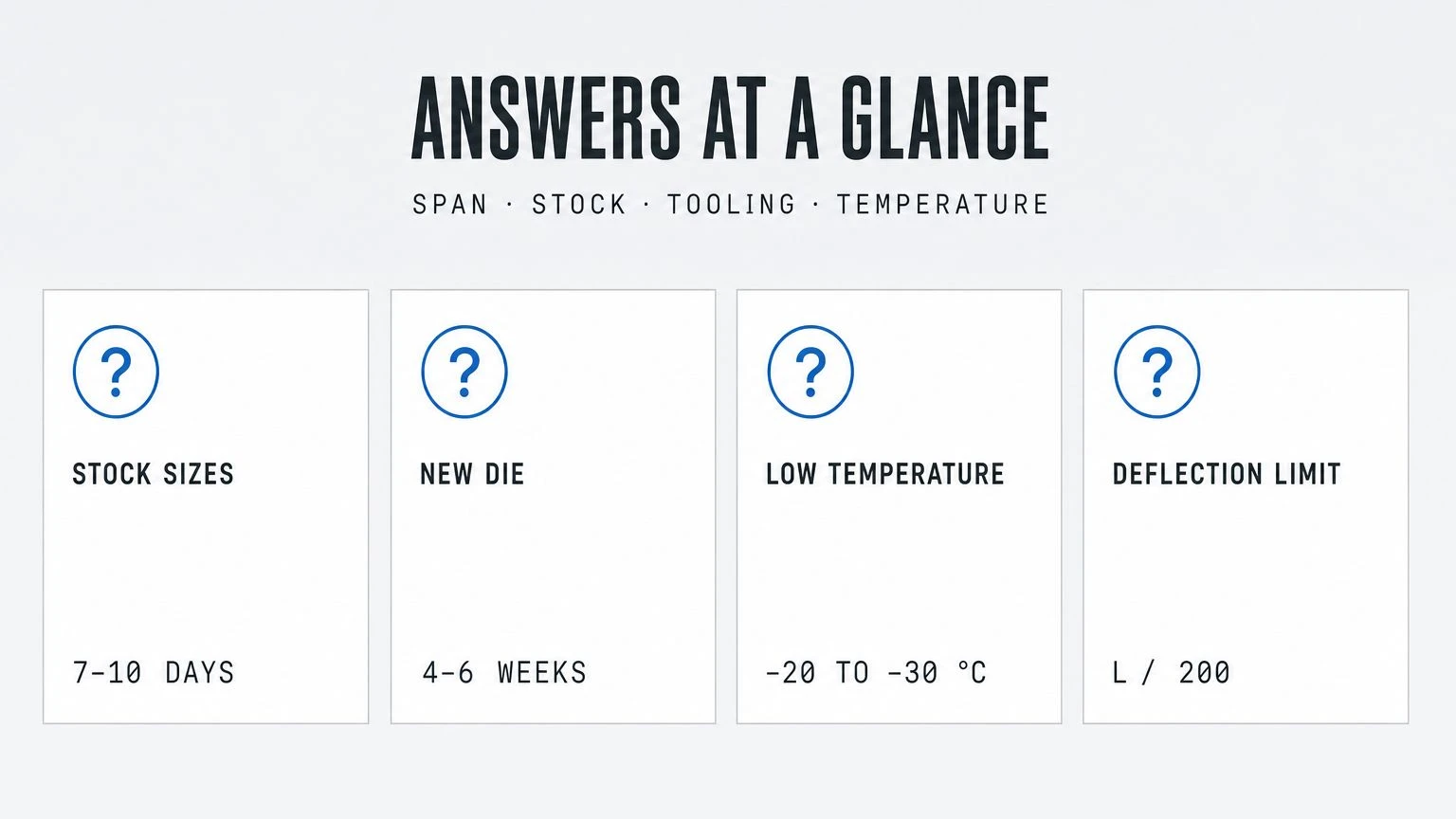
Deflection δmax ≤ L / 200
Column buckling Pcr = π² E I / L² (pinned-pinned)
Safety factors 3.0 permanent · 2.5 temporary
The allowable figure sits well below the 800 MPa coupon value because it already carries the creep allowance, the fatigue allowance and the factor of safety. That gap is intentional - a supplier quoting allowable stress close to their coupon strength is not leaving room for 25 years of sustained load.
Creep, or the sag nobody budgets for
Under a sustained load, composite keeps deforming slowly - more than steel does. Over a long span carrying constant weight, that shows up as gradual sag. We recommend using a creep-modified modulus for anything under permanent load, which means designing to a lower effective E than the datasheet figure.
Tell us the load and the span, and we will size it with the creep allowance included and show you predicted deflection at 1 year and at 25 years.
08 Where it gets specified
Industrial platforms, walkways, handrails
Maintenance-free in chemical and coastal air; insulating; cut on site without hot work.
Agricultural greenhouses
Resists ammonia and moisture without corroding.
Marine and docks
Salt spray tolerance, no rot, no water absorption.
Solar mounting and tracker frames
Weight reduction lowers tracker torque requirements.
Electrical and telecom
Non-conductive and signal-transparent - antenna shrouds, substation structures, 5G frames.
Transport and municipal
Noise barrier posts, signage supports, de-icing salt exposure.
Cooling towers and wastewater
Structural members in permanent heat and humidity.
Architectural and canopies
Colourable, stable appearance, no repainting.
Warehouse racking and machine frames
Light, rust-free, dimensionally stable.
Modular and temporary structures
Bonded multi-tube decks, fast assembly, reusable.

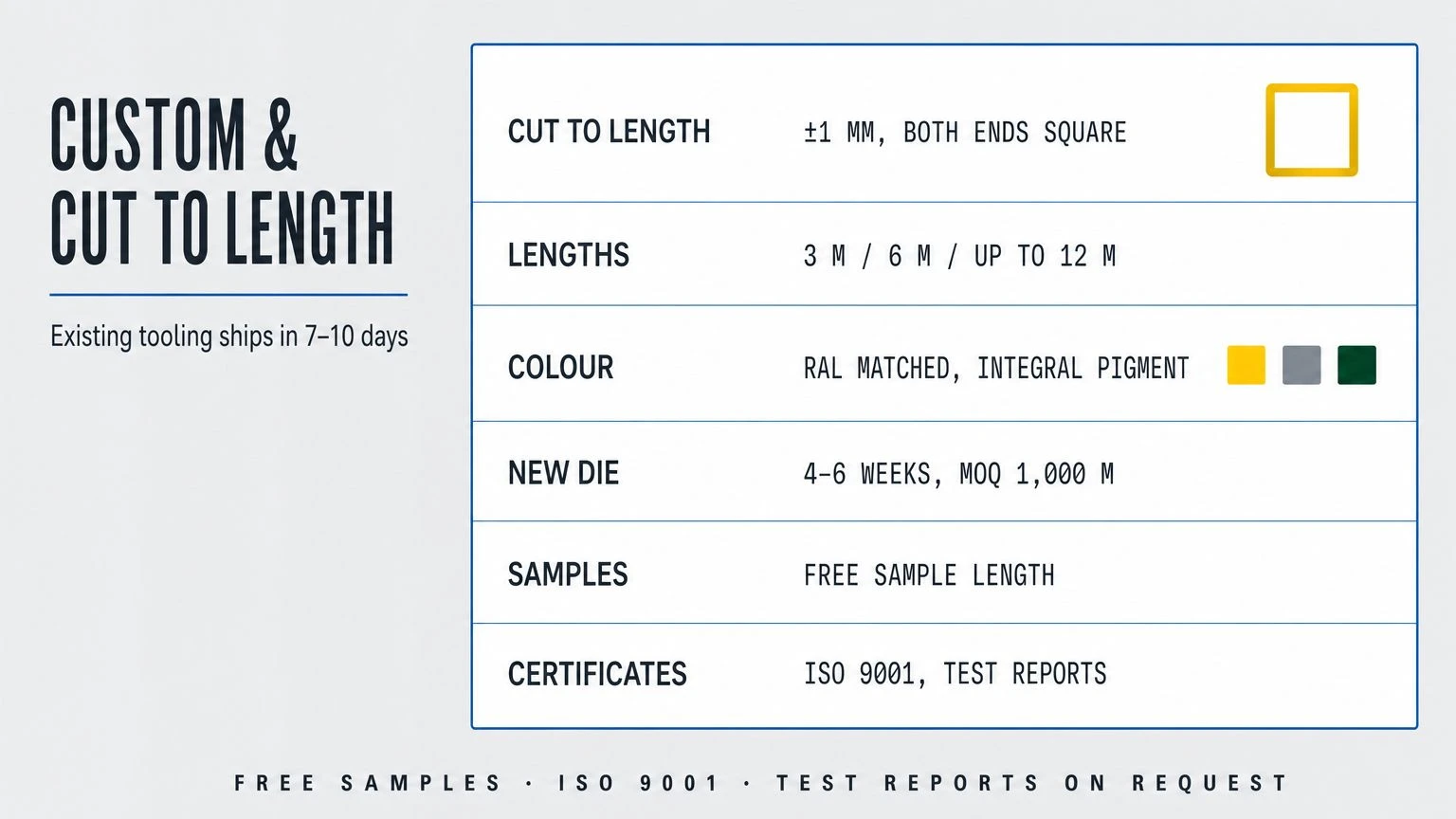
09 Custom, cut to length, ordering
| Existing tooling | Sizes in table 01, no die charge | Colour | Integral pigment, RAL matched |
| New die | 4–6 weeks, MOQ 1,000 m | Standard colours | Safety yellow · grey · green |
| Cut to length | ±1 mm, both ends square | Lengths | 3 m / 6 m, up to 12 m |
| Fabrication | Drilling, slotting, notching, mitring | Samples | Free samples |
| Surface | Smooth · gritted anti-slip · concave | Certificates | ISO 9001; test reports available on request |
10 Production Process


11 FAQ
What size do I need for a given span?
Send the span, the load and how it is supported, and we will size it. Working it backwards from the tables above: check deflection at L/200 first. With a modulus around a fifth of steel's, deflection governs before strength does in most composite beam cases.
Is this size in stock or made to order?
Table 01 marks it. Stock sizes ship in 7–10 days. Made-to-order sizes need a die, 4–6 weeks.
What blade should I use, and will it split when drilled?
Carbide-tipped or diamond, with the profile supported on both sides of the kerf. For drilling, a sharp HSS bit at moderate speed and light feed, with the exit face backed by a scrap block - heavy feed is what splits the far wall.
Can I tap a thread into it?
No. Transverse strength is roughly 3% of longitudinal, so a cut thread will not hold. Use a threaded insert, a through-bolt, or a rivet nut.
How much load does it take across the tube?
Far less than along it - see section 03 for the measured numbers. If your load bears on the wall rather than along the length, spread it with a backing plate and size the joint for bearing.
Will it sag over time?
Under sustained load, yes, more than steel. We size with a creep-modified modulus and can give predicted deflection at 1 and 25 years for your load case.
Does it go brittle in the cold?
The resin governs low-temperature behaviour. Standard grades are specified to about −20 °C to −30 °C; below that we would look at epoxy. Tell us the minimum service temperature if it is below −20 °C.
Does the colour fade or the surface fray?
A surface veil plus resin-integrated UV stabiliser prevents fibre bloom. Pigment runs through the section rather than sitting on it, so chips do not expose a different colour underneath. Cheap pultrusions without a veil whiten and fray after a few summers.
We currently use 304 stainless near the coast. Would this actually be better?
In chloride exposure, usually yes - and this is the most common specification mistake we see. Grade 304 pits and can suffer stress corrosion cracking near the sea, on de-icing-salt roads, around pools and in much chemical plant. It is an indoor grade. The grade that handles chloride is 316, which typically costs five to eight times carbon steel per kilogram. Composite has no chloride pitting mechanism and lands closer to 304 on material cost. Sections 05 covers the full comparison, including where stainless still wins - temperature, surface hardness and end-of-life scrap value.
Can it replace aluminium in a design I already have?
Only if you re-check deflection first. Aluminium's modulus is around 69 GPa against composite's 40, so a straight size-for-size swap will deflect more. Strength is not the problem - composite is stronger on both absolute tensile and on strength per kilogram - stiffness is. Send us the span, the load and the section you are using now, and we will tell you what depth you need and whether it still fits the space you have.
How does the price compare with aluminium square tube?
Material cost is usually below aluminium and above carbon steel, but it moves with size, resin and volume. What tends to close the gap is the absence of maintenance and coating renewal in corrosive environments. Give us your size and quantity and we will quote against the specific aluminium section you are comparing to.
Do you supply test certificates?
ISO 9001; test reports available on request. We also supply lot traceability, and for structural orders we recommend requesting a sample coupon for independent testing.
Tell us the span and the load
Send the size you are currently using, or the span and load you need to cover. We will come back with a section recommendation, the deflection figures, and a price. If the answer is that aluminium or steel is the better call for this job, we will say that.
Hot Tags: fiberglass square tube, China fiberglass square tube manufacturers, suppliers, factory