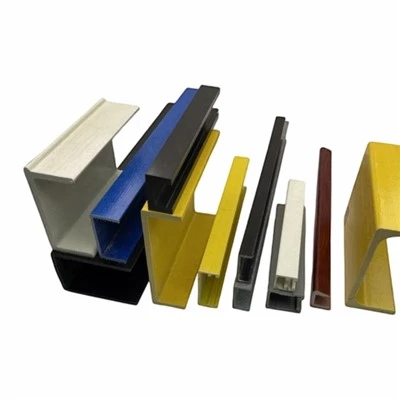
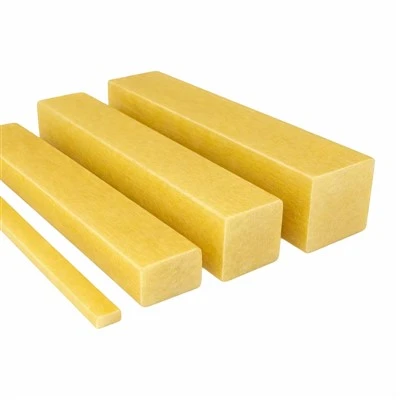
Henan Enbuess Composite Materials Co., Ltd. is one of the leading manufacturers and suppliers of fiberglass h beam in China. We are committed to providing high quality customized service for global clients. If you're going to buy high strength fiberglass h beam made in China, welcome to get free sample from our factory.
Fiberglass H Beam for Heavy Bearing and Two-Way Loading
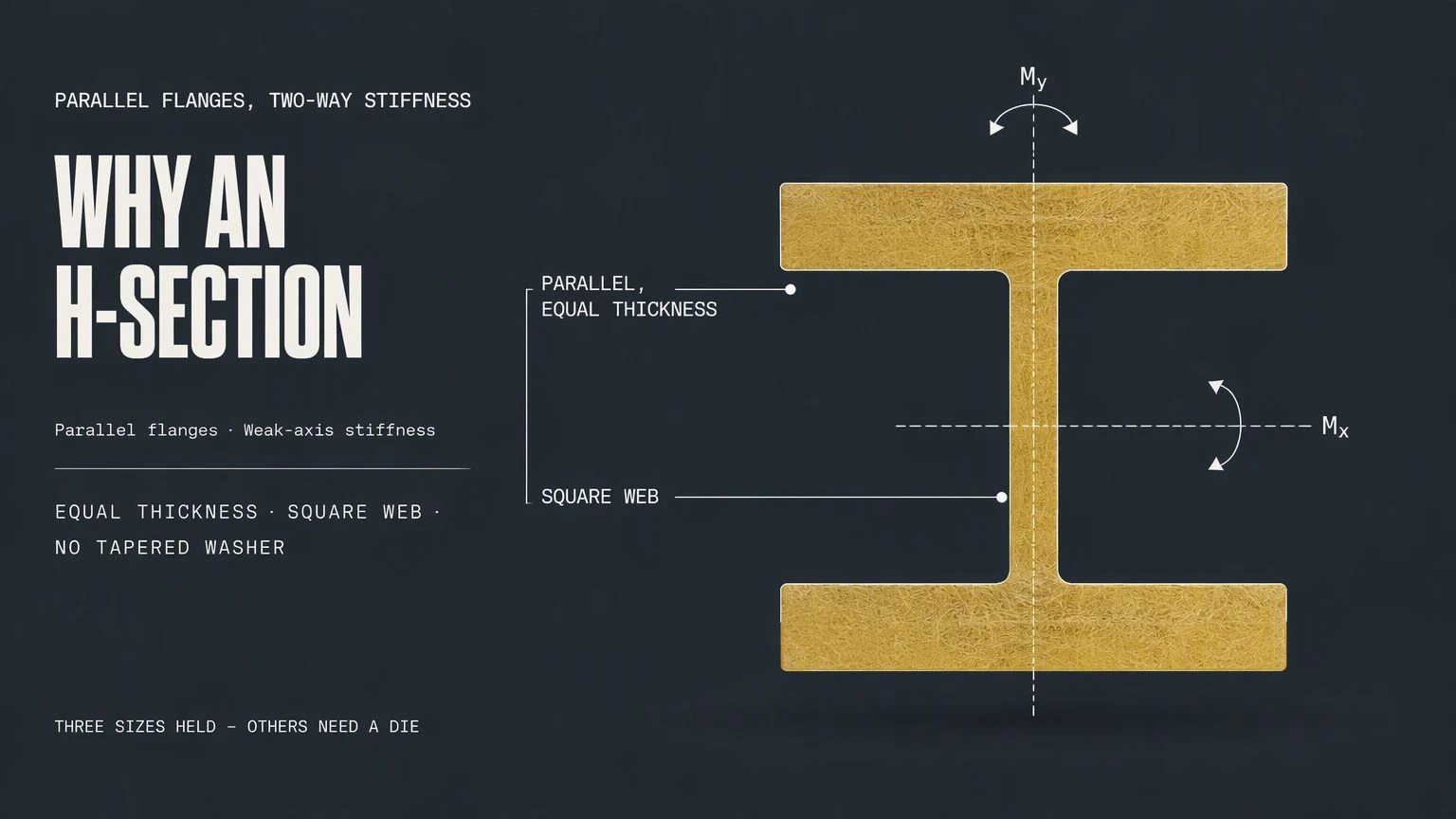
An H section has wide, parallel flanges of equal thickness and a web set square between them. Compared with an I beam that gives you two things: a flange you can bolt straight through without a tapered washer, and genuine stiffness about the weak axis.
We hold three H beam dies. That is a deliberately short list, and we would rather say so in the first paragraph than have you design around a size that needs tooling.

Standard sizes
Three dies, listed in full. Anything outside this table needs a new die, and an H beam die is a significant tooling investment - tell us early if your design needs a fourth size.
|
Depth × flange × lip × thickness (mm) |
Weight (kg/m) |
Tooling |
|
110 × 100 |
3.5 |
Existing |
|
130 × 56 × 40 × 2.5 |
1.07 |
Existing |
|
130 × 76 × 40 × 2.5 |
1.24 |
Existing |
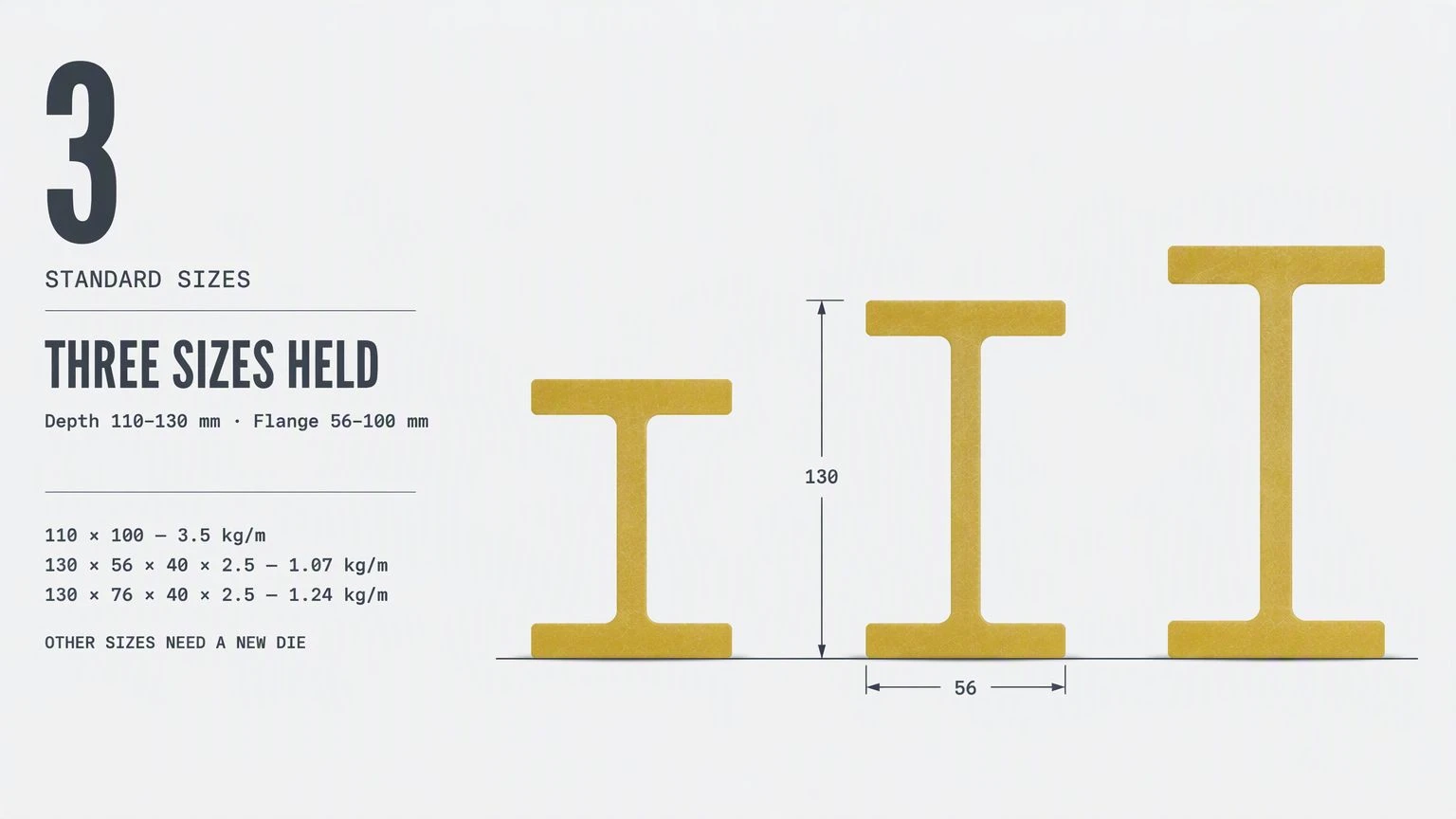
Three sizes is a short list, so this is the profile where we most often suggest an alternative. If neither of these fits, a square tube, an I beam or a built-up section from channel will usually get you there faster and cheaper than tooling a new H die.
What buyers ask about this profile
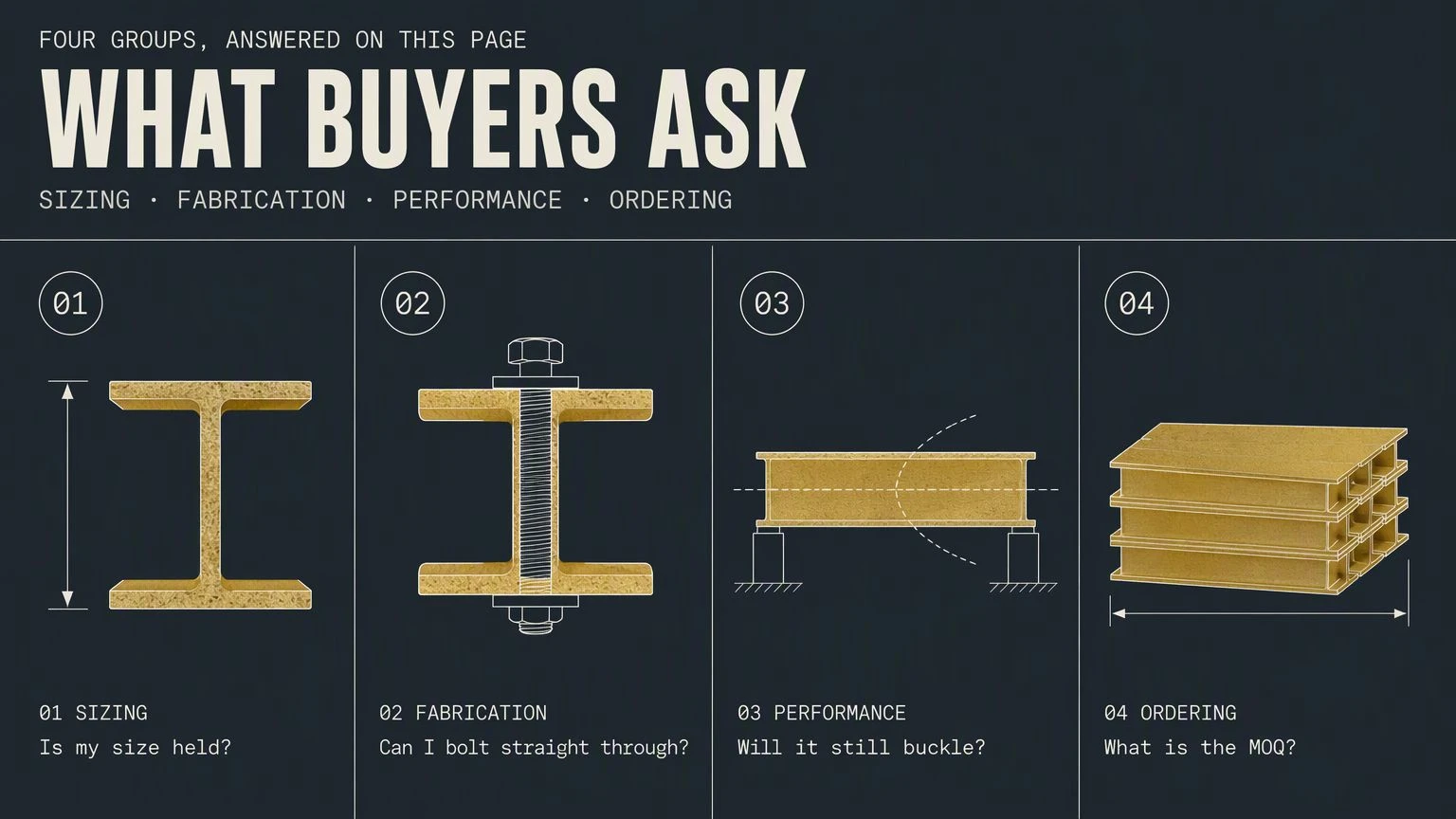
Four groups. Each one is answered on this page.
Sizing
When do I need an H beam rather than an I beam?
Is my size held or does it need a die?
What is the flange thickness tolerance?
Can it take load about both axes?
Fabrication
Can I bolt straight through the flange?
Can I cut it to length?
How do I connect beam to column?
Will the web crush at a clamp?
Performance
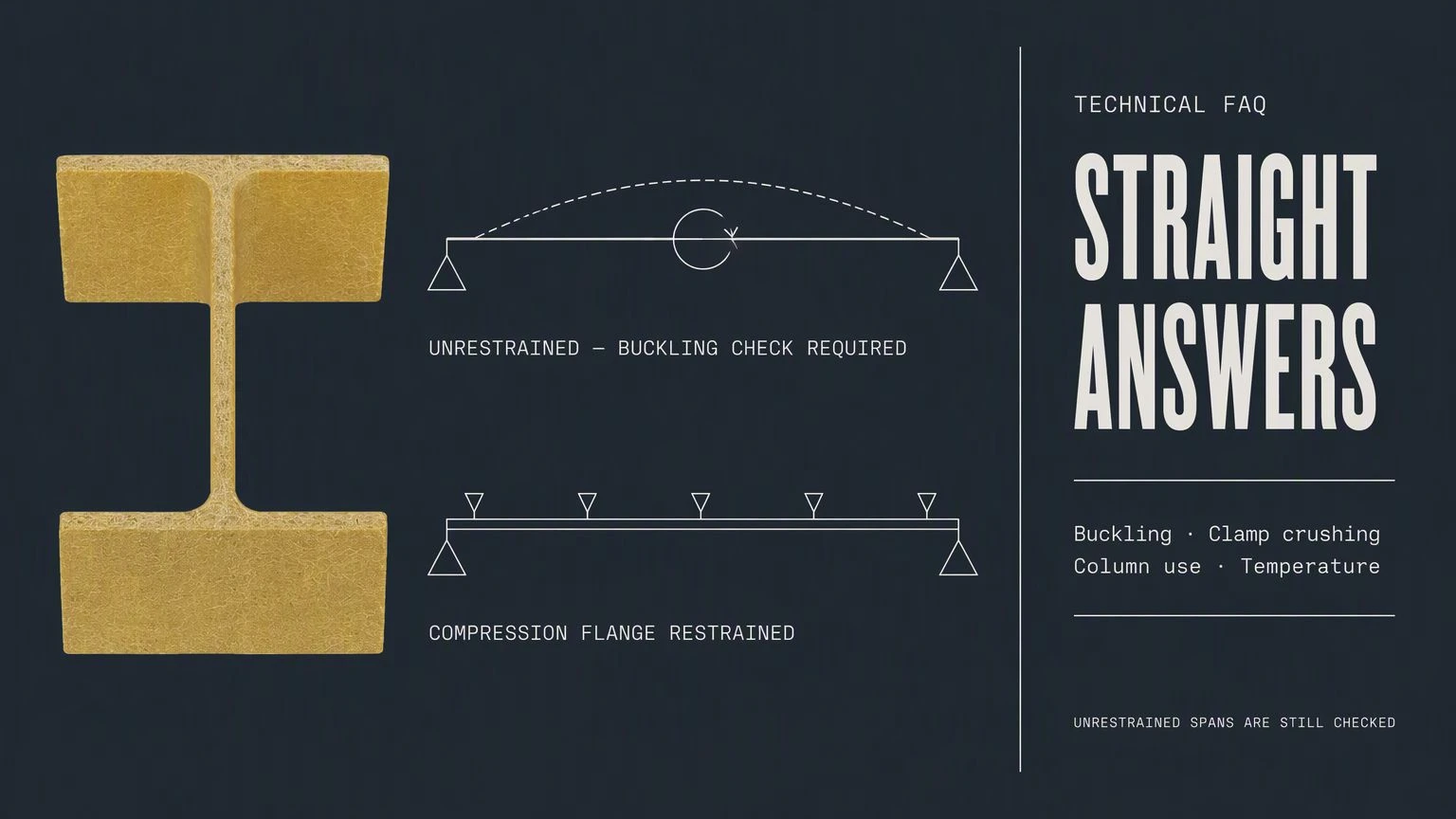
Does it still buckle sideways?
Will it creep under permanent load?
Can I use it outdoors?
What is the temperature limit?
Ordering
How does it compare with steel H beam?
Can I get a sample length?
Do you supply test certificates?
What is the MOQ on a custom die?
Why an H section
Two advantages over an I beam, and the honest reason we hold so few.
|
Parallel flanges take a bolt without a washer |
|
Many I beam flanges are tapered. A bolt through a tapered flange does not seat square, so it needs a tapered washer or a machined seat to bear properly. An H section has parallel flanges of equal thickness, so a standard bolt, a clamp or a seat bearing goes straight on. On site, that is fewer parts and fewer things to get wrong. |
|
Real stiffness about the weak axis |
|
The wide equal flanges give an H section considerably more weak-axis stiffness than an I beam of similar depth. Where a beam takes load from more than one direction, or where lateral restraint cannot be provided along the whole span, that matters - and it means the beam is less dependent on restraint to reach its capacity. |
|
Why we only hold three |
|
Pultruded H sections are uncommon, because the die is complex and most applications are served by an I beam or a square tube at lower cost. Rather than hold sizes nobody orders, we hold three and tool others when a project justifies it. If your design genuinely needs a fourth, tell us the section and the quantity and we will quote the tooling honestly. |
Where it gets specified
H beam is chosen for bearing and two-way loading, not for the longest span.
Heavy equipment base beams
Where the load comes down through a wide footprint.
Bridge and walkway stringers
Where a flat parallel flange carries the deck directly.
Platform main girders
Where a wide flange gives a better bearing surface for decking.
Tank and vessel support beams
Bearing under a curved or flat vessel base.
Two-way loaded frames
Where load arrives from more than one direction.
Marine deck beams
Salt exposure with a flat top face for decking.
Column sections
An H section works as a column where an I beam would be too weak about the weak axis.
Chemical plant equipment skids
Where coating renewal is not an option.
Against the metals you are replacing
H beam is most often bought to replace a mild steel universal column or a wide-flange beam.
|
Property |
Pultruded composite |
Carbon steel |
Galvanised steel |
Stainless 304 |
Stainless 316 |
Aluminium 6061-T6 |
|
Density (g/cm³) |
1.8–2.2 |
7.85 |
7.85 |
8 |
8 |
2.7 |
|
Tensile strength (MPa) |
≥ 800 |
370–500 |
370–500 |
515 |
515 |
310 |
|
Specific strength |
≈ 400 |
≈ 51 |
≈ 51 |
≈ 64 |
≈ 64 |
≈ 115 |
|
Weight for equal section |
~25% of steel |
Baseline |
Baseline |
~102% |
~102% |
~34% |
|
Erection |
Two people on these sizes |
Crane |
Crane |
Crane |
Crane |
Light lift |
|
Weak-axis stiffness |
Good for the depth |
Good |
Good |
Good |
Good |
Good |
|
Modulus (GPa) |
≥ 40 |
~200 |
~200 |
~193 |
~193 |
~69 |
|
Salt / chloride |
No mechanism |
Rusts through |
Zinc gone in 2–3 yrs |
Pitting, SCC |
Good |
Pitting |
|
Repainting at height |
Never |
3–4 cycles |
1–2 cycles |
Inspect in chloride |
Low |
Oxidation control |
|
Electrical |
Insulating |
Conductive |
Conductive |
Conductive |
Conductive |
Conductive |
|
Maintenance, 25 yrs |
None |
Paint 3–4 times |
1–2 times |
Inspect in chloride |
Low |
Oxidation control |
|
Scrap value at end |
Low |
High |
High |
Very high |
Very high |
High |
Where the weight row becomes the argument
These are heavy sections by composite standards, but still around a quarter of the weight of the steel equivalent. That is the difference between a beam that two people can carry into position and one that needs a crane and a lift plan. On plant where crane access is difficult or where a shutdown window is short, that is often worth more than the material price difference.
Where steel H beam is simply better
Long spans, heavy point loads, and high temperature. A steel universal column carries more for the same depth, and it has no resin ceiling. If your design is driven by span rather than by corrosion or access, we will tell you to use steel.
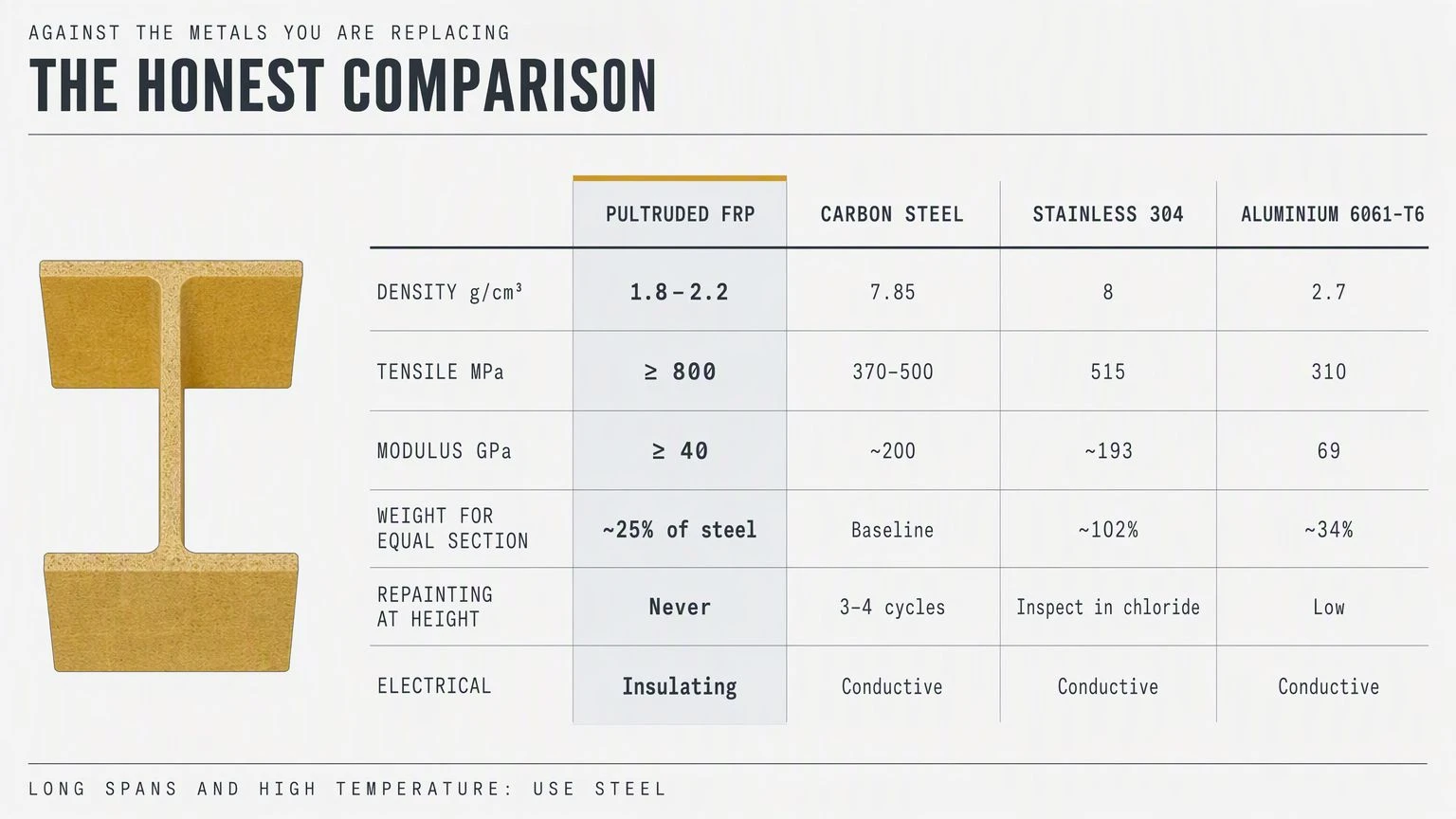
What the metals do better. Stiffness and span - steel is about five times stiffer and reaches much further at the same depth. Temperature, with no resin ceiling. Availability of a full size range: steel H sections come in hundreds of standard sizes, and we hold three. And scrap value at end of life.
Material data
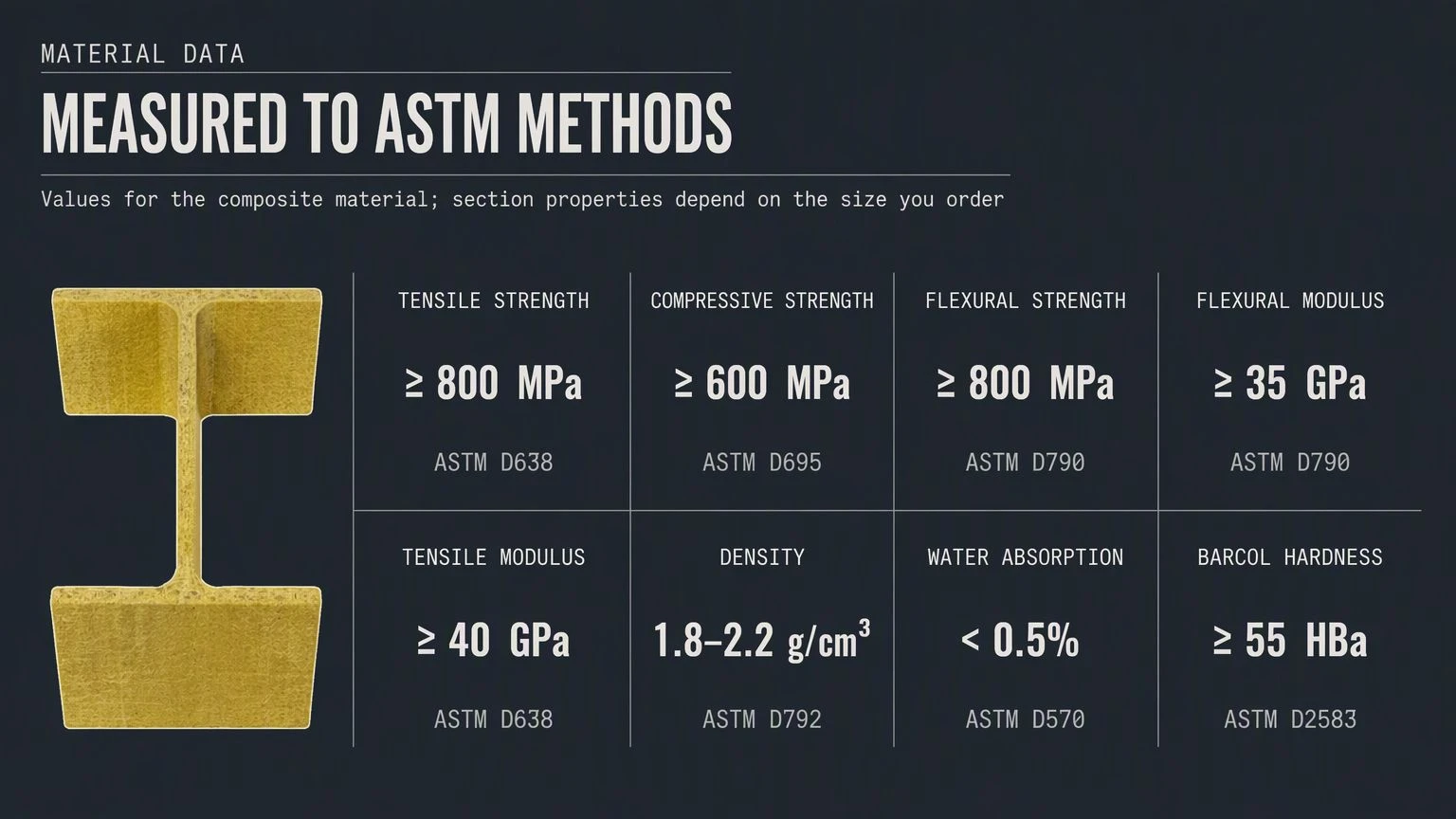
Measured to ASTM methods on the pultruded section. Values are for the composite material; section properties depend on the size you order.
| Tensile strength, longitudinal | ≥ 800 MPa · ASTM D638 | Compressive strength, longitudinal | ≥ 600 MPa · ASTM D695 |
| Tensile modulus, longitudinal | ≥ 40 GPa · ASTM D638 | Density | 1.8–2.2 g/cm³ · ASTM D792 |
| Flexural strength, longitudinal | ≥ 800 MPa · ASTM D790 | Water absorption | < 0.5% · ASTM D570 |
| Flexural modulus, longitudinal | ≥ 35 GPa · ASTM D790 | Barcol hardness | ≥ 55 HBa · ASTM D2583 |
For these sections the governing checks are bending stress about the loaded axis, deflection, and where the beam is unrestrained, lateral-torsional buckling. We calculate all three for your span and load rather than quoting a generic capacity.
Custom, cut to length, ordering
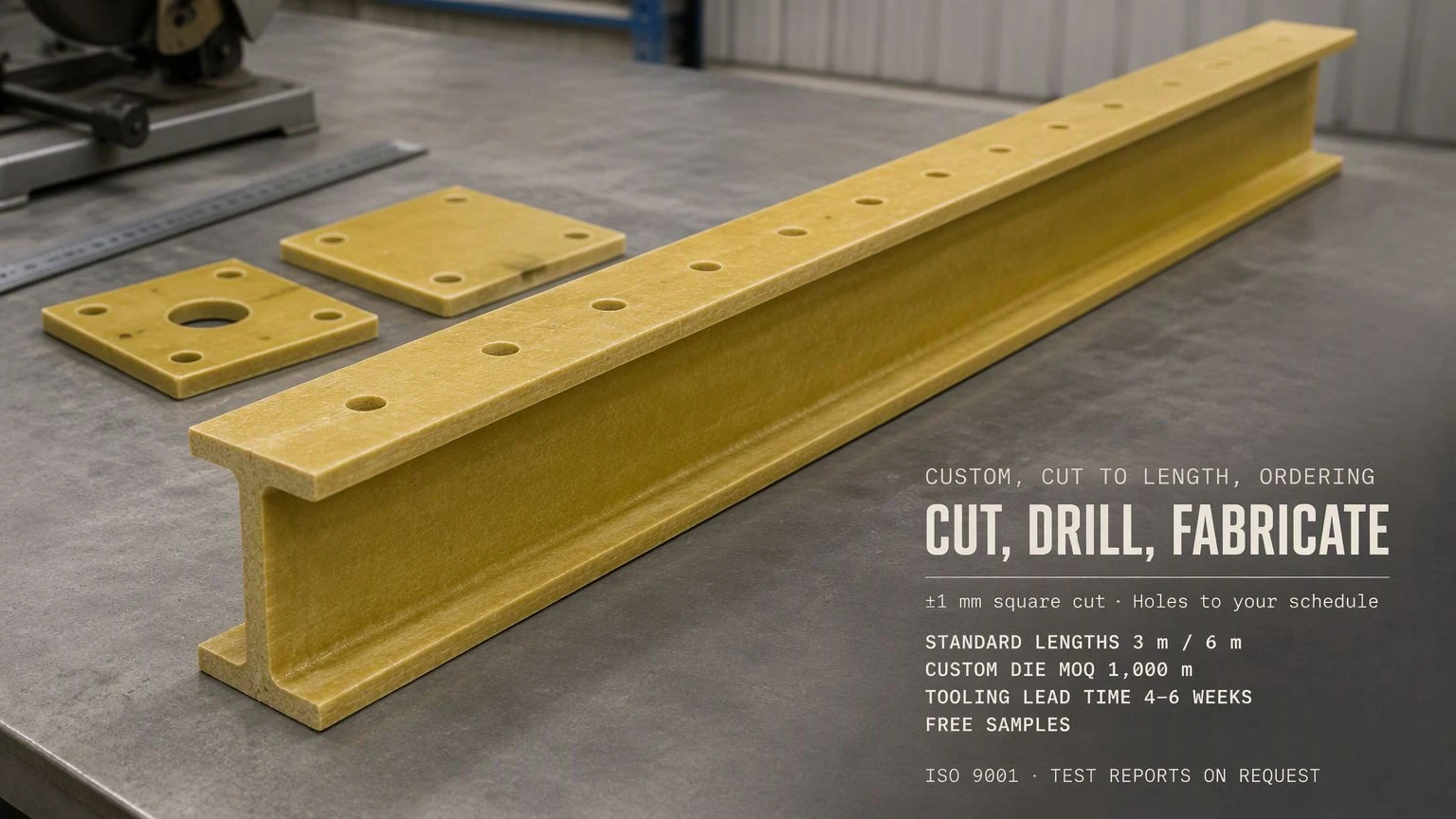
| Cut to length | ±1 mm, square cut | Standard lengths | 3 m / 6 m |
| Drilling | Flange and web holes to your schedule | Tooling lead time | 4–6 weeks |
| Bearing plates | Supplied for concentrated load points | Custom die MOQ | 1,000 m |
| Seat and cap plates | Fabricated to your connection detail | Samples | Free samples |
| Colour | Integral pigment, RAL matched | Certificates | ISO 9001; test reports available on request |
Production Process


FAQ
When do I need an H beam rather than an I beam?
When you need a flat parallel flange to bolt or bear onto, or when the beam takes load about both axes. If the load is purely vertical and you can restrain the compression flange, an I beam of the same depth is usually more economical - and we hold 29 I beam dies against three H sizes.
You only hold three sizes. Is that a problem?
It depends on your design. If one of the three works, no. If not, tooling a new H die is a real investment and the lead time is long, so it is worth checking an alternative first - an I beam, a square tube, or a built-up section from channel will usually get you there faster. Tell us the section you need and we will quote both routes honestly.
Can I bolt straight through the flange?
Yes. The flanges are parallel and of equal thickness, so a standard bolt seats square without a tapered washer. Use a backing plate or a large-diameter washer: composite is limited by bearing under the bolt head, not by the bolt's shear capacity.
Does it still buckle sideways?
Less readily than an I beam, because the wide flanges give more weak-axis stiffness. But the modulus is still a fifth of steel's, so on a long unrestrained span the check is still required. Tell us the span and whether the compression flange is restrained and we will run it.
Will the web crush at a clamp?
Yes, if the load is concentrated and unspread. Use a bearing plate or a web stiffener at every clamp and every point load. This is the most common site problem with composite beams and it is entirely avoidable.
How does it compare with steel H beam?
Steel carries far more for the same depth and is five times stiffer. Composite is roughly a quarter of the weight, needs no coating, needs no earthing, and on these sizes can often be placed by hand. On a corrosive site or one with poor crane access, composite usually wins over 25 years. On span and point load, steel wins outright.
Can it be used as a column?
Yes, and it is a better column section than an I beam of similar depth because of the weak-axis stiffness. The check is Euler buckling about the weaker axis: Pcr = π²EI/L². Tell us the height and the end conditions and we will size it.
What is the temperature limit?
Standard resin systems are specified to about +100 °C, with epoxy grades reaching a little higher. Below −20 °C tell us the minimum service temperature so we can confirm the resin. Steel and stainless have no comparable ceiling.
Tell us the load, the span and the depth you have
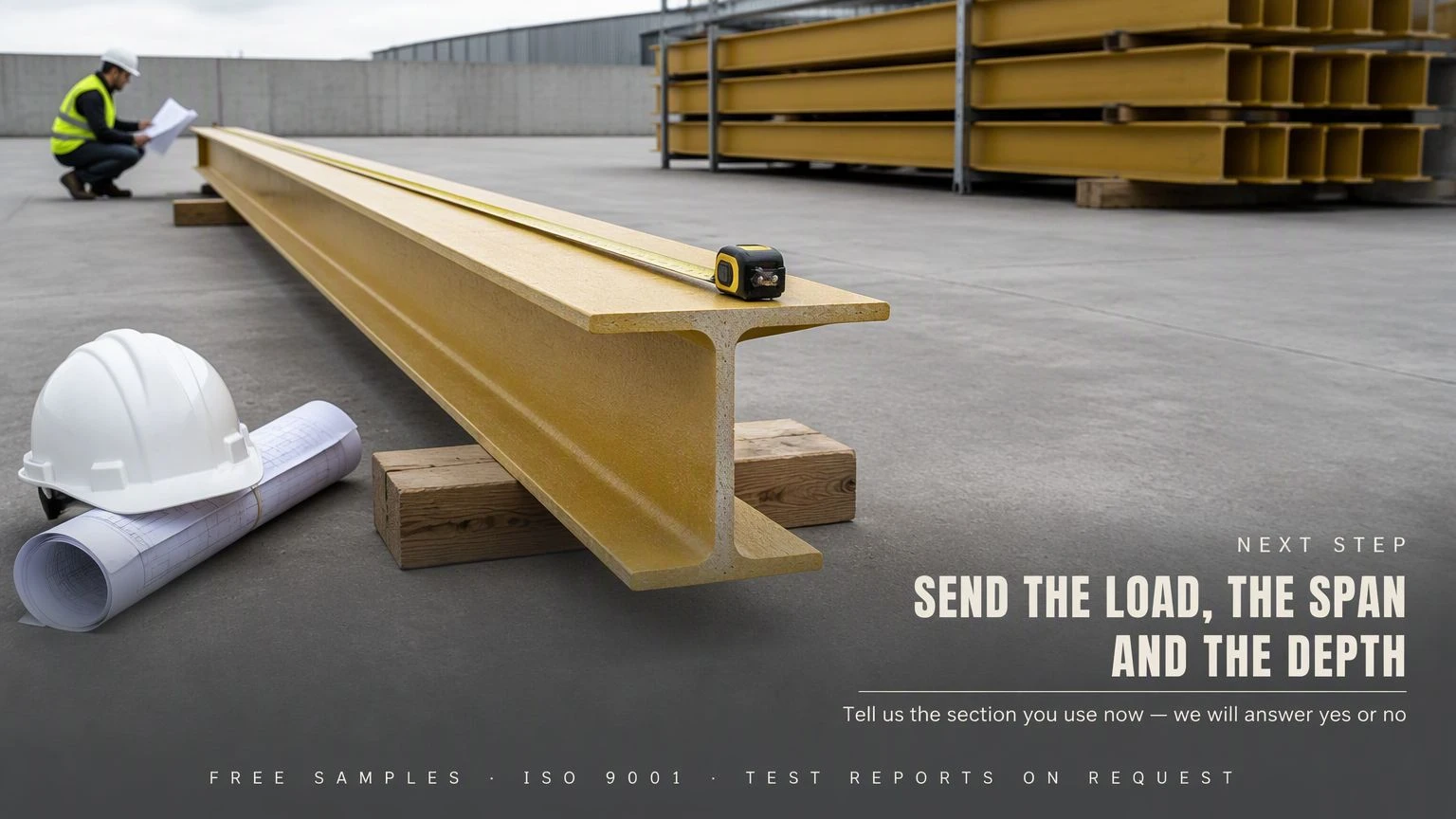
With three sizes held, the first question is whether one of them fits. Send the section you are using now and we will tell you yes or no quickly - and if no, which alternative gets you there fastest.
Hot Tags: fiberglass h beam, China fiberglass h beam manufacturers, suppliers, factory