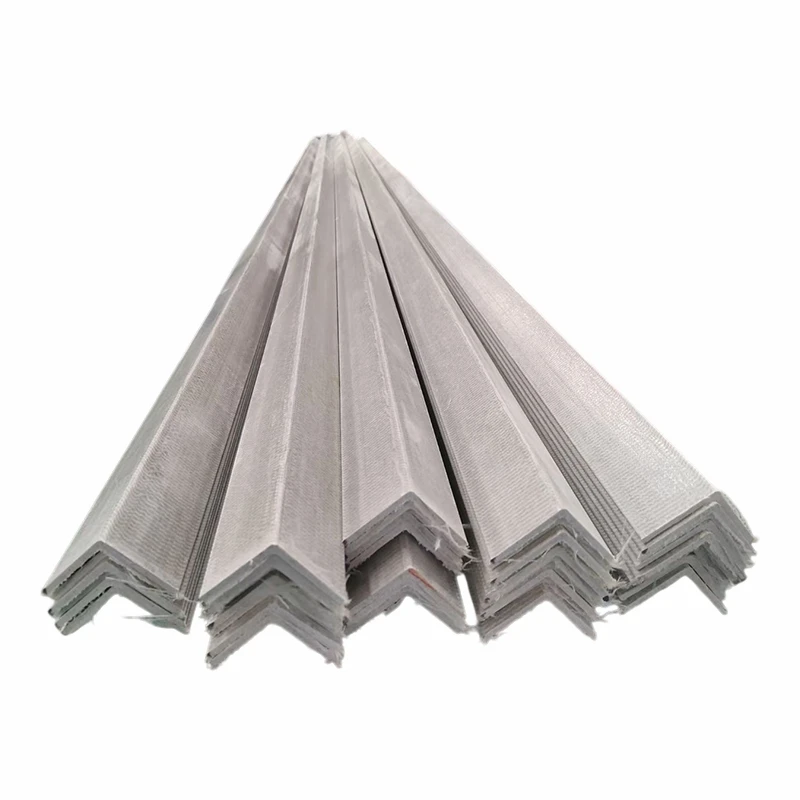


Henan Enbuess Composite Materials Co., Ltd. is one of the leading manufacturers and suppliers of fiberglass angle bar in China. We are committed to providing high quality customized service for global clients. If you're going to buy high strength fiberglass angle bar made in China, welcome to get free sample from our factory.
Fiberglass Angle Bar for Bracing, Corners and Edge Protection
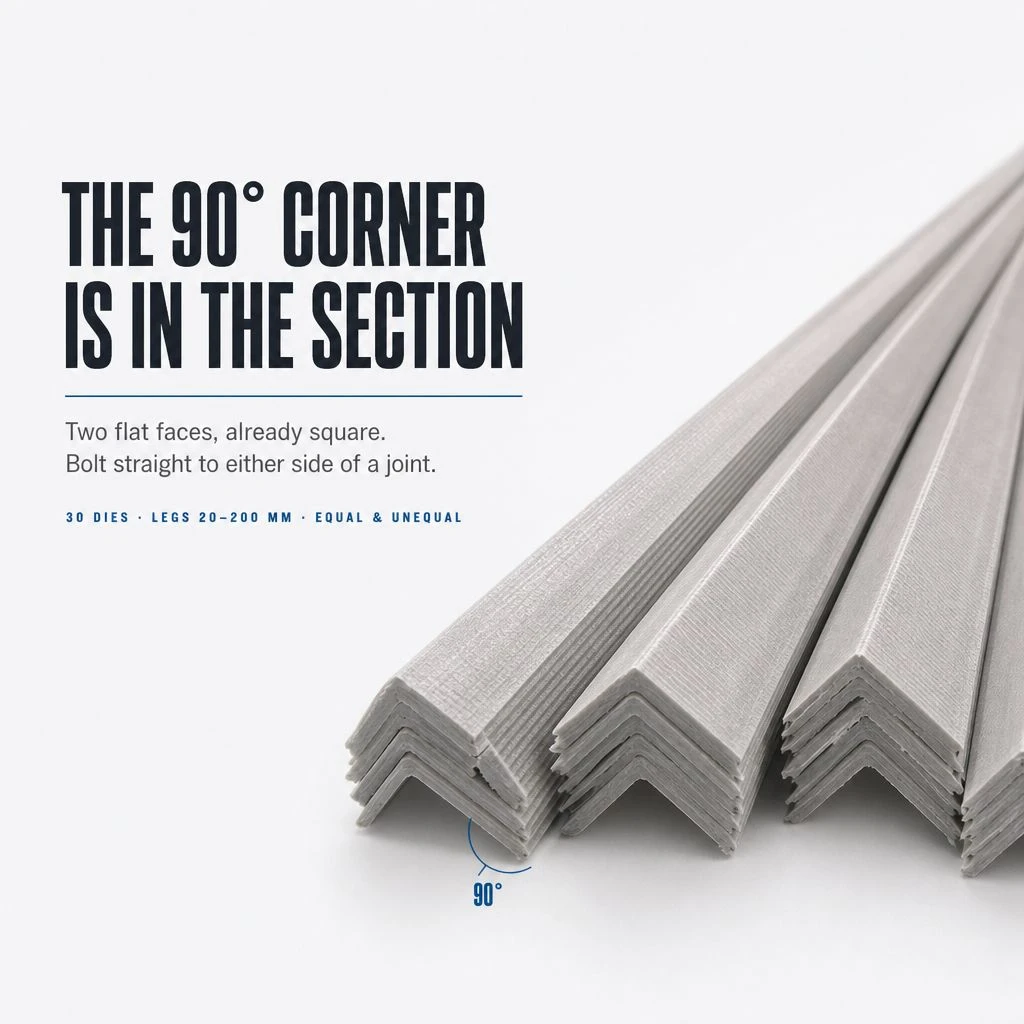
An angle is the only structural profile that gives you a ninety-degree corner without fabricating one. Two flat faces, already square to each other, ready to bolt to either side of a joint. It is the cheapest way to turn two members into a frame.
We hold 30 angle dies with legs from 20 mm to 200 mm, in equal and unequal leg versions. It is also the profile we most often see wrongly specified - because an angle carrying load along its length behaves in a way that surprises people.
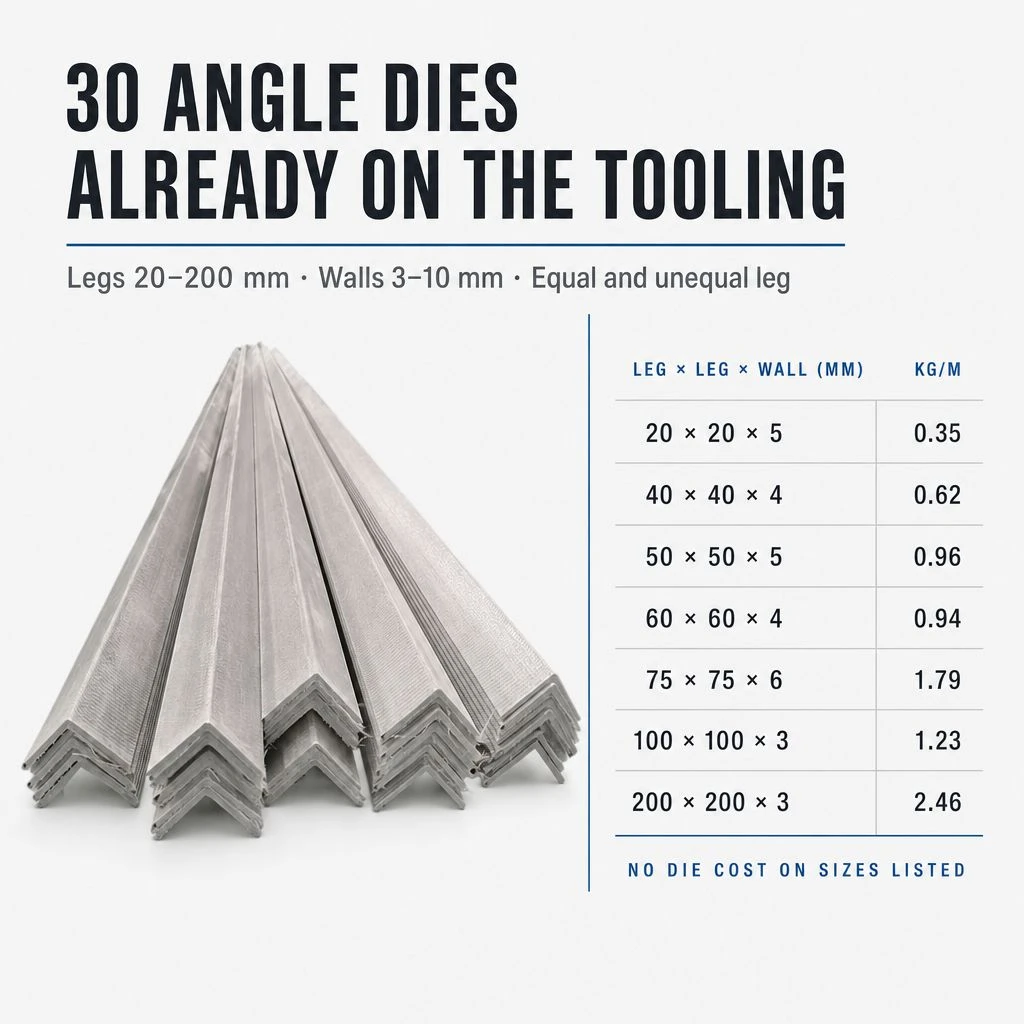

Standard sizes
All rows run on tooling we already hold. Equal-leg sizes are shown as leg × leg × thickness; unequal-leg sizes show both legs.
|
Leg × leg × thickness (mm) |
Weight (kg/m) |
Tooling |
|
20 × 20 × 5 |
0.35 |
Existing |
|
23 × 9.97 |
- |
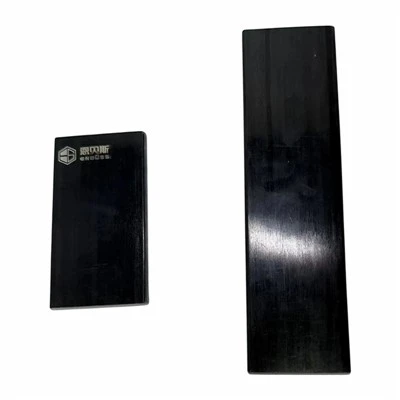
Existing carbon fibre |
|
30 × 30 × 3 |
0.34 |
Existing |
|
30 × 30 × 4 |
0.48 |
Existing |
|
32 × 32 × 5 |
0.62 |
Existing |
|
40 × 40 × 4 |
0.62 |
Existing |
|
40 × 40 × 6 |
0.94 |
Existing |
|
40 × 40 × 3.5 |
0.53 |
Existing |
|
40 × 40 × 4 × 6 |
0.77 |
Existing |
|
44 × 44 × 4 × 6 |
- |
Existing |
|
45 × 45 × 5 |
0.9 |
Existing |
|
50 × 50 × 4 |
0.8 |
Existing |
|
50 × 50 × 5 |
0.96 |
Existing |
|
50 × 50 × 6 |
1.17 |
Existing |
|
60 × 60 × 4 |
0.94 |
Existing |
|
70 × 70 × 6 |
1.75 |
Existing |
|
70 × 25 × 3 |
0.69 |
Existing |
|
70 × 50 × 3 |
0.77 |
Existing |
|
75 × 75 × 6 |
1.79 |
Existing |
|
75 × 75 × 10 |
2.82 |
Existing |
|
82 × 82 × 2.5 |
- |
Existing |
|
100 × 100 × 3 |
1.23 |
Existing |
|
100 × 9.5 × 3 |
0.63 |
Existing |
|
100 × 50 × 5 |
1.5 |
Existing |
|
140 × 140 × 4 |
- |
Existing |
|
200 × 200 × 3 |
2.46 |
Existing |

Unusual sizes in this list - the 135° angle and the carbon-fibre angle - are held for specific customers. Ask and we will tell you whether they are available for your run.
What buyers ask about this profile
Four groups. Each one is answered on this page.
Sizing
Equal leg or unequal leg?
What leg length do I need for a gusset?
Is my size held or does it need a die?
What is the leg-length tolerance?
Fabrication
Can I bolt straight through both legs?
Will it split at the corner?
Can it be mitred for a corner frame?
How do I join two lengths?
Performance
Why does it twist when loaded?
Will it sag over a long run?
Does the corner weaken over time?
Can I use it outdoors?
Ordering
How does it compare with steel angle?
Can I get a sample length?
Do you supply test certificates?
What is the MOQ on a custom die?
Why an angle
Three reasons it gets specified - and one behaviour you need to design for.
| It arrives already square |
|
A frame corner built from flat bar needs a gusset cut, fitted and welded or bolted. An angle gives you the ninety degrees in the section itself. That is fewer parts, fewer fasteners, and no error in the angle - which matters on site, where a cut gusset is only as square as the person cutting it. It is why angle is the default for bracing, shelf supports, and the corner of any equipment frame. |
|
It stiffens a flat surface without much depth |
|
Bonded or bolted flat to a panel, a sheet or an existing member, an angle adds stiffness out of plane for very little added depth. This is the cheapest way to stop a large flat panel drumming or flexing, and it is why angle is used as a stiffener on walkway plates, covers and doors far more often than as a primary beam. |
|
It protects an edge and takes the knock |
|
An angle wrapped around a column corner, a wall edge or a door jamb absorbs the impact that would otherwise damage the substrate - and in a composite it does that without the rust staining that a painted steel corner guard leaves down the wall within a couple of years. |
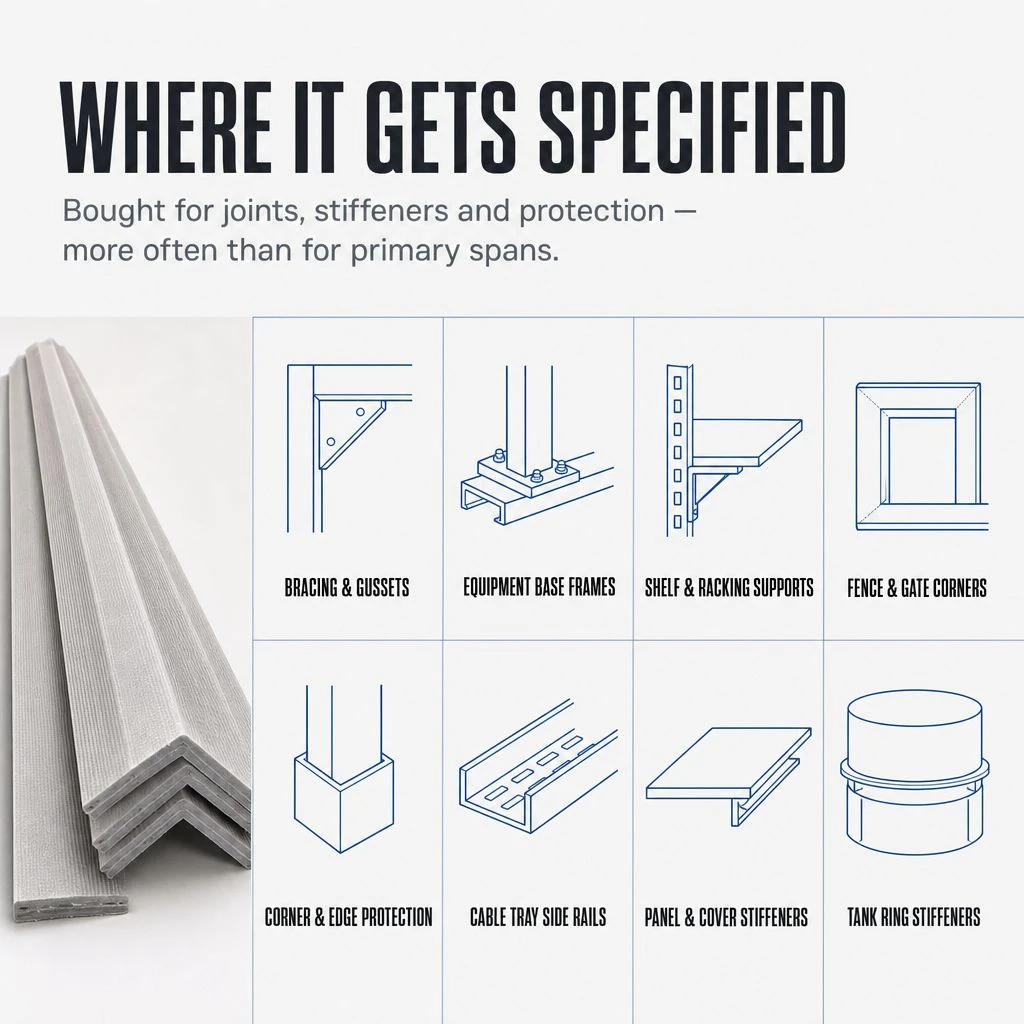
Where it gets specified
Angle is bought for joints, stiffeners and protection more often than for primary spans.
Bracing and gussets
Turns two members into a rigid frame without a fabricated plate.
Equipment base frames
Bolts to both the floor and the machine foot in one part.
Shelf and racking supports
The leg sits flat against the upright and the other carries the shelf.
Fence and gate corners
Gives a square corner without cutting mitres on site.
Corner and edge protection
Absorbs impact on columns, jambs and wall corners without rust staining.
Cable tray and ladder side rails
Where the run needs a lip rather than a full channel.
Panel and cover stiffeners
Bonded flat to stop large panels flexing or drumming.
Tank and vessel ring stiffeners
External stiffening without introducing a dissimilar metal.
Against the metals you are replacing
Angle is most often bought to replace mild steel angle, and the corrosion argument is unusually strong here.
|
Property |
Pultruded composite |
Carbon steel |
Galvanised steel |
Stainless 304 |
Stainless 316 |
Aluminium 6061-T6 |
|
Density (g/cm³) |
1.8–2.2 |
7.85 |
7.85 |
8 |
8 |
2.7 |
|
Tensile strength (MPa) |
≥ 800 |
370–500 |
370–500 |
515 |
515 |
310 |
|
Specific strength |
≈ 400 |
≈ 51 |
≈ 51 |
≈ 64 |
≈ 64 |
≈ 115 |
|
Corrosion at cut edges |
No mechanism |
Rusts first here |
Zinc gone at cut |
Generally sound |
Sound |
Generally sound |
|
Coating durability at the corner |
N/A - no coating |
Thinnest at the corner |
Thinnest at the corner |
Sound |
Sound |
Oxidation |
|
Galvanic corrosion |
Not a failure mode |
Yes |
Yes |
Yes |
Yes |
Yes |
|
Electrical |
Insulating |
Conductive |
Conductive |
Conductive |
Conductive |
Conductive |
|
Modulus (GPa) |
≥ 40 |
~200 |
~200 |
~193 |
~193 |
~69 |
|
Cut and drill on site |
Hand tools |
Grinder, hot work |
Grinder, re-protect |
Grinder |
Grinder |
Hand tools |
|
Maintenance, 25 yrs |
None |
Paint 3–4 times |
1–2 times |
Inspect in chloride |
Low |
Oxidation control |
|
Scrap value at end |
Low |
High |
High |
Very high |
Very high |
High |
Why the corrosion argument is strongest on this profile
On a coated steel angle, the coating is thinnest exactly where the corrosion starts: at the corner, at the cut ends and at the bolt holes. Paint pulls away from a sharp edge as it cures, and a cut end has no coating at all. That is why steel angle rusts at the ends and corners while the middle of the leg looks fine. A composite angle has no coating to be thin, so the corner and the middle age at the same rate.
The behaviour that catches people out
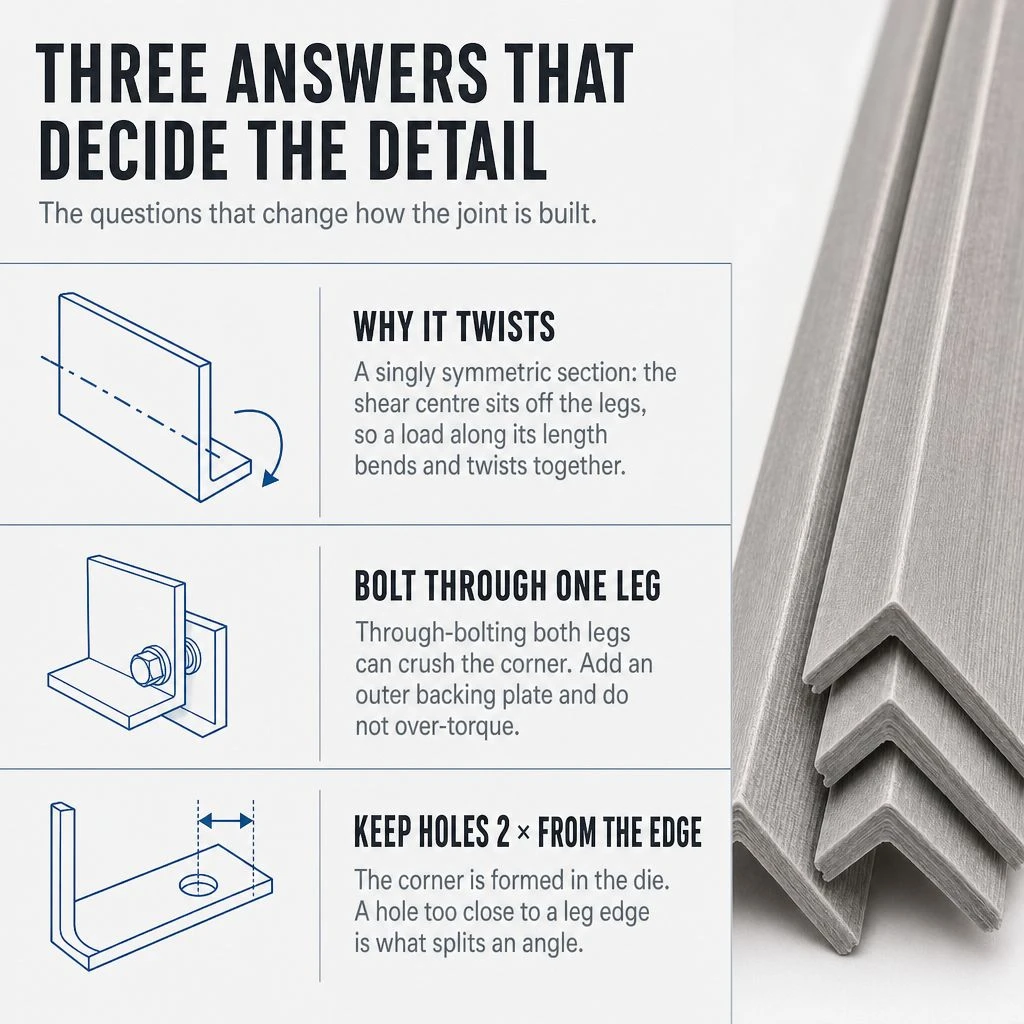
An angle is a singly symmetric section: its shear centre does not sit on either leg. Load it along its length and it does not simply bend - it bends and twists at the same time. On a short brace bolted at both ends this rarely matters. On a long unsupported angle carrying load it produces a twist that looks like a material problem but is a section property. If your angle spans more than about a metre under load, restrain it along the length or use tube or channel instead.
What the metals do better. Stiffness, clearly - steel is around five times stiffer. Temperature, where steel and stainless go well above the resin ceiling. Toughness at the leg tip: a steel angle takes a hard knock on the edge better than composite does. And scrap value, which every metal here has and composite does not.

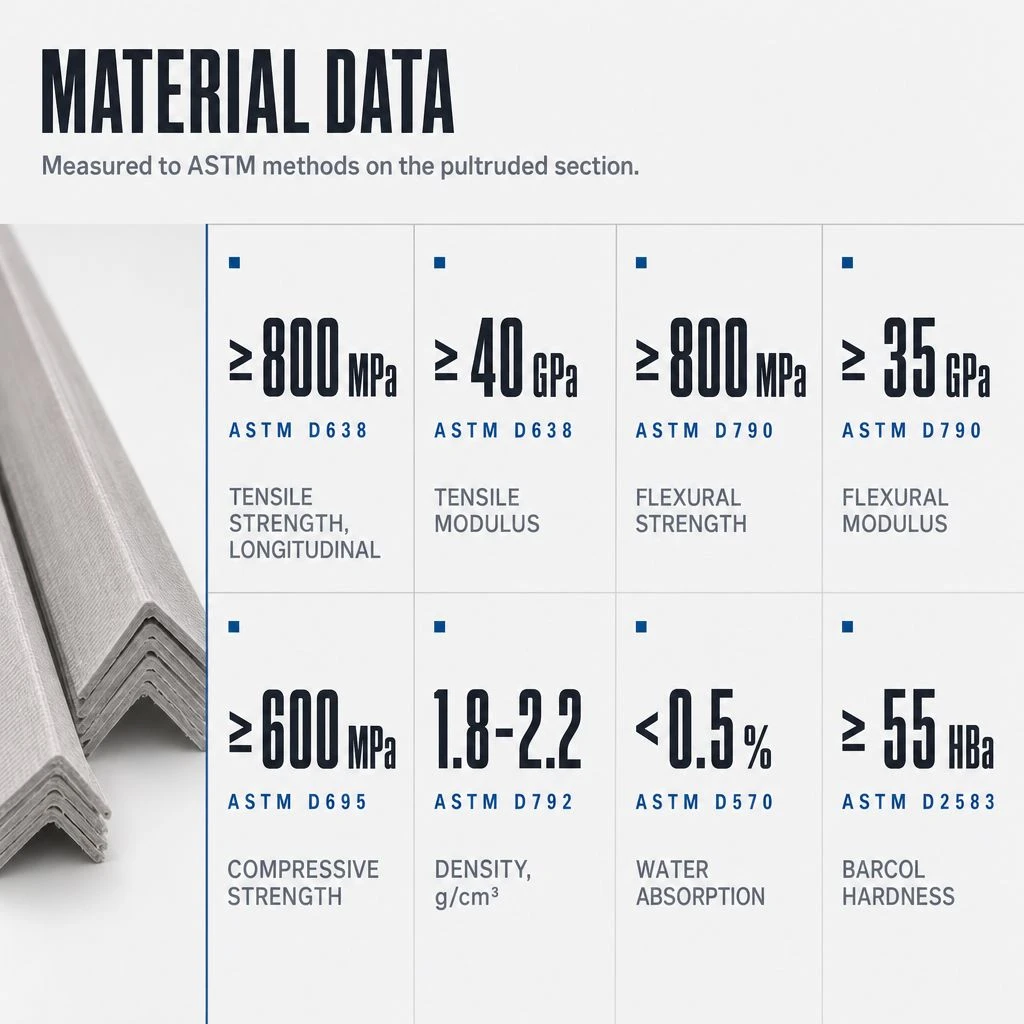
Material data
Measured to ASTM methods on the pultruded section. Values are for the composite material; section properties depend on the size you order.
| Tensile strength, longitudinal | ≥ 800 MPa · ASTM D638 | Compressive strength, longitudinal | ≥ 600 MPa · ASTM D695 |
| Tensile modulus, longitudinal | ≥ 40 GPa · ASTM D638 | Density | 1.8–2.2 g/cm³ · ASTM D792 |
| Flexural strength, longitudinal | ≥ 800 MPa · ASTM D790 | Water absorption | < 0.5% · ASTM D570 |
| Flexural modulus, longitudinal | ≥ 35 GPa · ASTM D790 | Barcol hardness | ≥ 55 HBa · ASTM D2583 |
An angle is usually limited by its twist behaviour rather than by material strength. If your span is long or the load is eccentric, send us the arrangement and we will tell you whether an angle is right or whether channel would serve better.
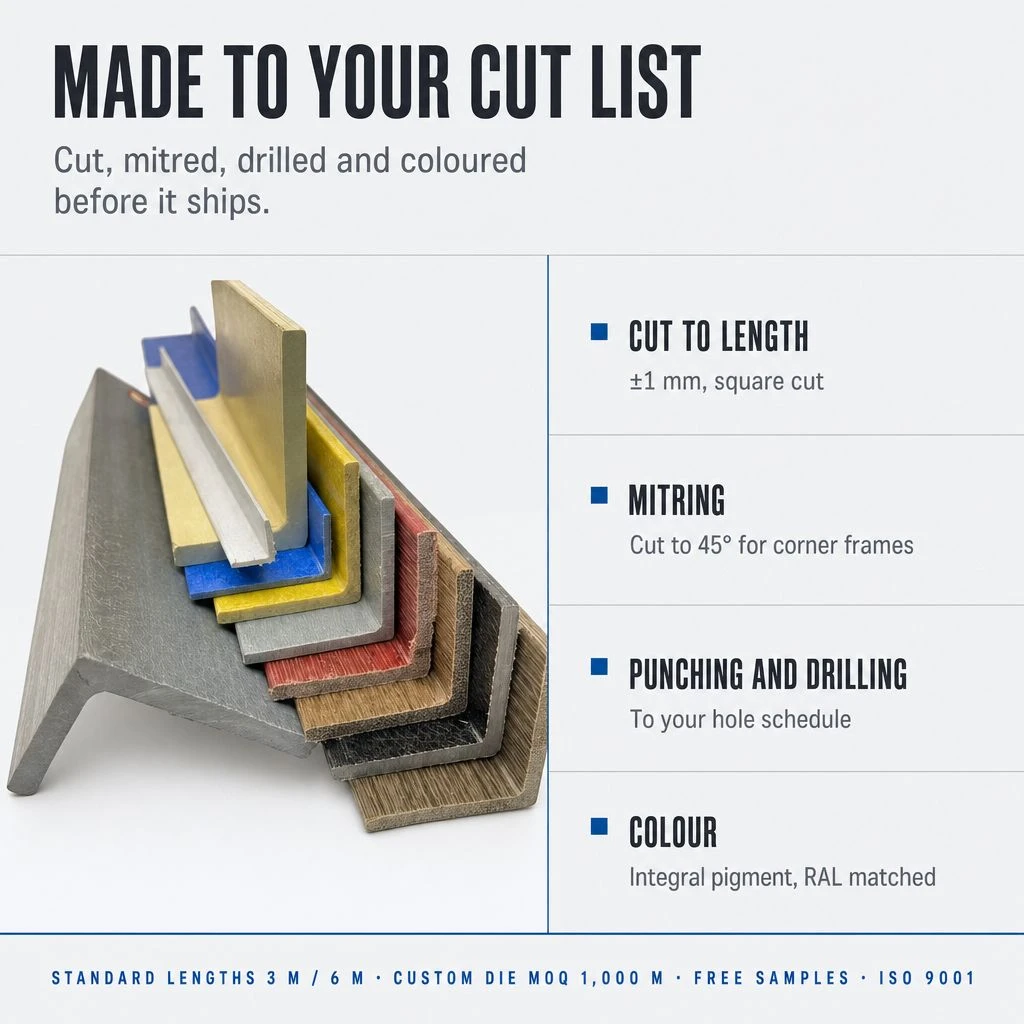
Custom, cut to length, ordering
| Cut to length | ±1 mm, square cut | Standard lengths | 3 m / 6 m |
| Mitring | Cut to 45° for corner frames | Tooling lead time | 4–6 weeks |
| Punching and drilling | To your hole schedule | Custom die MOQ | 1,000 m |
| Notching | For leg clearance at joints | Samples | Free samples |
| Colour | Integral pigment, RAL matched | Certificates | ISO 9001; test reports available on request |
Production Process


FAQ
Equal leg or unequal leg?
Equal leg for bracing and general framing, where load comes from either direction. Unequal leg when one face has to be wider than the other - a shelf support, a base frame, or anywhere one leg carries and the other just fixes. We hold both; ask for the unequal list if that is what your drawing shows.
Why does it twist when I load it?
Because an angle is singly symmetric: its shear centre sits off the section, so a load along the length produces bending and twisting together. This is a property of the shape, not a defect in the material, and it is true of steel angle too - it is just less visible when the material is five times stiffer. Restrain long angles along their length, or switch to tube or channel.
Can I bolt straight through both legs?
You can, but bolt through one leg where you can. Through-bolting both legs into a corner clamps the section in a way that can crush the corner over time. Where the joint must be fixed on both faces, use a backing plate on the outer face and do not over-torque. Bearing, not bolt shear, is the limit.
Will it split at the corner?
Not under normal use. The corner is formed in the die and the fibre runs continuously through it. What splits an angle is a hole drilled too close to a leg edge or a notch cut into the corner itself. Keep holes at least two diameters from any edge.
Can it be mitred for a corner frame?
Yes. Cut both legs at 45° and join with a moulded corner plate or an internal gusset bonded in place. Mitring is the usual way to build a rectangular frame from angle, and it is the one operation where a fine-tooth carbide blade genuinely pays for itself.
How does it compare with steel angle?
On cost per metre, steel angle is cheaper and stiffer. On everything that happens after installation, it is not close in a corrosive environment: steel angle rusts at the cut ends and at the corner where the coating is thinnest, and a painted angle on an external corner leaves rust staining down the wall. Composite angle needs no coating and ages evenly.
What is the largest angle you hold?
200 × 200 × 3 mm is the largest equal-leg angle on tooling. Beyond that, or for a heavier wall than we hold, it needs a new die - and an angle die is relatively inexpensive because the section is simple.
Do you hold a 135-degree angle?
Yes, on a specific customer's tooling. Ask and we will confirm whether it can be run for your quantity.
Tell us what it has to brace, join or protect
Angle is specified by the joint, not the section. Send the leg length you are using now, or describe what the angle has to do, and we will confirm the size - or tell you that channel or tube would serve better.
Hot Tags: fiberglass angle bar, China fiberglass angle bar manufacturers, suppliers, factory