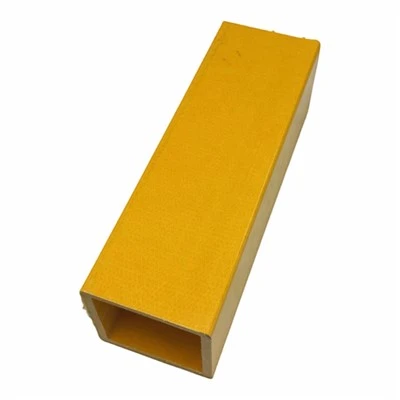
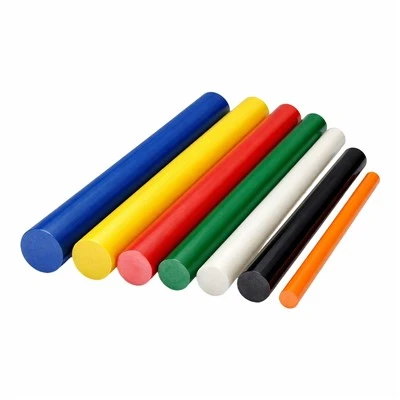
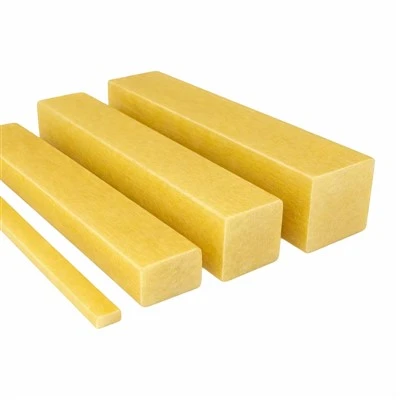
Henan Enbuess Composite Materials Co., Ltd. is one of the leading manufacturers and suppliers of fiberglass rectangular tube in China. We are committed to providing high quality customized service for global clients. If you're going to buy high strength fiberglass rectangular tube made in China, welcome to get free sample from our factory.
Fiberglass Rectangular Tube for Frames, Sashes and Racks
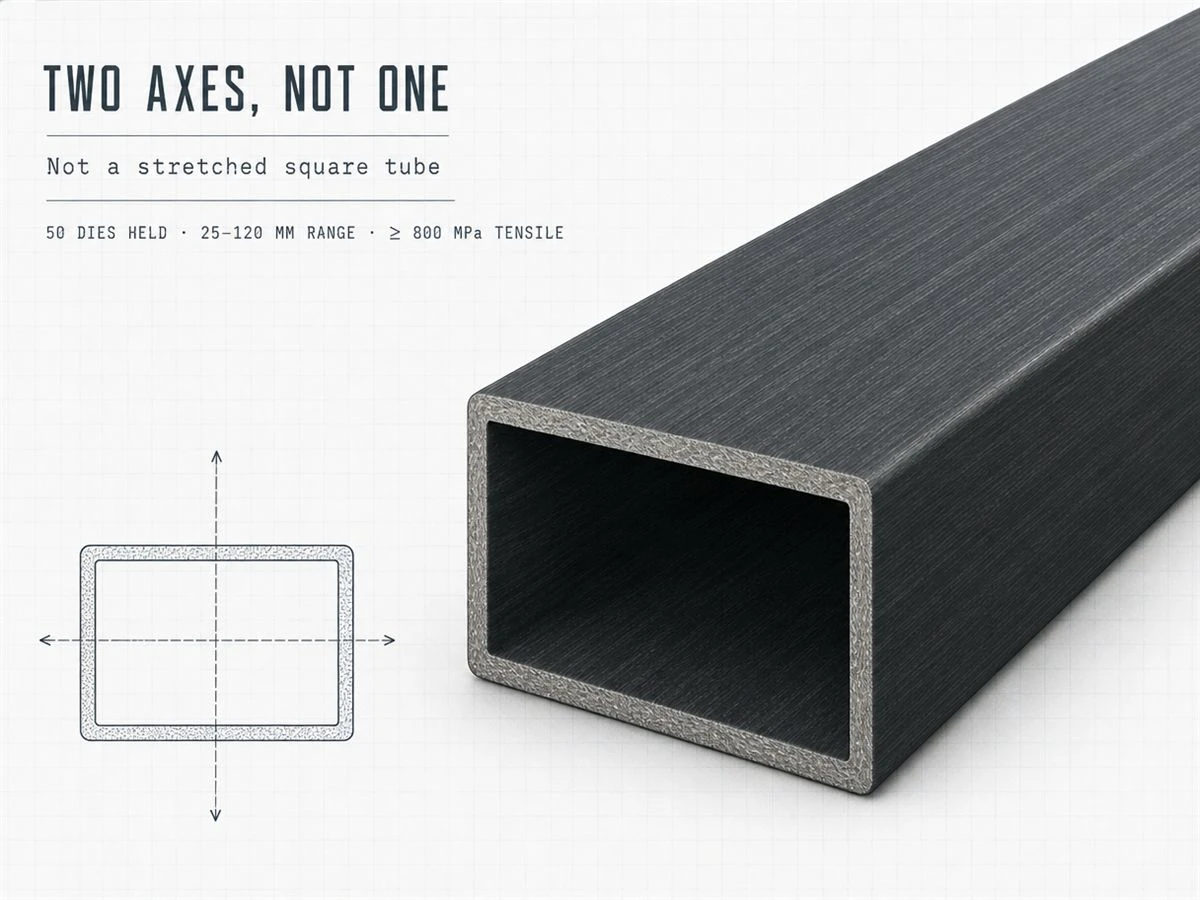
A rectangular tube is not a square tube with one side stretched. The two axes are different, and which way you stand the section up changes how far it spans and how much it deflects - often by a factor of three or more.
We hold 50 rectangular tube dies. It is our largest family after round tube, and it is the one we most often see fitted the wrong way round.
Standard sizes
Shown as width × depth × thickness. All rows run on tooling we already hold. Sizes with four dimensions have a stepped or unequal wall.
|
Width × depth × thickness (mm) |
Weight (kg/m) |
Tooling |
|
25.5 × 12.5 × 2 |
0.28 |
Existing |
|
30 × 15 × 2 |
0.31 |
Existing |
|
30 × 20 × 2 |
0.35 |
Existing |
|
35 × 20 × 3 |
0.59 |
Existing |
|
38 × 75 × 3.25 |
- |
Existing |
|
40 × 20 × 2 |
0.41 |
Existing |
|
40 × 20 × 3 |
0.68 |
Existing |
|
40 × 25.3 × 3 |
0.72 |
Existing |
|
40 × 30 × 2 |
- |
Existing |
|
40 × 30 × 2.5 |
0.63 |
Existing |
|
50 × 15 × 2.5 |
- |
Existing |
|
50 × 20 × 3 |
0.73 |
Existing |
|
50 × 25.3 × 3 |
0.86 |
Existing |
|
50 × 26 × 3.5 |
0.98 |
Existing |
|
50 × 28 × 4 |
- |
Existing |
|
50 × 30 × 3.5 |
1.04 |
Existing |
|
52 × 28 × 3.5 |
- |
Existing |
|
53 × 15 × 2 |
0.49 |
Existing |
|
56 × 35 × 3 |
- |
Existing |
|
60 × 30 × 3 |
1 |
Existing |
|
60 × 40 × 4 |
1.44 |
Existing |
|
65 × 25 × 6 |
1.85 |
Existing |
|
75 × 30 × 3 × 5 |
1.79 |
Existing |
|
75 × 35 × 3 × 6 |
2.1 |
Existing |
|
75 × 40 × 4 |
1.72 |
Existing |
|
80 × 35 × 3.5 × 5 |
2.1 |
Existing |
|
80 × 35 × 4 |
1.84 |
Existing |
|
80 × 40 × 3 |
1.33 |
Existing |
|
80 × 50 × 4 |
1.94 |
Existing |
|
85 × 50 × 4 |
1.98 |
Existing |
|
100 × 50 × 4 |
2.35 |
Existing |
|
100 × 50 × 5 |
2.93 |
Existing |
|
112 × 92 × 4 |
3.26 |
Existing |
|
114 × 70 × 8 |
- |
Existing |
|
115 × 105 × 5 |
4.4 |
Existing |
|
120 × 60 × 5 |
3.42 |
Existing |
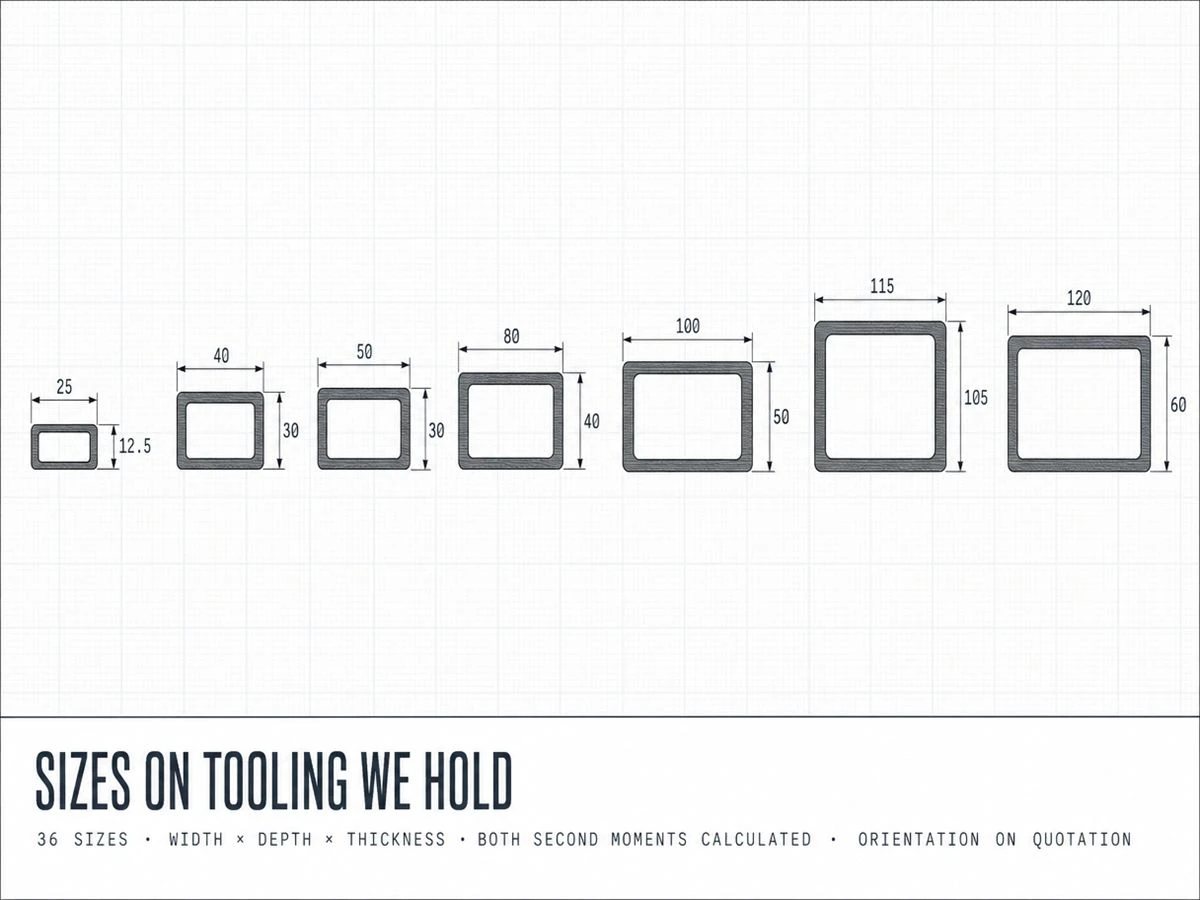
Because the section is non-symmetric, the second moment of area differs sharply between the two axes. We calculate both and supply them with the quotation - and we will tell you which way round the section should be installed.
What buyers ask about this profile
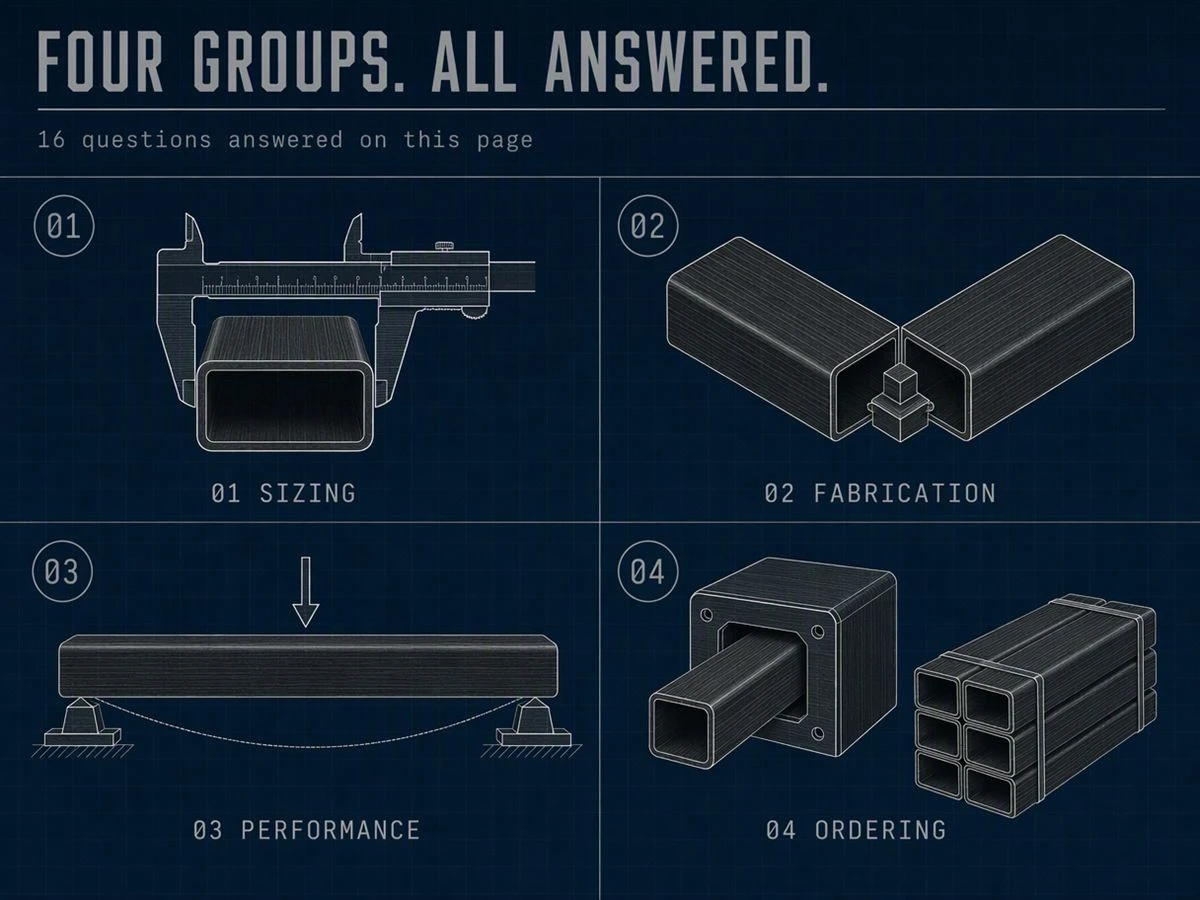
Four groups. Each one is answered on this page.
Sizing
Which way round should I fit it?
What size do I need for my frame?
Is my size held or does it need a die?
What is the wall tolerance?
Fabrication
How do I make a frame corner?
Can I mitre it?
Will it split when drilled?
How do I fix into the narrow face?
Performance
How much does orientation change capacity?
Will it sag over a long span?
Does it dent more than square tube?
Can I use it outdoors?
Ordering
How does it compare with aluminium window section?
Can I get a sample length?
Do you supply test certificates?
What is the MOQ on a custom die?
Why rectangular
Two reasons to choose it - and the orientation rule that decides whether it works.
|
Stand it up and it spans further |
|
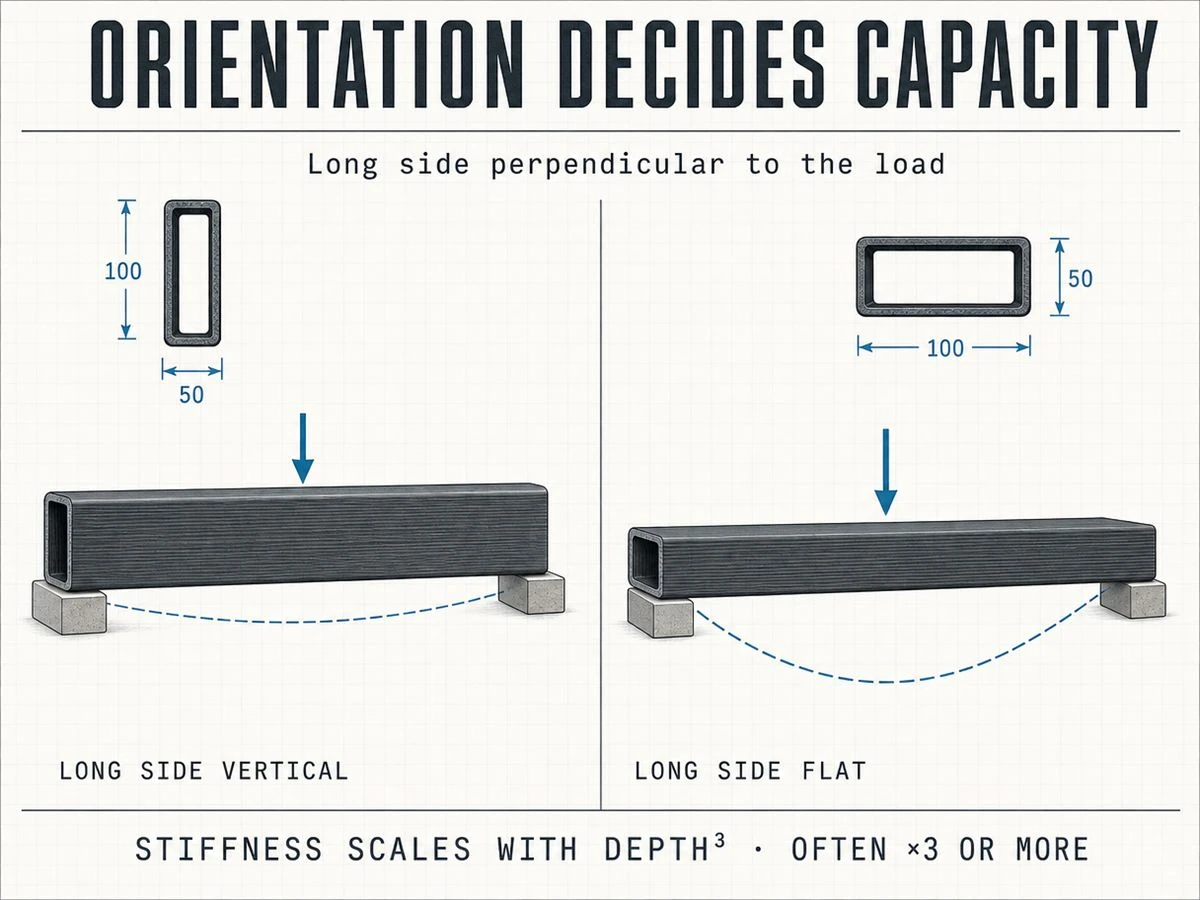
Bending stiffness comes from the second moment of area, and that scales with the cube of the dimension in the bending direction. Stand a 100 × 50 tube on its narrow edge and its stiffness about that axis can be several times what it is lying flat - for the same section and the same weight. This is the reason rectangular tube exists: it puts material where the bending is, which is the same logic as an I beam, in a closed section you can seal and clamp. |
|
Flat faces for mounting, and a shallow depth where you need one |
|
Rectangular tube gives you a wide flat face to mount against, clamp to, or bond a panel onto - while staying shallower than a square section of similar stiffness. That is why it is the default for window and door sashes, for sign frames, for display racking and for any assembly where something has to sit flush against the section. |
|
The rule: put the long dimension perpendicular to the load |
|
If a rail carries load from above, the long side should be vertical. If a panel is fixed to the face, the long side gives you the wider gluing or clamping surface. Get this wrong and you can lose most of the section's capacity - and because rectangular tube looks similar either way round, nobody notices until it deflects. We state the correct orientation on every quotation where it matters. |
Where it gets specified
Rectangular tube is bought where something mounts to a flat face, or where depth is constrained.
Window and door sashes and frames
Flat faces for glazing and hardware; no thermal bridge.
Racking and shelving uprights
Orient the long side to the load, mount to the wide face.
Sign and display frames
A wide face to mount the panel to, with the depth hidden.
Balustrade and infill panels
Shallow section where a square tube would project too far.
Equipment and machine frames
Flat mounting faces on a closed, sealed section.
Vehicle and trailer bodies
Weight saving with a flush mounting face.
Greenhouse and polytunnel structures
Light, and no rust staining down the glazing.
Water and wastewater covers
Sealed section with no internal corrosion.
Against the metals you are replacing
Rectangular tube is most often bought to replace aluminium window section or steel rectangular hollow section.
|
Property |
Pultruded composite |
Carbon steel |
Galvanised steel |
Stainless 304 |
Stainless 316 |
Aluminium 6061-T6 |
|
Density (g/cm³) |
1.8–2.2 |
7.85 |
7.85 |
8 |
8 |
2.7 |
|
Tensile strength (MPa) |
≥ 800 |
370–500 |
370–500 |
515 |
515 |
310 |
|
Specific strength |
≈ 400 |
≈ 51 |
≈ 51 |
≈ 64 |
≈ 64 |
≈ 115 |
|
Thermal conductivity (W/m·K) |
0.3–0.5 |
~50 |
~50 |
~16 |
~16 |
~167 |
|
Condensation on the section |
No thermal bridge |
Cold surface |
Cold surface |
Cold surface |
Cold surface |
Thermal bridge |
|
Internal bore corrosion |
No mechanism |
Rusts from inside |
Rusts at cut and weld |
Sound |
Sound |
Oxidation |
|
Salt / chloride |
No mechanism |
Rusts through |
Zinc gone in 2–3 yrs |
Pitting, SCC |
Good |
Pitting |
|
Electrical |
Insulating |
Conductive |
Conductive |
Conductive |
Conductive |
Conductive |
|
Modulus (GPa) |
≥ 40 |
~200 |
~200 |
~193 |
~193 |
~69 |
|
Cut and drill on site |
Hand tools |
Grinder, hot work |
Grinder, re-protect |
Grinder |
Grinder |
Hand tools |
|
Maintenance, 25 yrs |
None |
Paint 3–4 times |
1–2 times |
Inspect in chloride |
Low |
Oxidation control |
|
Scrap value at end |
Low |
High |
High |
Very high |
Very high |
High |
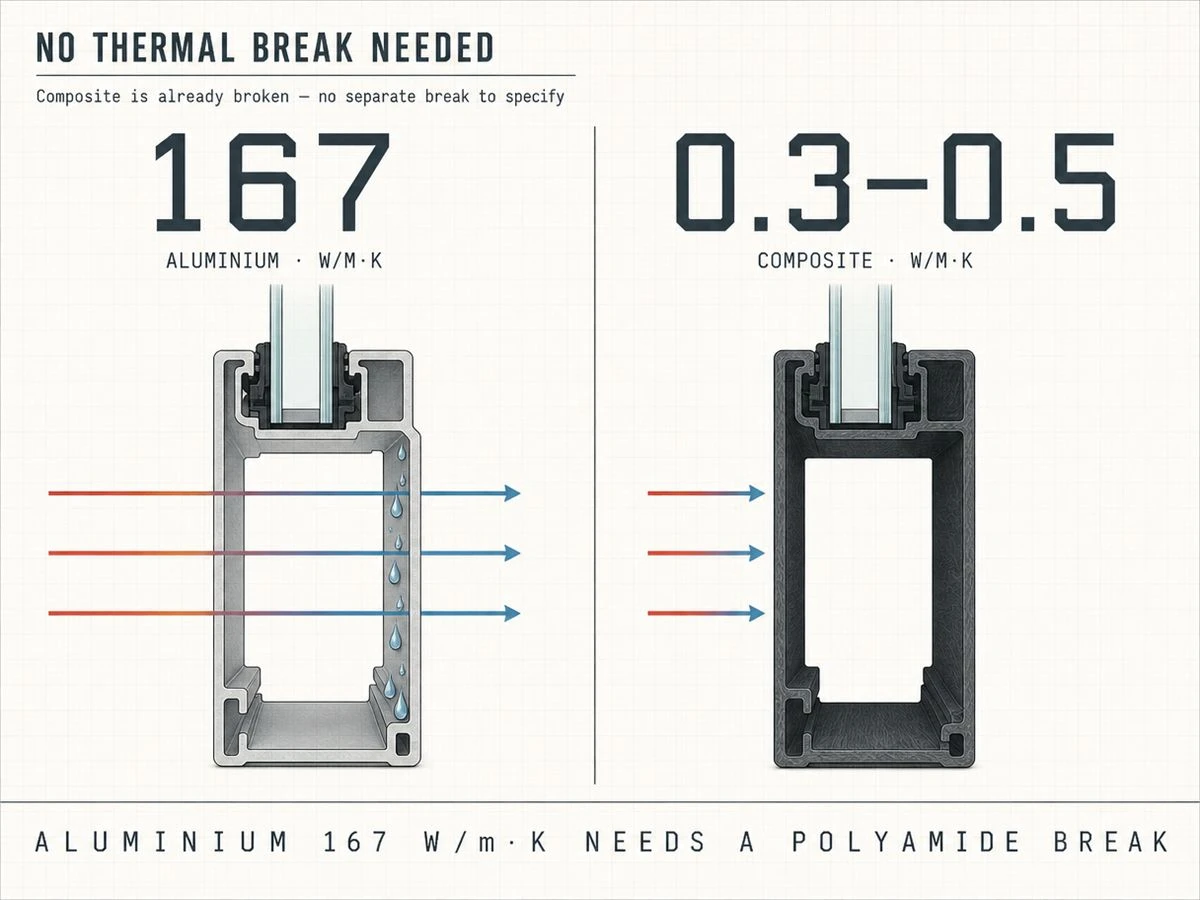
Against aluminium window section, the argument is the thermal bridge
Aluminium conducts at around 167 W/m·K. In a glazed frame that means the section is a thermal bridge: heat leaves through it, the inner face runs cold, and condensation forms on it - which is why aluminium systems need a polyamide thermal break. Composite runs at 0.3–0.5 W/m·K, so the frame is already broken; there is no separate break to specify, to fail, or to be value-engineered out.
Against steel hollow section, it is the inside of the tube
Steel rectangular hollow section is usually supplied seam-welded and either left bare inside or coated only on the outside. Condensation inside the sealed section causes corrosion that nobody can see or treat, and it starts at the weld. This is why steel hollow sections in outdoor frames fail from the inside out. A pultruded section has no weld and no internal corrosion mechanism.
What the metals do better. Stiffness: aluminium is about 69 GPa against our 40, so for the same outside dimensions an aluminium section is stiffer. Dent resistance - a metal section takes a knock that would mark a composite one. Temperature, where metal has no ceiling. And scrap value at end of life.
Material data
Measured to ASTM methods on the pultruded section. Values are for the composite material; section properties depend on the size you order.
| Tensile strength, longitudinal | ≥ 800 MPa · ASTM D638 | Compressive strength, longitudinal | ≥ 600 MPa · ASTM D695 |
| Tensile modulus, longitudinal | ≥ 40 GPa · ASTM D638 | Density | 1.8–2.2 g/cm³ · ASTM D792 |
| Flexural strength, longitudinal | ≥ 800 MPa · ASTM D790 | Water absorption | < 0.5% · ASTM D570 |
| Flexural modulus, longitudinal | ≥ 35 GPa · ASTM D790 | Barcol hardness | ≥ 55 HBa · ASTM D2583 |
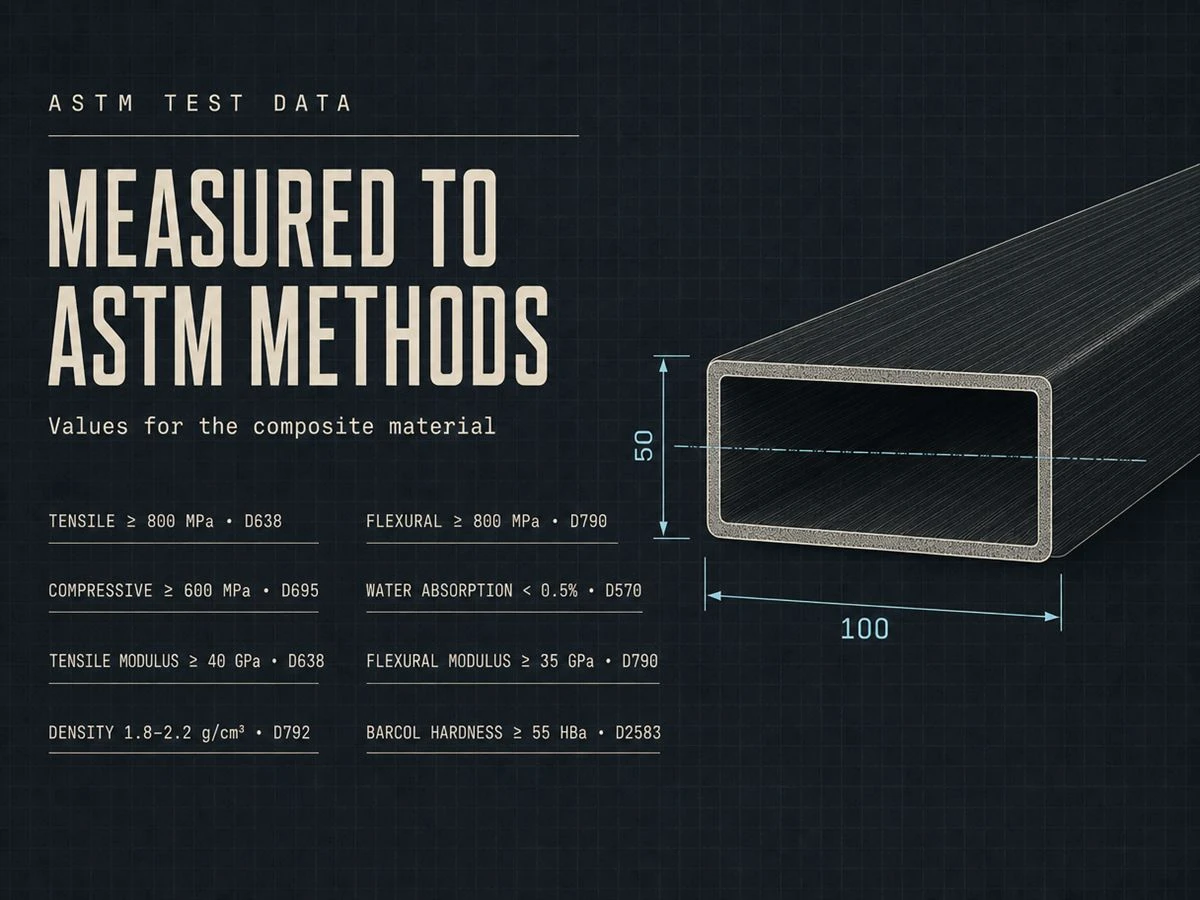
For a rectangular section there are two second moments of area, one per axis, and they differ substantially. We calculate both for the exact size you order and state the correct installation orientation with the quotation.
Custom, cut to length, ordering
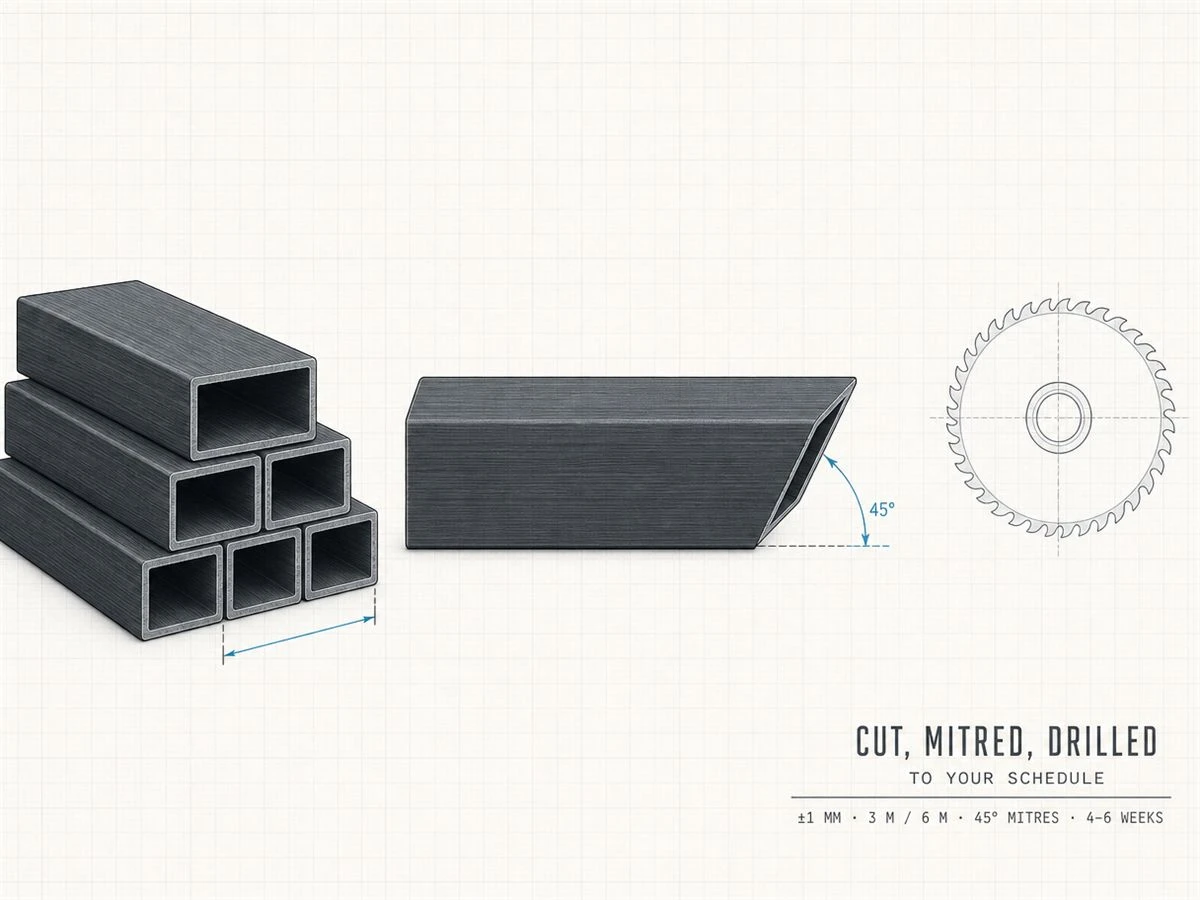
| Cut to length | ±1 mm, square or mitred | Standard lengths | 3 m / 6 m |
| Mitring | 45° cuts for frame corners | Tooling lead time | 4–6 weeks |
| Drilling and slotting | To your hole schedule | Custom die MOQ | 1,000 m |
| Corner assembly | Moulded keys, adhesive, or gasket-sealed | Samples | Free samples |
| Colour | Integral pigment, RAL matched | Certificates | ISO 9001; test reports available on request |
Production Process


FAQ
Which way round should I fit it?
Put the long dimension perpendicular to the load. If a rail carries weight from above, stand the long side vertical. Bending stiffness scales with the cube of the dimension in the bending direction, so orientation often changes capacity by a factor of three or more. We state the correct orientation on the quotation.
How much does orientation actually change things?
A great deal. For a 100 × 50 × 4 section, the second moment of area about the axis parallel to the long side is several times smaller than about the other - so the same tube fitted flat instead of on edge deflects several times more under the same load. This is the single most common error we see in rectangular tube installations.
Can I mitre it for a frame corner?
Yes. Cut both members at 45° and join with a moulded corner key, a bonded internal gusset, or a mechanical bracket. A fine-tooth carbide blade is worth it here - a torn mitre shows in a visible frame. We supply cut and mitred sets to your schedule.
How do I fix into the narrow face?
Carefully. The narrow face gives you less bearing width, so use a backing plate or a through-bolt rather than a screw into the wall. A fixing into a narrow face is limited by bearing, not by the fastener - and it is the detail that fails first on a rectangular frame.
Will it split when drilled?
Heavy feed splits the far wall. Use a sharp HSS bit at moderate speed with light feed, back the exit face with a scrap block, and keep holes at least two diameters from any edge. On a thin-walled rectangular section, the flat face will also flex under drill pressure, so support it along its length.
Does it dent more than square tube?
The wide flat face is more exposed to impact than a corner, so treat it like a panel: avoid point impacts on the centre of a wide face. Where impact is likely, a thicker wall or a square section is the better choice - tell us the exposure and we will advise.
How does it compare with aluminium window section?
Composite is roughly a third of the thermal conductivity problem: aluminium at 167 W/m·K is a thermal bridge that needs a polyamide break, composite at 0.3–0.5 W/m·K is not, so no condensation on the frame and no separate break to specify. Aluminium is stiffer for the same outside dimensions. On a glazed frame in a heated building, the thermal argument usually decides it.
How does it compare with steel hollow section?
Steel is stiffer and takes impact better. It also corrodes from the inside, where the weld is and where condensation collects, and nobody can see it or treat it. On an outdoor frame that is the failure mode that ends the service life. Composite has no weld and no internal corrosion mechanism.
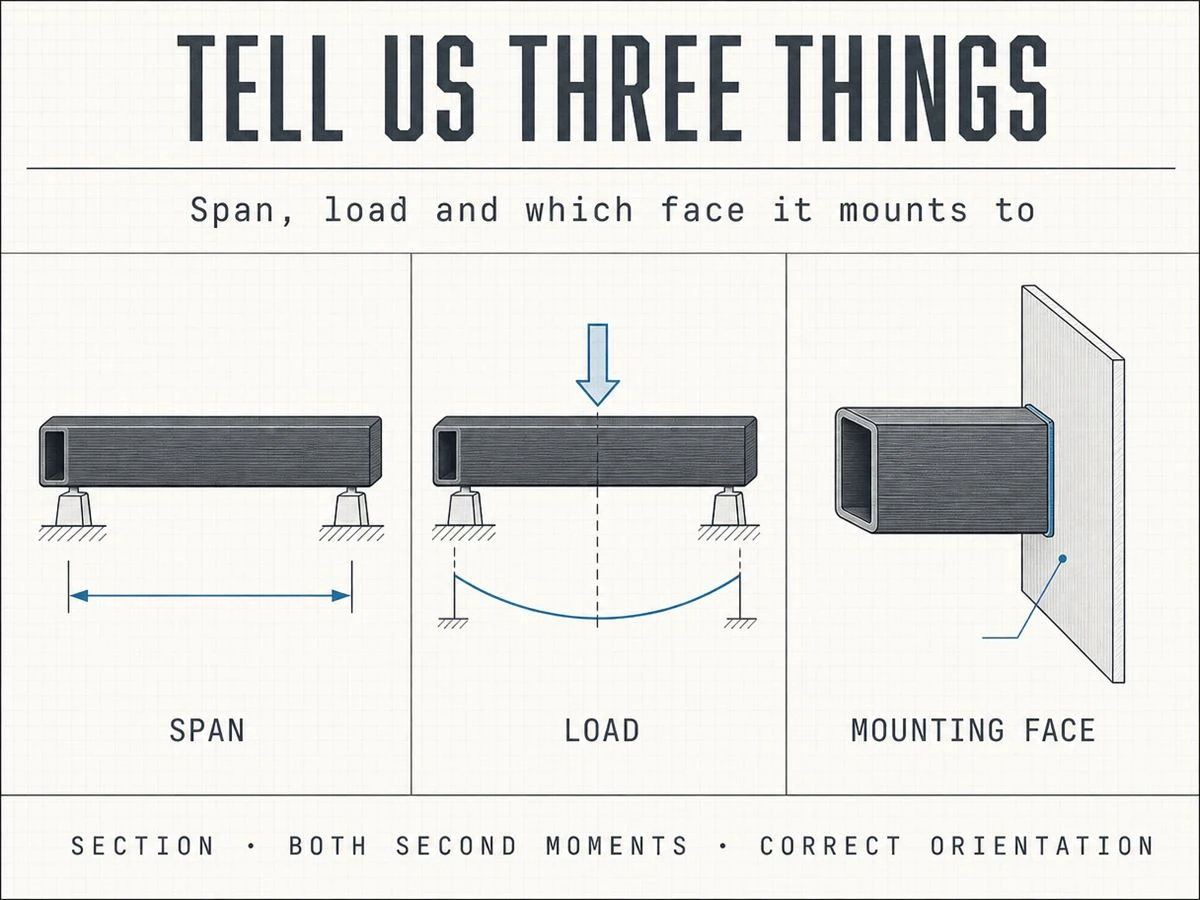
Tell us the span, the load and which face it mounts to
Three things decide the size and the orientation. Send them and we will come back with a section, both second moments of area, and the correct fitting orientation. If a square tube serves better, we will say so.
Hot Tags: fiberglass rectangular tube, China fiberglass rectangular tube manufacturers, suppliers, factory