
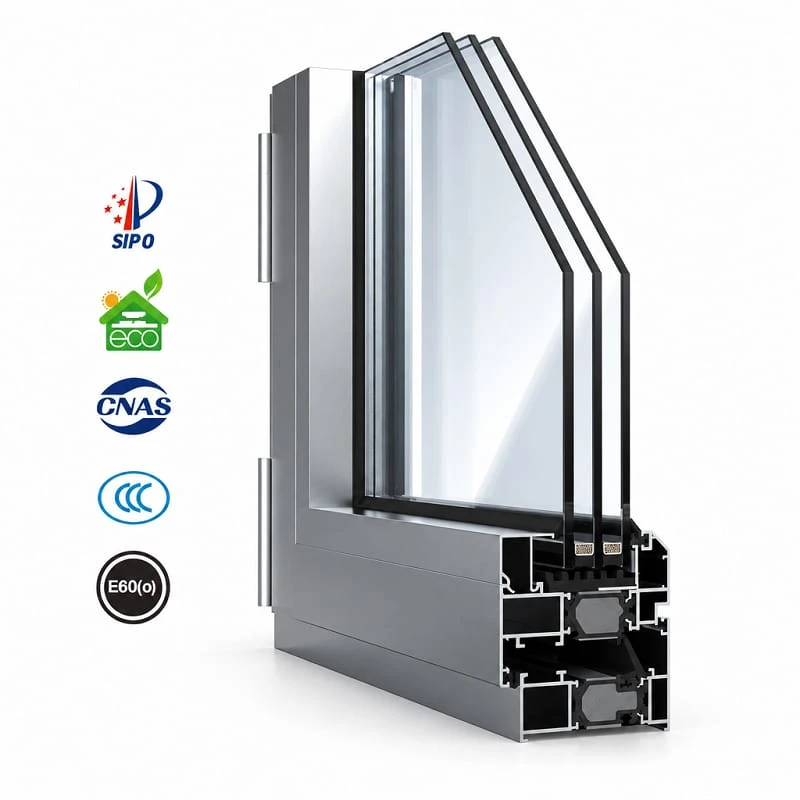
Henan Enbuess Composite Materials Co., Ltd. is one of the leading manufacturers and suppliers of 758 polyurethane aluminium fire window in China. We are committed to providing high quality customized service for global clients. If you're going to buy high strength 758 polyurethane aluminium fire window made in China, welcome to get free sample from our factory.
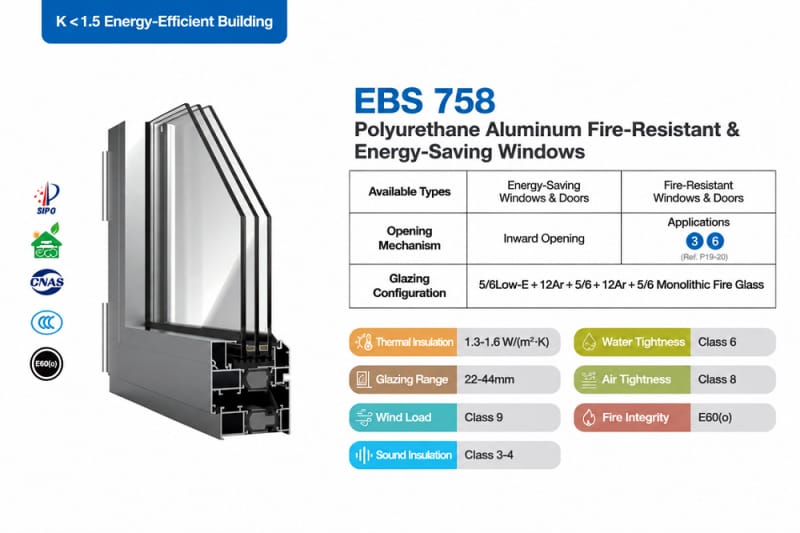
Fire windows are normally chosen late, after the façade has been designed. By then three decisions are locked: the opening size, the glazing build and the U-value target. Dropping in a steel fire window at that point breaks the third one, and nobody re-runs the calculation because the window is small in area.
It is not small in effect. A 1.2 × 1.5 m fire window at 3.0 W/(m²·K), repeated along a corridor elevation, contributes more to the heating load than its area suggests - and it becomes the coldest surface in the corridor, which means condensation on the frame and mould at the reveal within two winters.
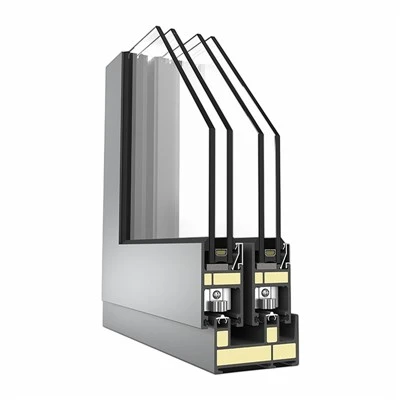
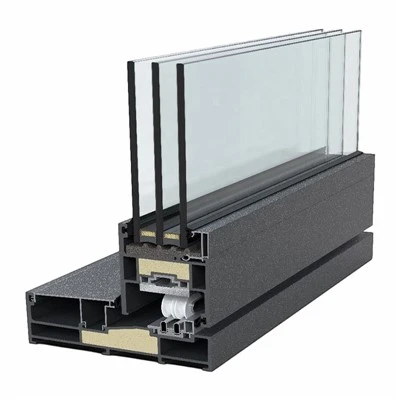
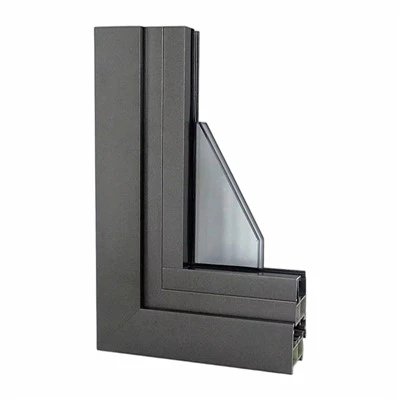
The 758 removes that trade. The frame is aluminium, but the section is broken and filled with polyurethane, so the U-value lands at 1.3–1.6 - inside the range a low-energy façade can absorb. You keep E60(o) and you keep the elevation.

Watch the Manufacturing Process
Click to watch a video of the 758 Polyurethane Aluminium Fire Window being manufactured
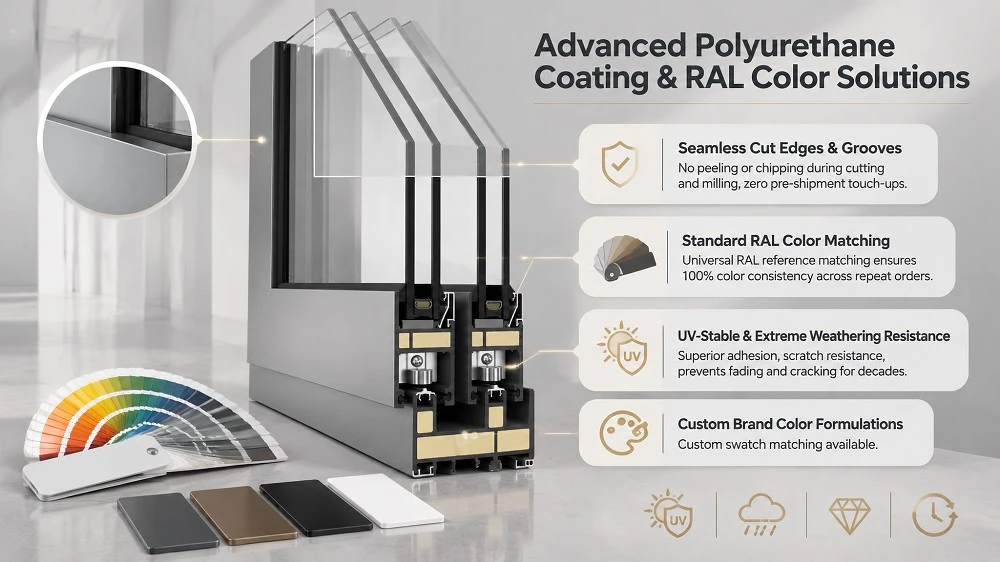
Our finished doors and windows bring a premium, smooth matte or gloss finish to residential renovation projects, using eco-friendly water-based polyurethane paint with full RAL color matching. The surface is scratch-resistant and UV-stable, so it stays looking new long after installation. Homeowners appreciate the uniform, high-end appearance that complements both modern and traditional interior and exterior designs.
Our foreign trade mainly exports door and window profiles.
You can buy only our composite door and window profiles and assemble them into finished windows in your own country.
This helps you save a lot on shipping costs.
Our MOQ is generally 2000 meters and above.
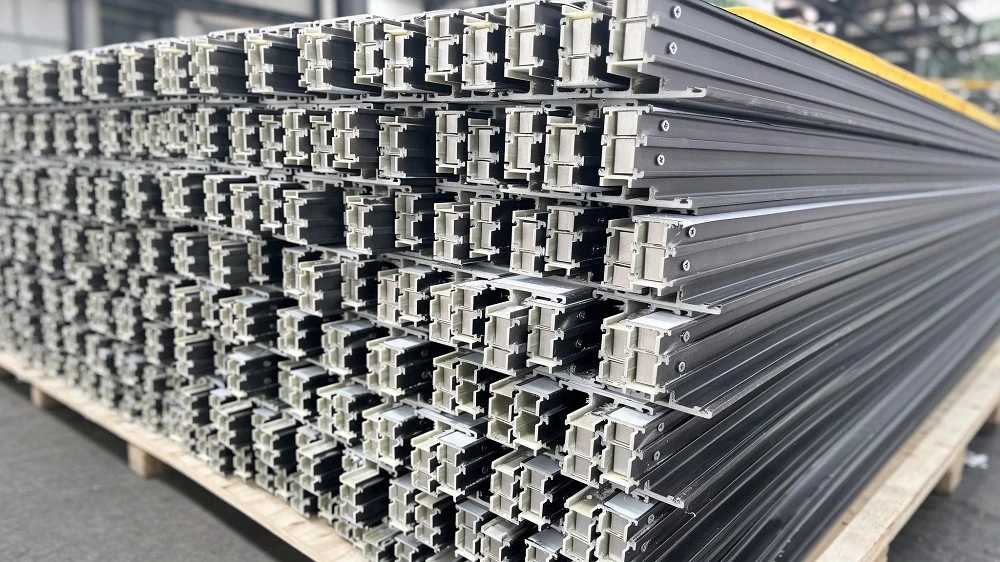
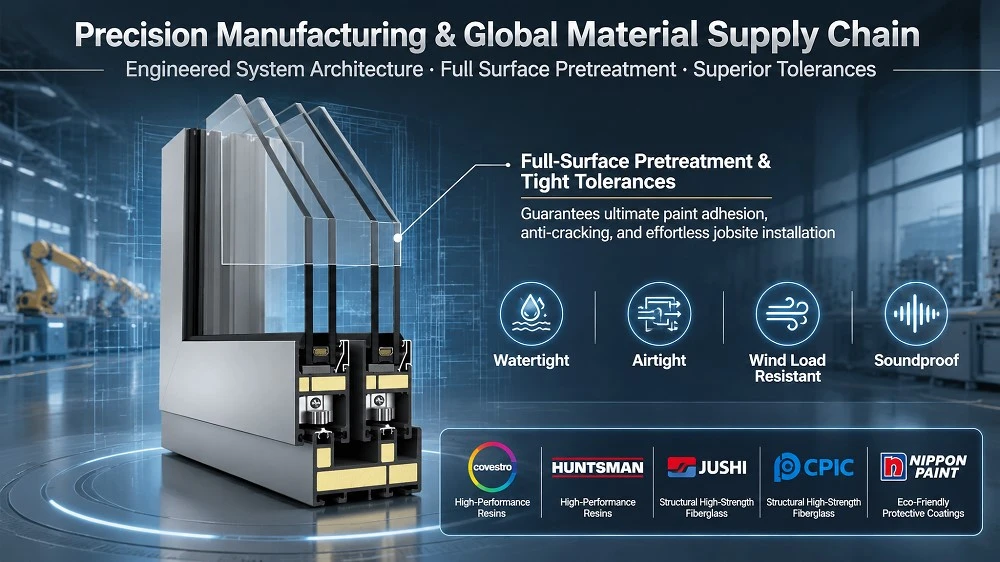
Every window and door is built on a systematically engineered profile system designed for reliable water tightness, air tightness, wind resistance and sound insulation. High-quality branded resins, glass fiber and coatings are used throughout, and full surface pre-treatment ensures the paint adheres tightly and won't crack or peel. Precision manufacturing means tight tolerances and clean, consistent finishes that installers love to work with.
We stand behind our products with clear warranty terms and fast customer support. If your homeowner has questions or issues after installation, we respond quickly with troubleshooting guidance or replacement parts, helping you deliver a worry-free renovation experience and protect your referral reputation.

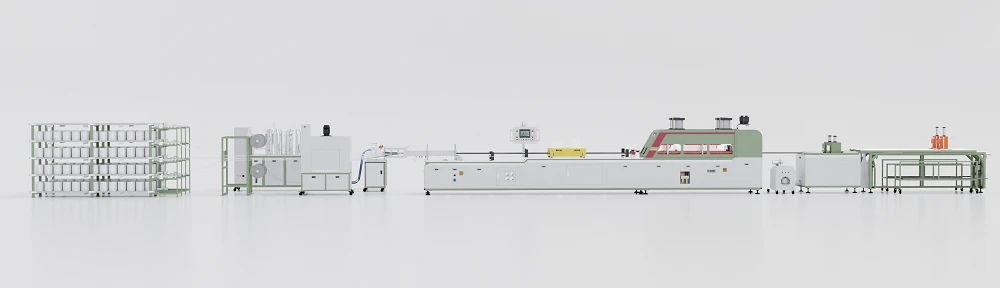
GRFPU Pultrusion Process
GRFPU material as one thermoset composites are built up by polyurethane resin as a matrix (about 20%) in combination with continuous fiber-reinforced (about 80%) materials, which is produced through a proprietary injection pultrusion molding process into a specific cross-sectional profile.
1. Reinforced fiberglass (80% Glass fiberglass Rovings)
2. Measuring pump
3. Guide plate
4. MDI storage tank
5. PPG storage tank
6. Static mixer
7. Injection die
8. Heated pultrusion die
9. Crawler pulling device
10. Cut off Saw
11. Finished profile
Fire windows are normally chosen late, after the façade has been designed. By then three decisions are locked: the opening size, the glazing build and the U-value target. Dropping in a steel fire window at that point breaks the third one, and nobody re-runs the calculation because the window is small in area.
It is not small in effect. A 1.2 × 1.5 m fire window at 3.0 W/(m²·K), repeated along a corridor elevation, contributes more to the heating load than its area suggests - and it becomes the coldest surface in the corridor, which means condensation on the frame and mould at the reveal within two winters.
The 758 removes that trade. The frame is aluminium, but the section is broken and filled with polyurethane, so the U-value lands at 1.3–1.6 - inside the range a low-energy façade can absorb. You keep E60(o) and you keep the elevation.
A conventional thermally broken aluminium window interrupts the metal with a polyamide strip. That works, but the strip is a narrow bridge: the wider the frame, the more the strip dominates, and every screw that crosses it is a new path.
The 758 fills the section with polyurethane instead, so the break is distributed through the depth of the profile rather than concentrated in a 20 mm element. Two consequences on site:
- The inner face stays warmer, so the reveal does not become the condensation line that it becomes behind a standard break.
- The frame still takes standard hardware - this is an aluminium window with a PU core, not a different construction method for the fabricator.
The 758 is designed around a monolithic fire-glass build rather than an insulating unit:
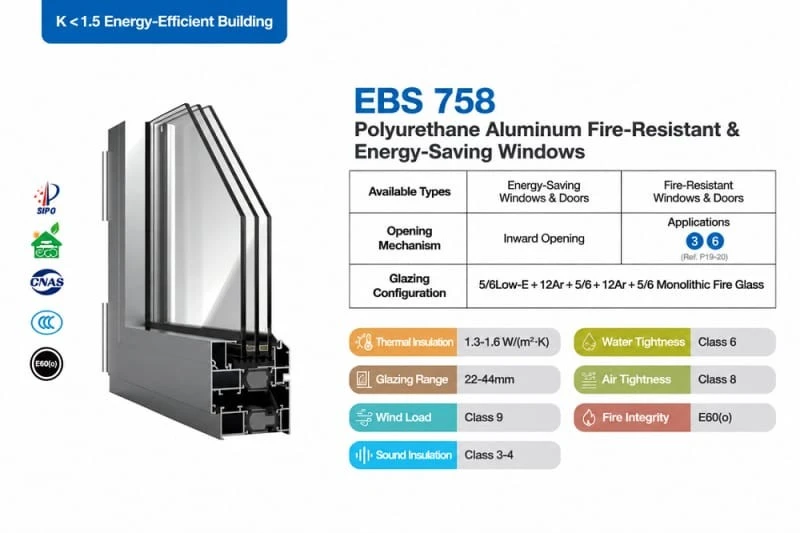
- 5/6 Low-E + 12Ar + 5/6 + 12Ar + 5/6 monolithic fire glass
- Glazing range 22–44 mm
That is the right answer where the fire requirement is E (integrity) and the thermal target is met by the frame plus a reasonable glass build - the typical corridor, stair and compartment window. Where the compartment also requires insulation (EI or Class A), the frame and glass have to change: use the 807, which is rated A1.50h.
Compartment windows that need E60 only: corridor and stair vision panels, plant room walls, service shafts, and façade openings on the fire compartment line where an insulating rating is not required. Inward opening is standard, which suits corridor-side installation where an outward leaf would obstruct evacuation.
There are two buyers for this section, and they need different things. A project team wants finished windows - assembled, glazed, labelled by opening, on site when the elevation opens up. A fabricator wants profiles cut to length with the drainage and hardware openings punched, so its own line can assemble against its own glass and hardware.
| Route | Finished units | Profiles for fabrication |
| Who it suits | Contractors and developers with an opening schedule | Window fabricators with an assembly line |
| What arrives | Assembled, glazed, labelled per opening | Cut-to-length profiles, punched, with the glazing specification |
| What you do | Install | Assemble, glaze, fit hardware to your own supply chain |
The fire rating follows the same rule as everything else in this range: E60(o) is a property of the tested assembly. If you build the 758 in your own workshop, the glazing and the seal must match the configuration we tested. We issue that specification with the order, so your technical team is not guessing at the interface.
758 or 807
| Spec | 758 | 807 |
| Fire performance | E60(o) - integrity only | A1.50h (Class A)- integrity + insulation |
| Frame U-value | 1.3–1.6 W/(m²·K) | 1.4–2.0 W/(m²·K) |
| Glazing range | 22–44 mm | 41–48 mm |
| Opening | Inward | Inward / outward |
| Choose it when | The specification says E60 | The specification says EI or Class A |
The rule is simple and we apply it at enquiry: read the compartment classification first, then choose the section. Buying the 807 where E60 is enough costs money and glass thickness you do not need; buying the 758 where EI is required fails the inspection.
| Item | Parameter |
| Model | EBS 758 Polyurethane Aluminium Fire Window |
| Type | Energy-saving and fire-resistant window |
| Frame | Aluminium with polyurethane core |
| Fire integrity | E60(o) |
| Thermal insulation | 1.3–1.6 W/(m²·K) |
| Glazing range | 22–44 mm |
| Glazing option | 5/6Low-E+12Ar+5/6+12Ar+5/6 monolithic fire glass |
| Air tightness | Class 8 |
| Water tightness | Class 6 |
| Wind load resistance | Class 9 |
| Sound insulation | Class 3–4 |
| Opening mechanism | Inward opening |
| Supply options | Finished units / cut-to-length profiles |
| Origin | Henan, China · Brand: Enbuess |
The 758 is fabricated with standard aluminium window practice - cut, crimp or screw, glaze, fit. The difference is at the fixing: the frame must not be bridged by a steel bracket that reconnects the cold side to the warm side, so the drawing set specifies the bracket type and the standoff. Where the window sits in a masonry reveal, the same detail determines whether the 1.3 figure survives contact with the wall.
Material Property
Corrosion Resistance Performance

Aluminum/Polyurethane


5% HCL
(hydrochloric acid)
for 66 hours

10% NaOH
(natrium hydroxydatum)
for 24 hours

Na₂CO₃
(natrium carbonicum)
for 106 hours
Performance Testing

SOUND INSULATION
Sound insulation, quiet living
We provide official factory warranty. Under normal installation and use, non-artificial quality problems are eligible for maintenance and replacement services.

HIGH STRUCTURAL STRENGTH
High strength, strong and durable
We provide official factory warranty. Under normal installation and use, non-artificial quality problems are eligible for maintenance and replacement services.

CORROSION & AGING RESISTANCE
Corrosion and moisture resistant
We provide official factory warranty. Under normal installation and use, non-artificial quality problems are eligible for maintenance and replacement services.

FIRE RETARDANT
Fire retardant safety performance
We provide official factory warranty. Under normal installation and use, non-artificial quality problems are eligible for maintenance and replacement services.

EXCELLENT WEATHER RESISTANCE
Weather & aging resistant
We provide official factory warranty. Under normal installation and use, non-artificial quality problems are eligible for maintenance and replacement services.

LOW CARBON
Low carbon, energy-efficient
We provide official factory warranty. Under normal installation and use, non-artificial quality problems are eligible for maintenance and replacement services.
Q: What does the "(o)" in E60(o) mean?
A: It is the designation used on our test documentation for this build. What matters for specification is the letter E: integrity only, 60 minutes. If your compartment requires insulation, this is the wrong product - take the 807.
Q: Can it be used externally?
A: Yes. The frame is aluminium with a PU core and a coated finish; it is specified on façades as well as internally. For coastal sites, confirm the coating system at enquiry.
Q: Does it come in outward opening?
A: Inward is standard for this section. If your detail needs outward opening, tell us - the answer depends on the hardware and the compartment, not on the frame alone.
Q: How is it different from a normal thermally broken window?
A: The break is filled with polyurethane through the section rather than concentrated in a polyamide strip, and the frame is tested as a fire assembly with the specified glazing. One is a thermal product, the other is a fire product that also performs thermally.
Q: Do you supply profiles only, for our own fabrication?
A: Yes. Profiles are supplied cut to length with drainage and hardware openings punched, plus the glazing specification the tested build uses. If your glass differs, we confirm whether the assembly still holds the rating before you commit.
Tell us the span and what it has to carry
Send the outside diameter you are using now, or the span and the load. We will come back with a size recommendation, the deflection figures, and a price. If the answer is that steel or stainless is the better call for this job, we will say that.
Hot Tags: 758 polyurethane aluminium fire window, China 758 polyurethane aluminium fire window manufacturers, suppliers, factory