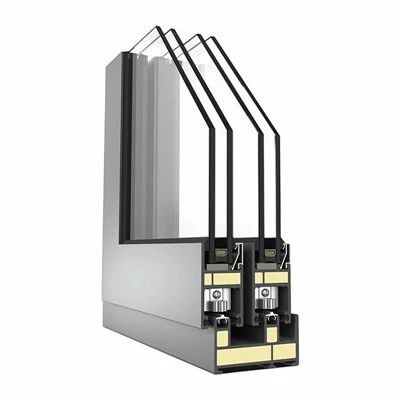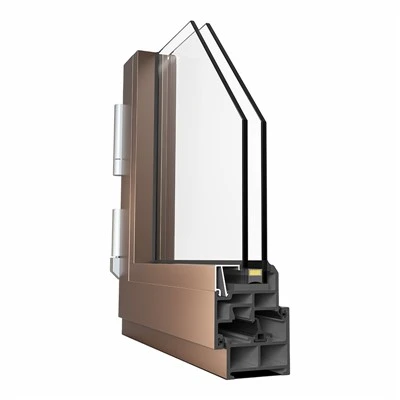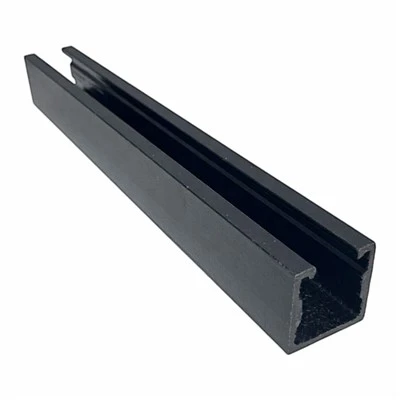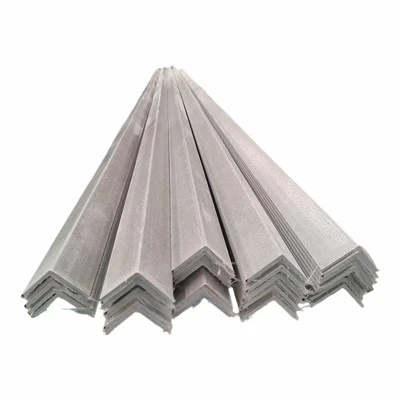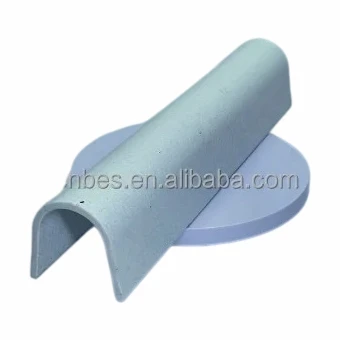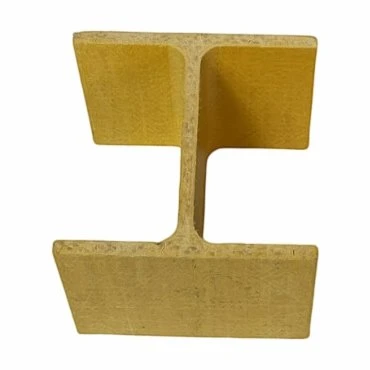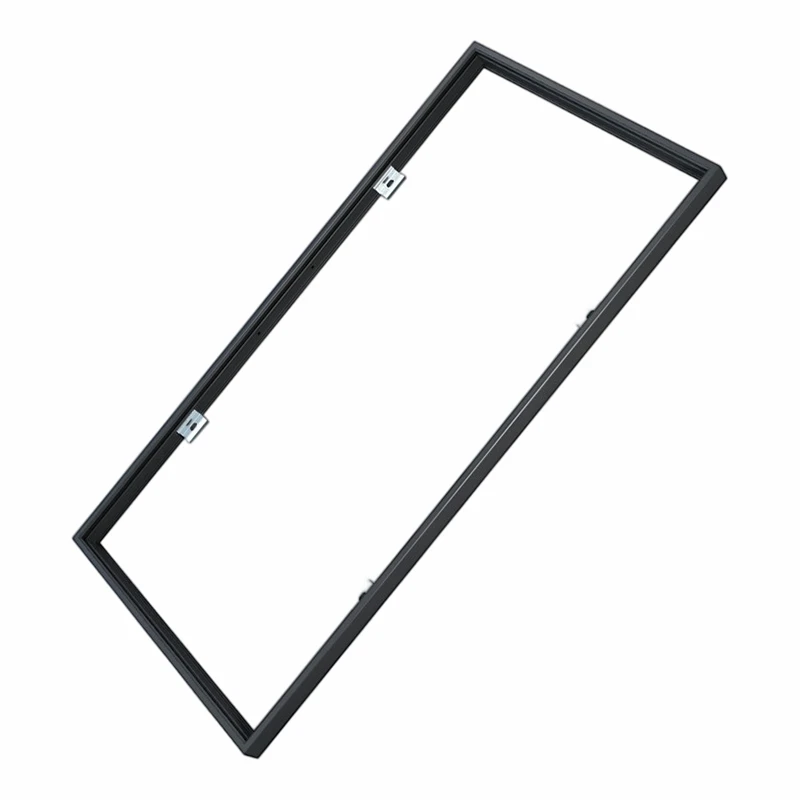


Henan Enbuess Composite Materials Co., Ltd. is one of the leading manufacturers and suppliers of frp solar panel frame in China. We are committed to providing high quality customized service for global clients. If you're going to buy high strength frp solar panel frame made in China, welcome to get free sample from our factory.
Is a composite frame the right call for your project?
You will get the most out of an FRP frame if any of these describe your site:
The array is coastal, offshore, floating, or inside a salt-spray zone
Ammonia or chemical exposure is expected - agrivoltaics, fish ponds, livestock barns
The roof has limited load-bearing reserve, or the building is an older structure
DC cable runs sit close to the frame, and earthing and bonding are adding real cost
Your financial model assumes 25–30 years with no frame replacement visit
You report embodied carbon - CBAM, green procurement rules, or an ESG mandate
Desert or high-irradiance sites with large day/night temperature swings
Large-format 182 mm or 210 mm modules where handling weight is the constraint
If none of these apply and your site is mild, dry and inland, an aluminium frame is probably still the cheaper choice. We will tell you that if you ask.
What you are actually buying
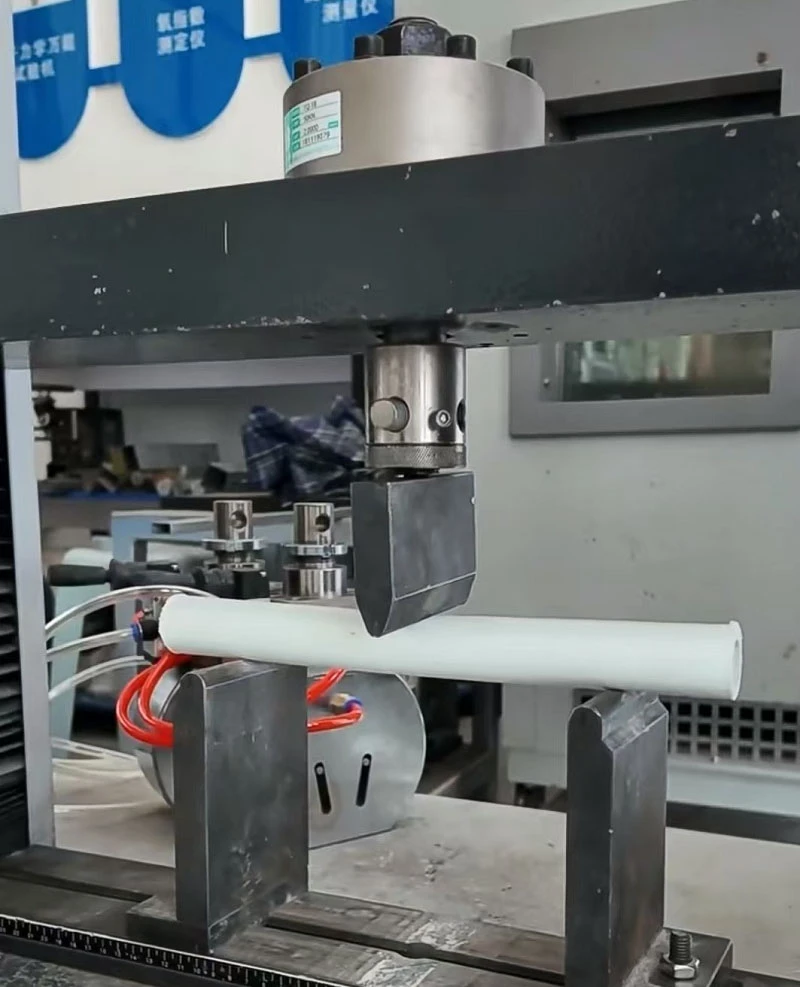
Pultrusion, and why it matters more than the datasheet.
Each profile is pultruded. Continuous glass-fibre roving is pulled through a resin bath and a heated die, so the fibre runs the full length of the section rather than being chopped and pressed. Fibre content lands between 75% and 85% by weight, and that is where the tensile strength comes from.
The resin system - polyurethane or epoxy, depending on the profile - carries its UV stabilisers and pigment through the entire cross-section. Colour is not a coating that wears off at the corners and cut ends. It is the same material all the way through, which is why a scratched FRP frame performs the same as an unscratched one.
Frames are supplied as cut lengths with corner keys, or as assembled four-sided frames ready for your lamination line, in mechanical, structural-adhesive or gasket-sealed configurations.
What changes on your project
Six differences that show up on the balance sheet, not just on the datasheet.
Corrosion stops being a maintenance line item
Galvanised steel in coastal service typically needs coating attention inside 8 to 12 years. Aluminium does not rust, but it pits under sustained salt spray and forms a galvanic couple wherever it meets a dissimilar metal. FRP has neither mechanism. No coating to renew, no anode to inspect, no corrosion allowance in the section. Tested to IEC 61701 salt spray, and beyond 3,000 hours of ASTM G154 UV-A exposure with colour shift (ΔE) below 3 and no chalking.
No grounding, no bonding, and less PID exposure
Volume resistivity ≥ 1×10¹⁴ Ω·cm, breakdown voltage above 8 kV. The frame cannot become an unintended current path, so it does not require earthing alongside DC cabling. That removes a line item from installation and removes one of the drivers of potential-induced degradation at the module edge - the failure mode that quietly costs high-voltage arrays several percent of output over time.
Weight savings you can measure in tonnes
An FRP section runs roughly 25–30% lighter than the equivalent aluminium profile, and about a quarter the weight of steel. On a 630–700 W module that is 0.6 to 1.2 kg removed per panel. Per panel it sounds trivial. Across a utility-scale array it shows up in three places: freight to a remote site, crew size for handling, and whether two people can carry a panel along a floating walkway without a lift plan.
Thermal expansion that matches the glass
Aluminium moves at roughly 23 × 10⁻⁶/°C. Photovoltaic glass moves at about 8.5 to 9 × 10⁻⁶/°C. Pultruded FRP sits in the 6 to 10 × 10⁻⁶/°C range. Every heating and cooling cycle loads the edge seal and the silicone bond. On double-glass bifacial modules, that bond is where long-term failure usually starts - not in the frame, but at the interface the frame is supposed to protect.
A frame that outlives the finance model
25+ years, maintenance-free, with no coating renewal cycle to budget for at year eight or year twelve. In environments aggressive enough to shorten an aluminium frame's life, the composite frame is the one component that is not on the replacement schedule. Over 25 years this is what turns a slightly higher unit price into a lower levelised cost. The comparison to make is lifecycle cost per watt, not purchase price per metre.
Embodied carbon you can put in a report
Primary aluminium carries roughly 16–24 tCO₂ per tonne of material depending on the smelter's power mix. Composite frame material sits far below that - published figures range from about 0.23 to 3.5 tCO₂ per tonne, and the spread is wide because the studies use different system boundaries. We are not going to quote you the flattering end of that range. Send us the boundary your ESG reporting uses and we will give you a number calculated the same way, with the working shown.
FRP vs aluminium vs galvanised steel
Typical values for standard pultruded profiles. Your section geometry and load case will change them.
|
Property |
FRP composite |
Aluminium |
Galvanised steel |
|
Density (g/cm³) |
2.1 |
2.7 |
7.85 |
|
Tensile strength (MPa) |
800–1,200 |
~250 (frame alloy) |
300–500 |
|
Weight vs aluminium |
−25% to −30% |
Baseline |
190% |
|
Behaviour in salt spray |
No corrosion mechanism |
Pitting; needs anodising |
Coating fails in 8–12 yrs |
|
Galvanic corrosion |
Not a failure mode |
Yes |
Yes |
|
Grounding required |
No |
Yes |
Yes |
|
PID contribution |
Insulating; negligible |
Conductive |
Conductive |
|
Thermal expansion (10⁻⁶/°C) |
6–10 |
~23 |
~12 |
|
Thermal conductivity (W/m·K) |
~0.5 |
~200 |
~50 |
|
Coating renewal cycle |
None |
5–10 yrs |
5–8 yrs |
|
Typical service life |
25–30 yrs |
30–50 yrs inland, shorter in salt |
15–25 yrs |
|
Embodied carbon |
Low |
High |
Medium |
One honest note: inland, in a mild climate, aluminium still outlasts composite on paper and still costs less per metre. This table is not a claim that FRP wins everywhere. It wins where corrosion, electrical insulation, weight or carbon is the binding constraint on your project.
Technical specification
Typical values for our standard pultruded profiles. We issue a project-specific datasheet with every quotation.
| Fibre content | 75–85% by weight | Volume resistivity | ≥ 1×10¹⁴ Ω·cm |
| Density | 2.05–2.1 g/cm³ · ASTM D792 | Breakdown voltage | ≥ 8,000 V |
| Tensile strength (long.) | ≥ 850 MPa · GB/T 1447 | Flame resistance | V-0 / V-1 · UL 94 |
| Tensile modulus (long.) | ≥ 40 GPa | Service temperature | −40 °C to +100 °C |
| Flexural strength (long.) | ≥ 850 MPa · GB/T 1449 | Mechanical load (module) | 5,400 Pa / 2,400 Pa · IEC 61215 |
| Flexural modulus | ≥ 40 GPa | Salt spray | Severity 6–7 · IEC 61701 |
| Barcol hardness | ≥ 55 HBa | Aging sequences | DH2000 · TC200 · HF20 · UV300 |
| Straightness | ≤ 1 mm/m | Wall thickness | 3–10 mm, custom on request |
We will show you the test report behind each number. If a property on this list has not been measured on your specific profile, we will say so rather than extrapolate.
Where these frames are specified
Five environments where the specification decision is straightforward.
Offshore and floating PV
Salt spray is continuous and maintenance access is expensive and weather-dependent. This is the strongest economic case for composite: the cost of getting a crew back out to the array exceeds any saving on the frame.
Coastal ground-mount
Salt air penetrates galvanised coatings at ground level within two to three years. FRP performs identically at the coast and inland, which removes site exposure from the material selection decision entirely.
Agrivoltaics and fishery-PV
Fertilisers, pesticides, organic acids and ammonia create a chemically aggressive environment at ground level and under barn roofs. Composite is unaffected by soil and groundwater chemistry in the way that accelerates steel corrosion.
Rooftop and BIPV
Weight is often the binding constraint on older industrial roofs. A 25–30% reduction can be the difference between a feasible retrofit and a structural upgrade. Insulation also simplifies compliance where DC runs sit close to the frame.
Desert and high-irradiance
Large day/night temperature swings load the edge seal. Composite expansion closely tracks glass, reducing thermal cycling stress on the laminate. UV stability runs through the full cross-section, not as a surface layer.
High-voltage utility arrays
Where string voltages are high and PID is a modelled loss, the insulating frame removes the edge leakage path and the earthing hardware that goes with it.
Built to your module, not to our catalogue
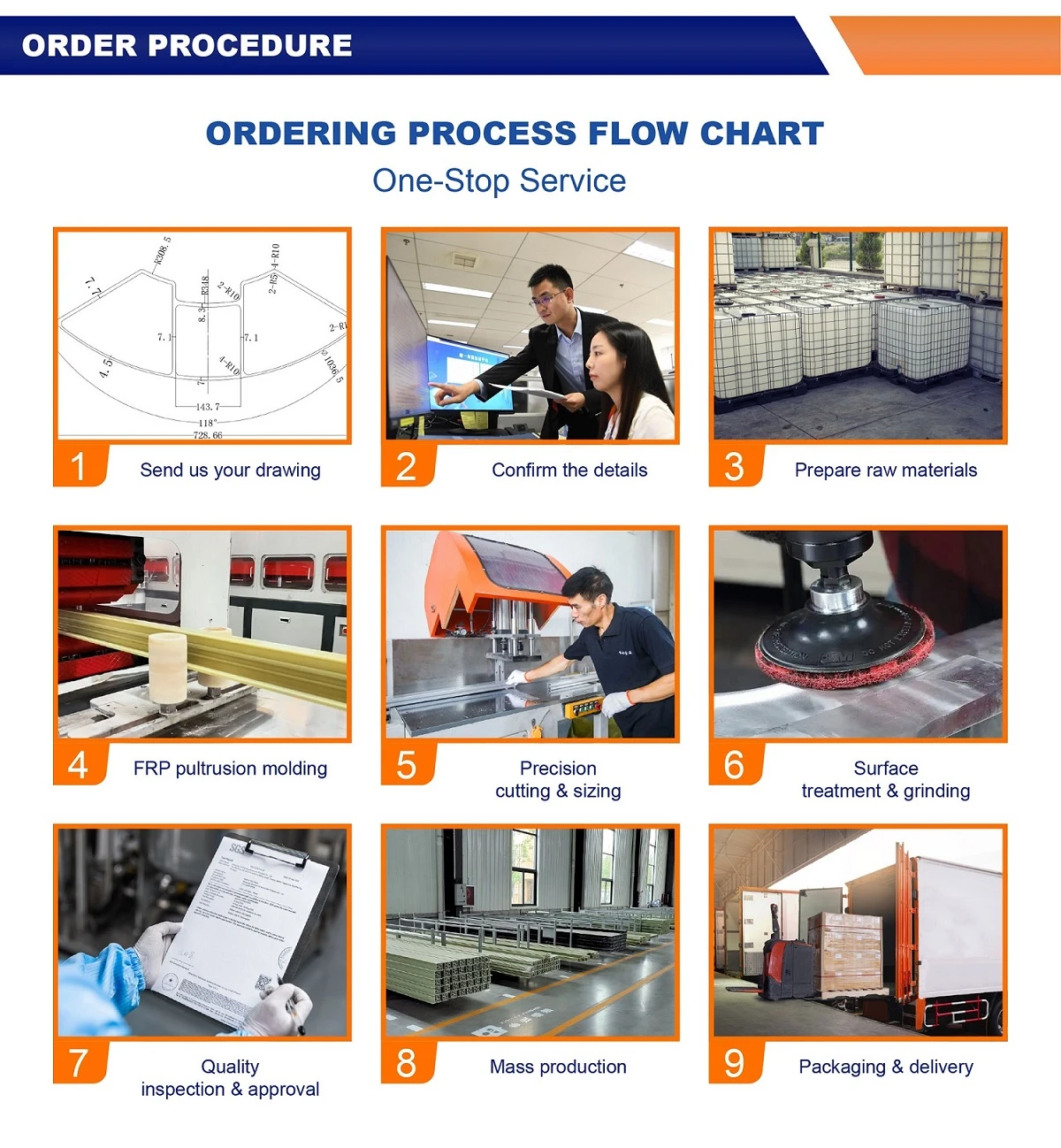
Send us your module drawing or an existing frame sample. We will return a section drawing and a mechanical check within 7 working days.
Section geometry developed from your drawing, or reverse-engineered from a sample
Corner assembly: mechanical keys, structural adhesive, or gasket-sealed
Compatible with 182 mm and 210 mm cell formats, TOPCon, HJT and double-glass bifacial
Post-processing: drilling, slotting, chamfering, notching to your hole schedule
Length and width cut to your laminate dimensions
Surface coating: two-component polyurethane, fluorocarbon or epoxy
Wall thickness 3–10 mm, engineered against your wind and snow load case
Packaged for export with impact protection at vulnerable edges
Colour matched to any RAL code or physical sample; matte or gloss finish
MOQ 1,000 m · sample policy Free samples
Testing and traceability
Every production batch is traceable to its resin lot and fibre delivery.
Mechanical properties are verified in-house on each run. These are the third-party reports we supply with your quotation:
IEC 61215 - mechanical load, damp heat, thermal cycling, UV sequences
IEC 61701 - salt spray corrosion
IEC 61730 - construction and fire behaviour
UL 94 - flame classification
Certificates available on request
Full test reports are available on request. If your EPC or lender needs a specific protocol run, tell us which one and we will quote it as a separate line item.
Production Process


Questions engineers ask us
Including the ones that do not flatter us.
Is FRP strong enough to replace aluminium?
On tensile strength, yes - pultruded composite runs 800–1,200 MPa against roughly 250 MPa for typical frame aluminium. On elastic modulus, no: composite is around 40 GPa against aluminium's ~69 GPa. That means an FRP section needs a slightly deeper profile to reach the same stiffness. We size the geometry against your load case with CAE and confirm it against IEC 61215 mechanical load testing. If you swap frames one-for-one without re-engineering the section, it will deflect more. That is the single most common mistake we see in composite frame specifications.
Do composite frames need grounding?
No. Volume resistivity above 1×10¹⁴ Ω·cm means the frame cannot act as a current path, so it does not require earthing or bonding in the way metal frames do near DC runs. This also removes frame-borne leakage current as a contributor to PID.
How does the price compare per watt?
Per metre, composite generally sits below aluminium and above galvanised steel. Per watt over a 25-year lifecycle, it depends almost entirely on your environment. Inland and mild, aluminium usually still wins on cost. Coastal, offshore or agricultural, the maintenance and replacement savings usually dominate. We will build the comparison for your specific site rather than hand you a generic percentage.
Do composite frames pass IEC 61215 and IEC 61730?
Yes, when the module is built and tested as a system. The frame alone is not certified - certification attaches to the finished module. Composite-framed modules have been certified by TÜV, VDE and SGS. We supply the test data your certification body will ask for.
How is the corner joint made?
Three options, selected by your lamination line and exposure class: mechanical corner keys, structural adhesive, or gasket-sealed assembly. For coastal and offshore we generally recommend adhesive or gasket-sealed, because mechanical keys introduce a fastener and a dissimilar-material contact point.
Will the colour fade?
UV stabiliser and pigment run through the full cross-section rather than sitting on the surface. Accelerated testing shows ΔE below 3 after 3,000 hours of UV-A exposure, which is below the threshold most observers notice.
What is the lead time?
2–4 weeks from drawing approval. Repeat profiles ship faster. Custom dies take 4–6 weeks to tool.
What happens at end of life?
Composite frames are recyclable through established mechanical and chemical recycling routes for glass-fibre composites. Mechanical grinding produces filler material; chemical routes recover the fibre. This is less economically attractive than aluminium recycling, where scrap value is high - that is a real trade-off and we would rather state it than have you discover it later.
Tell us where the project is
Send your module drawing, frame sample or load case. We will come back with a section drawing, a mechanical check, and a costed comparison against your current frame. No generic brochure.
Hot Tags: frp solar panel frame, China frp solar panel frame manufacturers, suppliers, factory