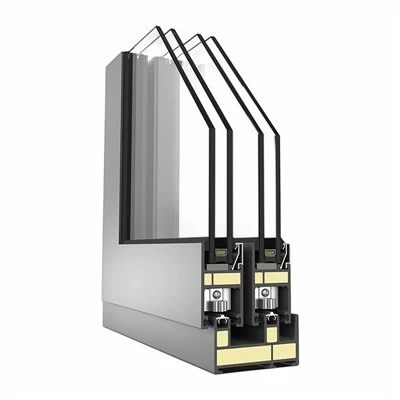
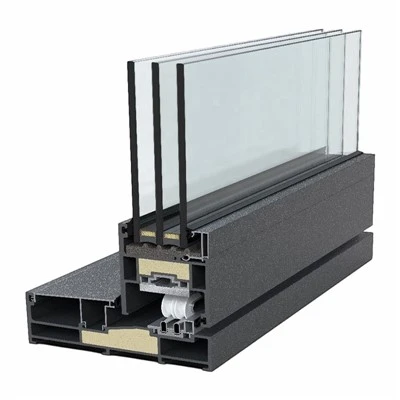
Lightweight and High-Strength
The density of FRP (Fiber-Reinforced Plastic) profiles is approximately 1.7-four to five times lighter than steel-yet they possess high strength. Their tensile strength ranges from 350 to 450 MPa, comparable to ordinary carbon steel, with a flexural strength of 388 MPa and a flexural modulus of 20,900 MPa; consequently, no steel reinforcement lining is required. Testing of "Beijing Shengfeng Yangguang" brand FRP windows shows a wind pressure resistance of 5.3 kPa, exceeding the Grade 8 level specified in the GB/T 7106-2002 national standard.
Energy Efficiency and Thermal Insulation
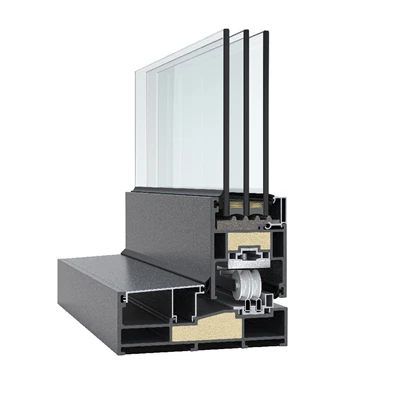
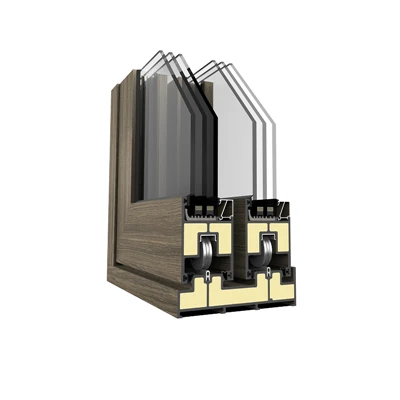
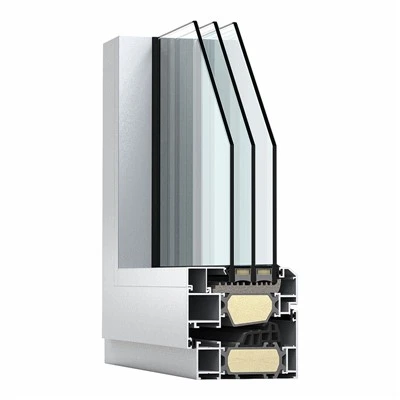
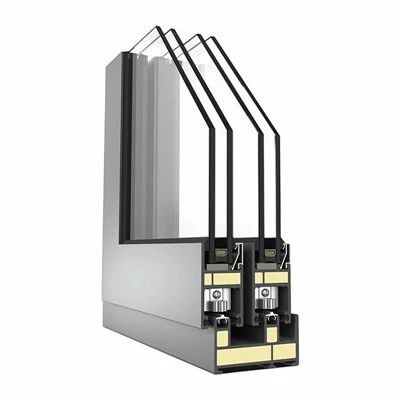
FRP profiles have a thermal conductivity of 0.39 W/(m·K)-only 1/100 to 1/1000 that of metal-making them excellent thermal insulation materials. Furthermore, the profiles feature a hollow-chamber structure, and all gaps are sealed with rubber strips and weatherstripping, resulting in outstanding thermal insulation performance. Test results indicate the following heat transfer coefficients (K0): 2.2 W/(m²·K) for FRP casement windows (single-frame, double-glazed), meeting the Grade 8 level of GB/T 8484-2002; 1.8 W/(m²·K) for FRP casement windows (single-frame, triple-glazed), meeting the Grade 9 level; and 1.3 W/(m²·K) for FRP casement windows (single-frame, triple-glazed with low-emissivity glass), meeting the Grade 10 level.
Excellent Sealing Performance
During assembly, the corner joints of FRP doors and windows are secured using a combination of adhesive bonding and mechanical fastening. Additionally, all gaps are sealed with rubber strips and weatherstripping. Combined with the unique profile structure, these features ensure superior sealing performance. Testing by the National Center for Quality Supervision and Inspection of Building Engineering, the Beijing Quality Supervision and Inspection Station for Architectural Hardware and Plumbing Products, and the Beijing Construction Engineering Quality Testing Center confirmed that the air-tightness meets Grade 5 requirements and the water-tightness meets Grade 3 requirements under the national standard GB/T 7107–2002.
Healthy, eco-friendly, and highly energy-efficient
Test results for the fiberglass (FRP) door and window profiles comply with the requirements for primary building materials specified in GB 6566–2001 ("Limits of Radionuclides in Building Materials"), with an internal exposure index of 0.2 and an external exposure index of 0.2.
Excellent sound insulation
Testing by the National Center for Quality Supervision and Inspection of Building Engineering showed that "Beijing Shengfeng Yangguang" brand fiberglass windows (with double and triple glazing) achieved weighted sound reduction indices (Rw) of 36 dB and 39 dB, respectively, corresponding to a Grade 4 sound insulation rating.
Corrosion resistance
Fiberglass is an excellent corrosion-resistant material; it offers strong resistance to acids, alkalis, salts, most organic compounds, seawater, and humidity, as well as to the effects of microorganisms. These properties make it particularly suitable for use in rainy, humid, and coastal regions, as well as in environments exposed to corrosive agents.
Good dimensional stability
The linear expansion coefficient of fiberglass profiles is 7.3 × 10⁻⁶/°C-lower than that of steel or aluminum alloys [1] and one-fifteenth that of standard plastics. Consequently, fiberglass doors and windows exhibit excellent dimensional stability, ensuring that temperature fluctuations do not impair their normal opening and closing functions.
Good weather resistance
Fiberglass is a thermosetting plastic; upon cross-linking, the resin forms a three-dimensional network molecular structure, creating an insoluble and infusible material that does not melt when heated. Fiberglass profiles have a heat distortion temperature exceeding 200°C, demonstrating excellent high-temperature resistance, and perform even better at low temperatures.
Good insulation properties
Fiberglass is an excellent insulating material; it is unaffected by electromagnetic waves, does not reflect radio waves, allows for good microwave transmission, and can withstand high voltages without damage. Therefore, fiberglass doors and windows are particularly suitable for temporary structures in the field and for buildings housing communication systems.
Good vibration-damping performance
Fiberglass profiles possess a modulus of elasticity of 20,900; doors and windows made from them exhibit high vibration-damping frequencies. The bond between the resin and fibers within the material provides shock-absorbing and seismic-resistant capabilities, preventing premature structural failure caused by resonance during operation.
Rich color options
Fiberglass profiles feature high hardness and can be finished with various coatings to produce doors and windows in a wide range of colors, catering to the aesthetic requirements of building facades across different styles and quality grades.