

PU frame for PV modules, designed as a direct-replacement for the aluminum frame in the module bill of materials. Same corner-key geometry, same mounting interface, no oxidation in salt air, and up to 30 % mass reduction per module - which compounds across every shipping container that leaves your plant.
Request an evaluation kit Download datasheet
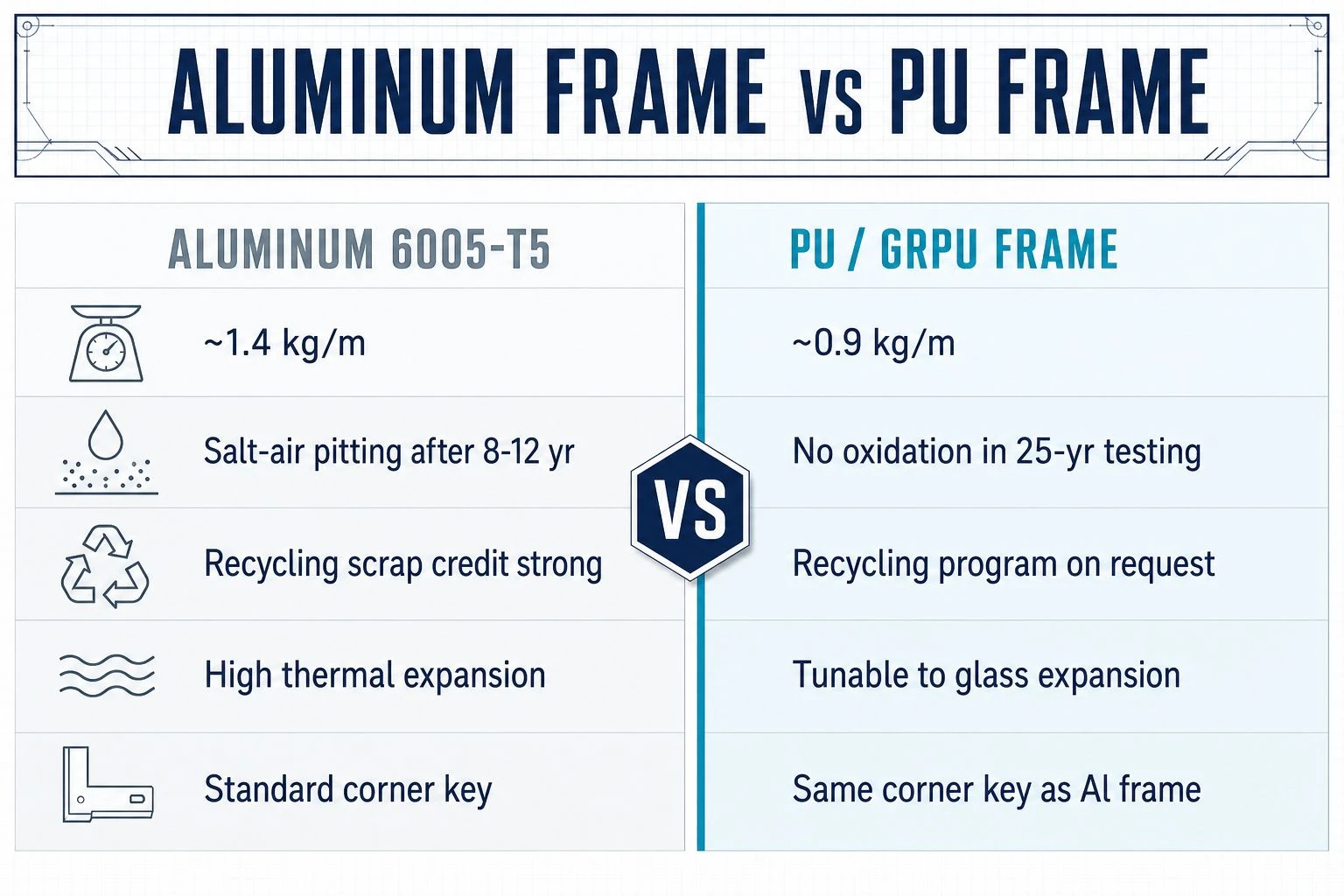
ALUMINUM FRAME vs PU FRAME
Al 6005-T5, ~ 1.4 kg/m vs PU composite, ~ {{0.9}} kg/m
Salt-air pitting after 8–12 yr vs No oxidation in 25-yr testing
Recycling scrap credit strong vs Recycling program on request
High thermal expansion vs Tunable to glass expansion
Standard corner key vs Same corner key as Al frame

What the buyer is trying to solve
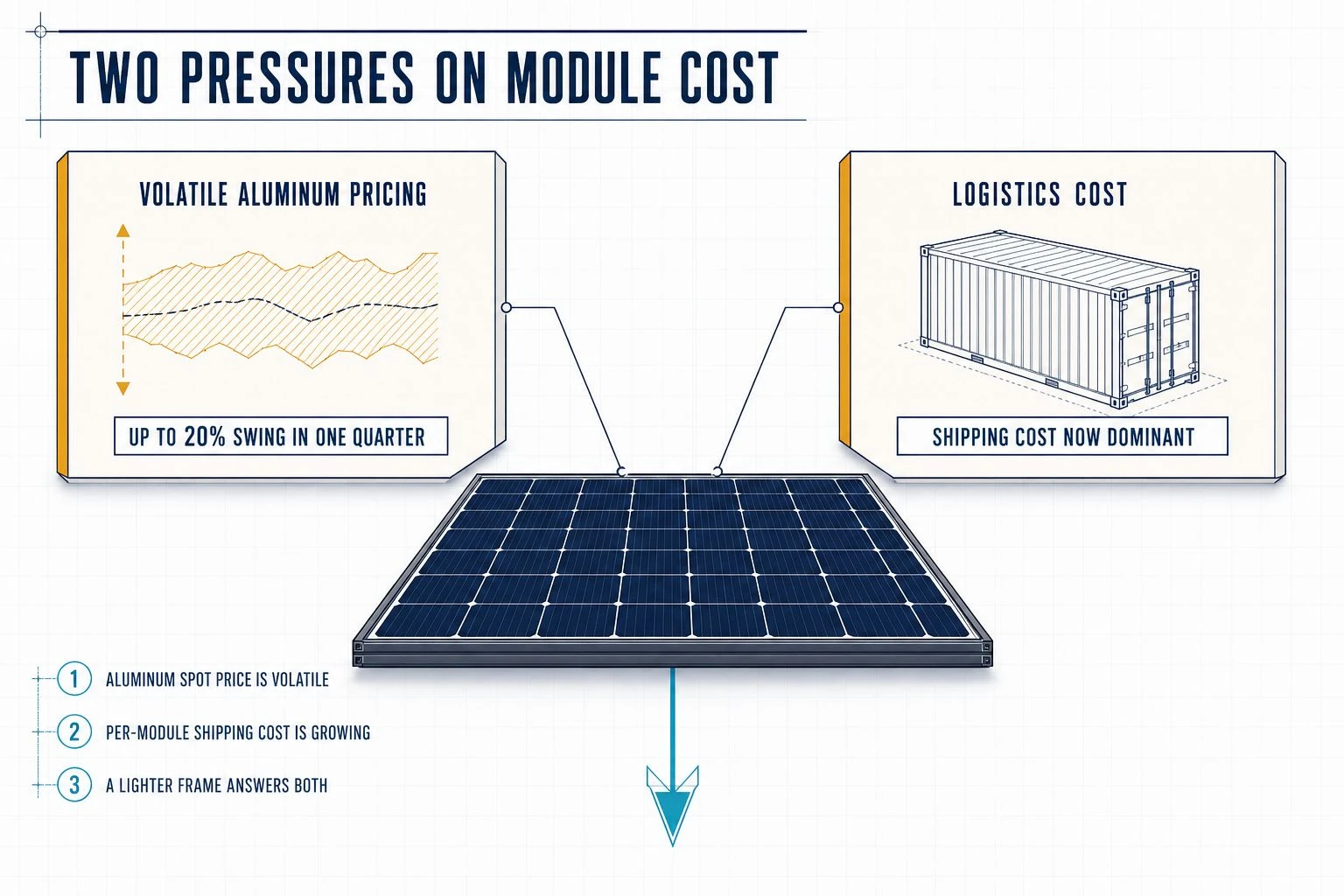
Why module manufacturers are evaluating PU frames now.
The buyers who arrive at this page are module product engineers, packaging engineers, and procurement leads at PV module makers. They are evaluating PU frame as an alternative to aluminum because the value chain is moving in two directions at once: aluminum frame price is volatile and global supply is concentrated, while the per-module shipping cost is increasingly dominant for overseas-built modules. A lighter, non-oxidizing frame that drops into the existing assembly line is the right answer to both.
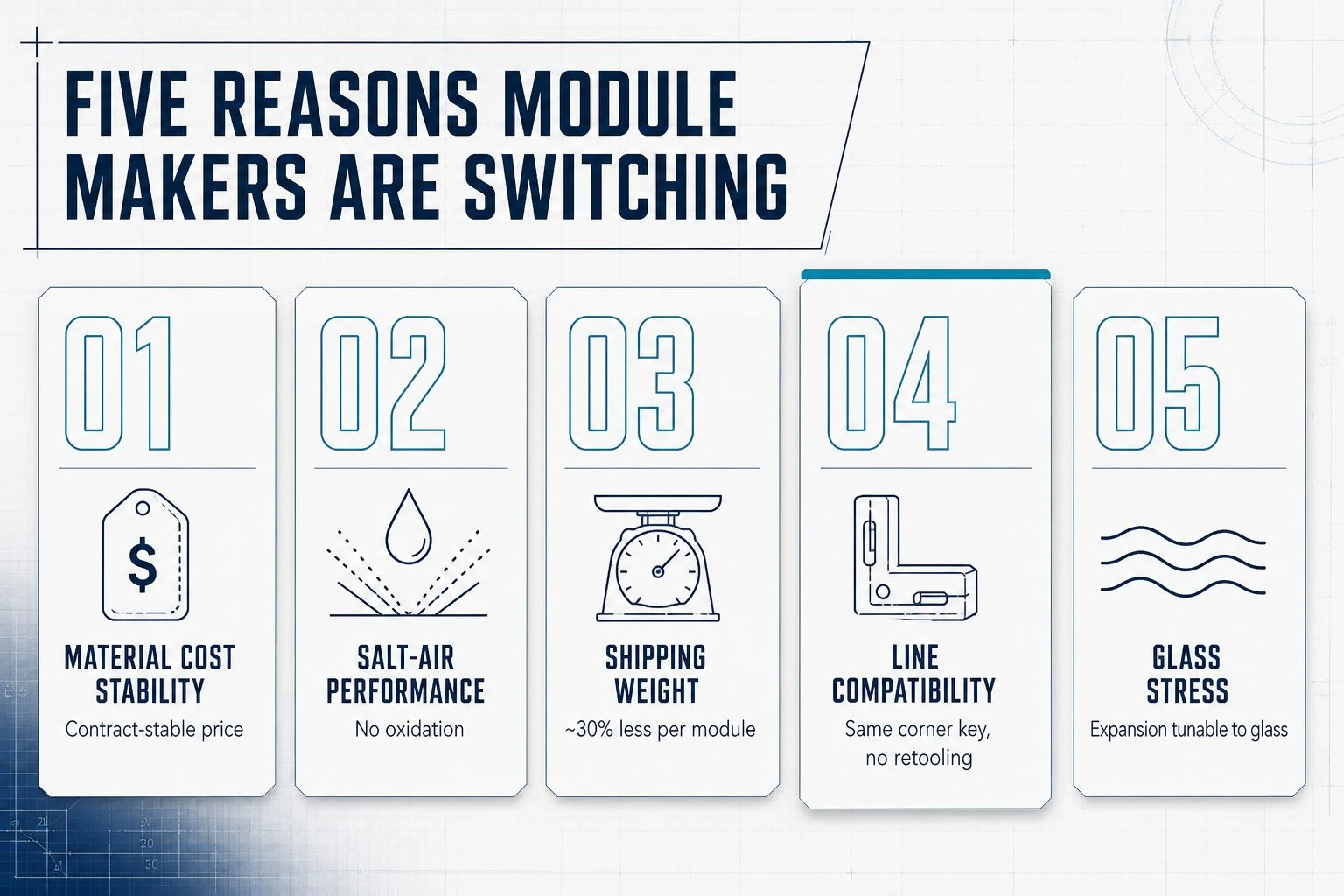
Five reasons module makers are switching
Material cost stability
Aluminum spot price can swing 20 % in a quarter. PU composite price is contract-stable.
01
Salt-air performance
Coastal and tropical sites see Al pitting; PU does not oxidize.
02
Module shipping weight
~ 30 % less per module compounds across the entire container.
03
Assembly line compatibility
Same corner key, same mounting holes, no line retooling.
04
Glass-module stress
PU thermal expansion tunable to glass reduces glass stress at hot cycles.
05
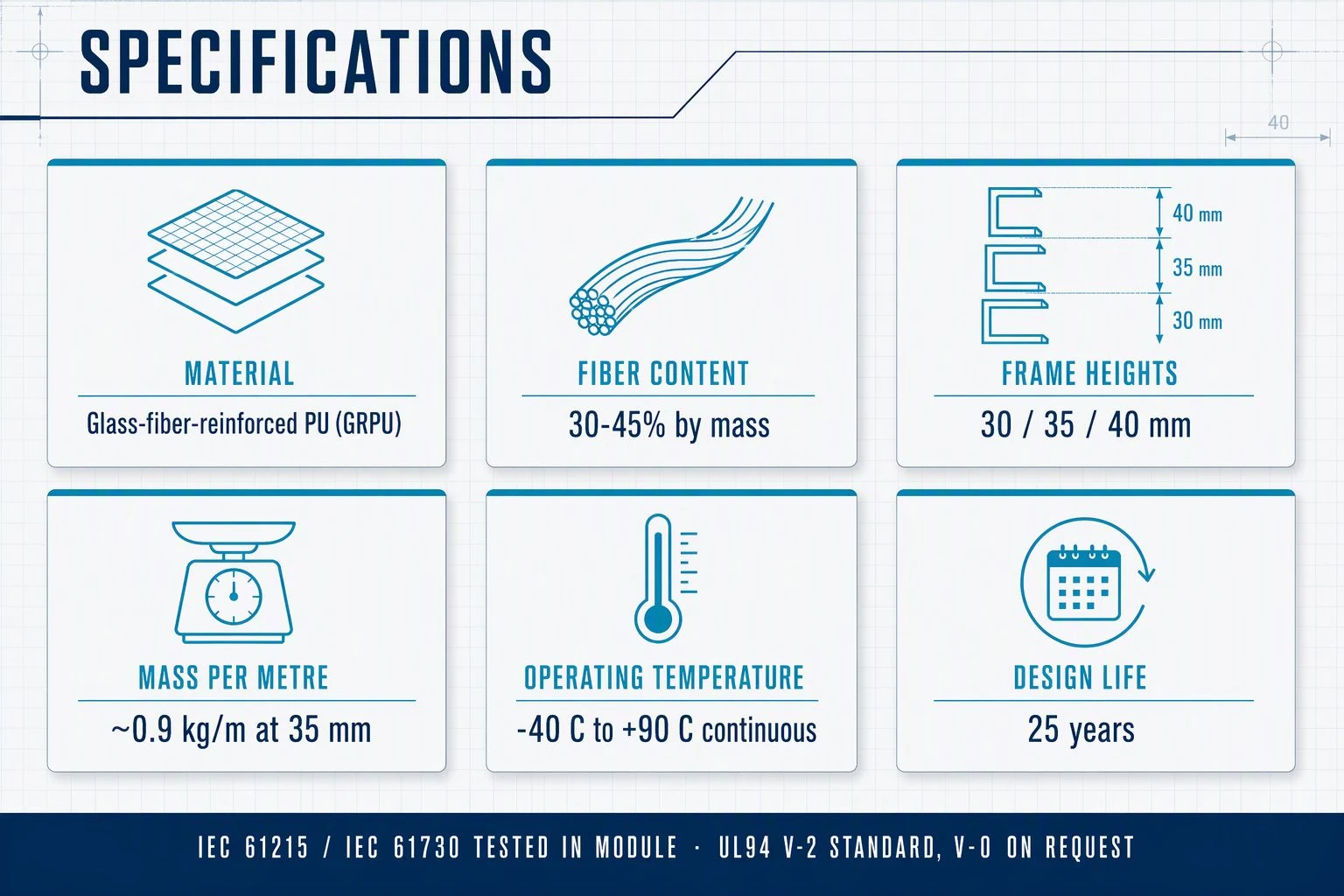
Specifications
|
Material |
Glass-fiber-reinforced polyurethane (PU / GRPU) |
|
Fiber content |
{{30–45}} % by mass, depending on profile (verify per part drawing) |
|
Cross-section family |
30 / 35 / 40 mm frame height; standard module sizes from cell-format to bifacial large-format |
|
Corner-key geometry |
Drop-in replacement for Al 6005-T5 standard corner key; M6 / M8 pin compatible |
|
Mounting holes |
Same pattern as Al frame; pre-drilled to OEM specification |
|
Drainage holes |
Standard pre-drilled locations; custom patterns on request |
|
Grounding |
WEEB-style grounding clip compatible; bonding path engineered separately per project |
|
Mass per metre (35 mm frame) |
~ {{0.9}} kg/m vs aluminum {{1.4}} kg/m |
|
Tensile strength |
{{verify published value}} MPa (ASTM D638) |
|
Flexural strength |
{{verify published value}} MPa (ASTM D790) |
|
Thermal expansion coefficient |
Tunable in {{15–25}} × 10⁻⁶ / K range; can be matched to glass for reduced glass stress |
|
UV package |
UV-9 inhibitor integral; UV-stable topcoat on visible surfaces |
|
Flammability |
UL94 V-2 standard; UL94 V-0 on request |
|
Operating temperature |
−40 °C to +90 °C continuous |
|
IEC qualification |
Tested in module to IEC 61215 / IEC 61730 (test reports on request) |
|
Color |
Black standard; silver or anodized-effect on request |
|
Design life |
25 years |
When not to specify PU frame
Cases where the aluminum frame is still the right call.
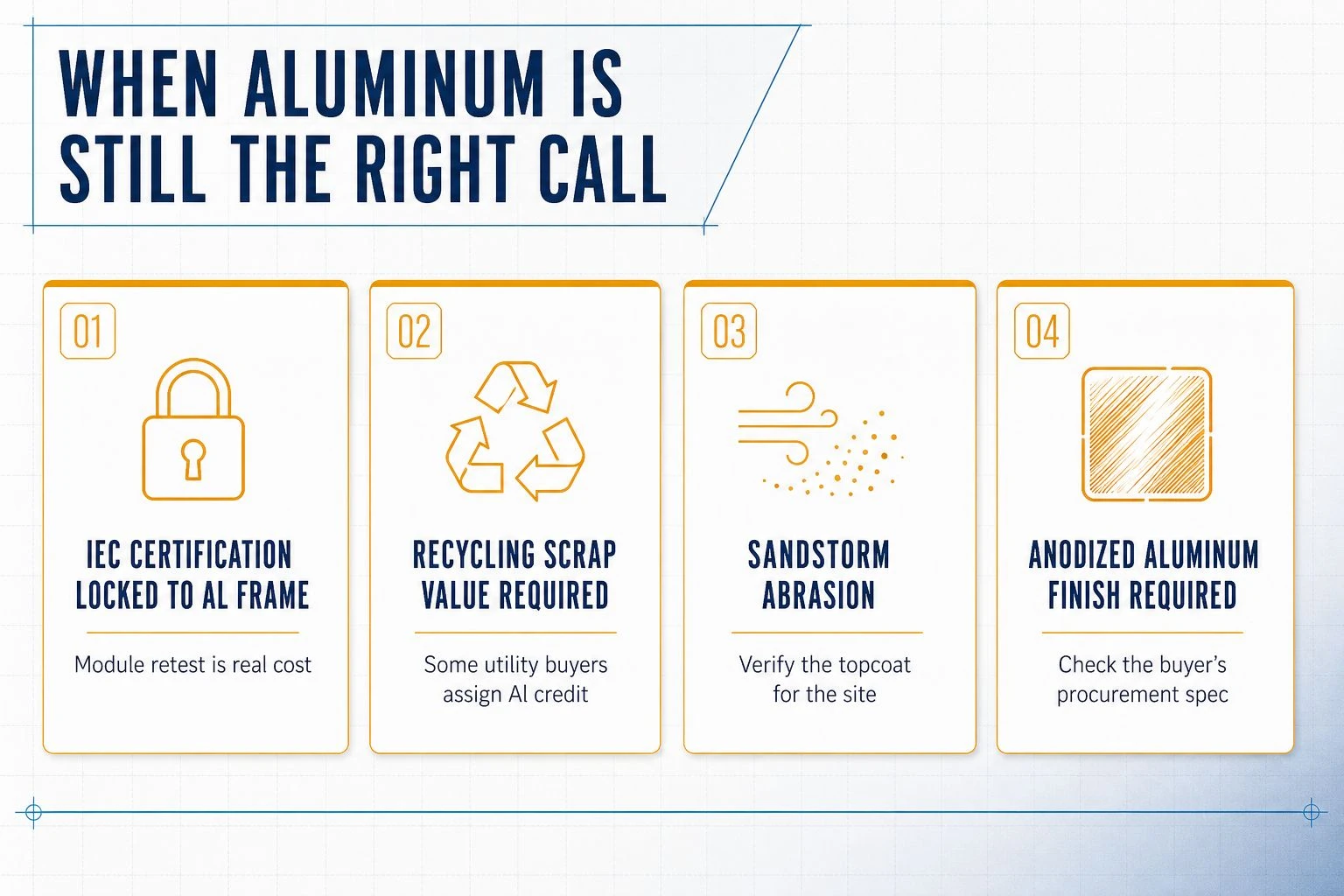
Four cases where aluminum remains correct
- The OEM's IEC certification is locked to Al frame. If your module is IEC-certified with the Al frame and you have not yet run the IEC retest with PU frame, do not switch without re-certification. The test cycle is real cost.
- Project requires aluminum-recycling scrap value. Some large utility buyers assign value to the aluminum frame scrap credit at end of life. PU frame recycling value is lower (and varies by region). Ask the buyer.
- Sandstorm abrasion. PU composites can be abraded by repeated sand-blast in extreme desert sites. We provide a topcoat upgrade; verify the topcoat is rated for the specific site.
- Customer end-buyer requires anodized aluminum finish. Some institutional buyers specify aluminum visual finish in their procurement specs. Check with the buyer's spec before substituting.
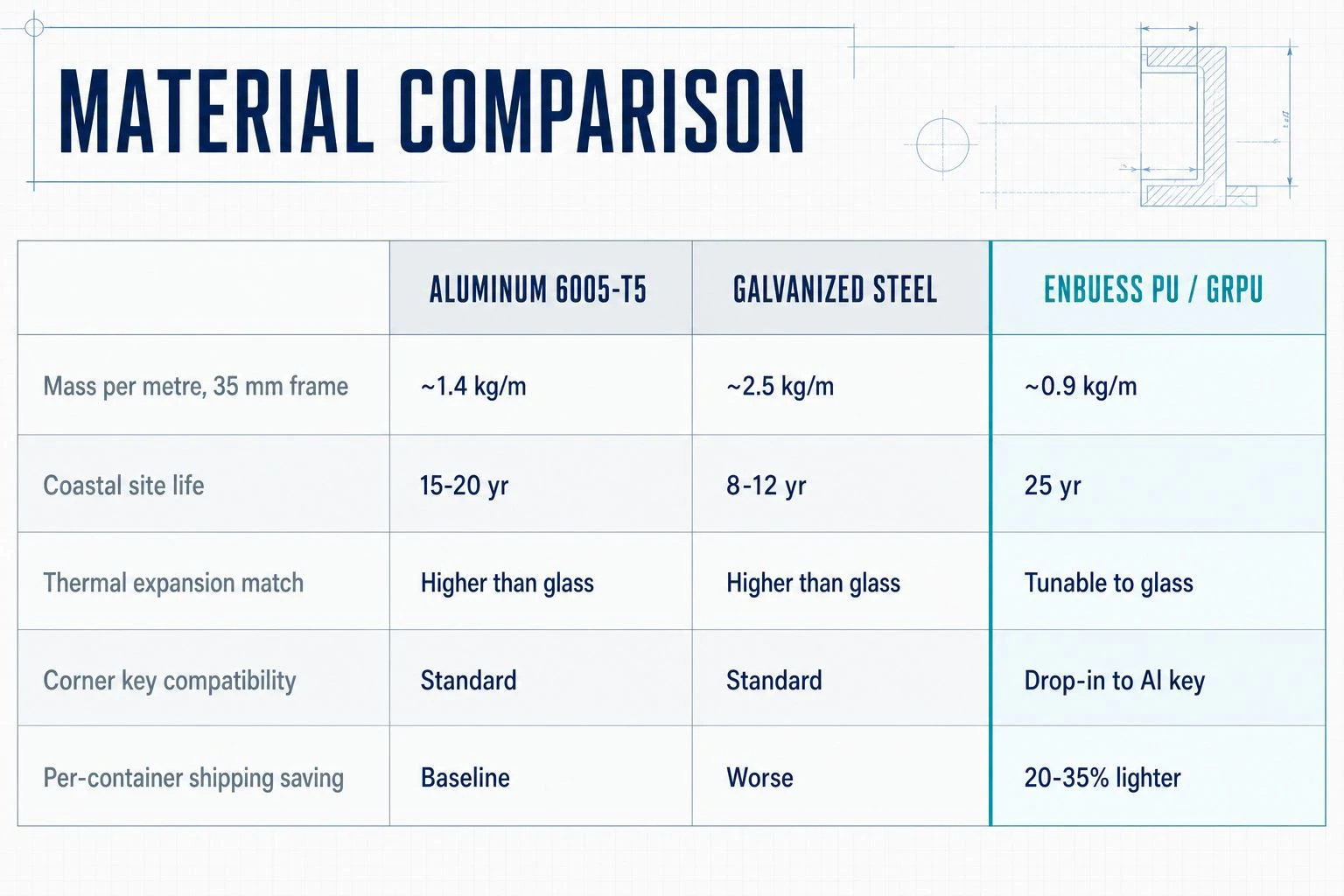
Material comparison
|
Property |
Aluminum 6005-T5 |
Galvanized steel |
Enbuss PU / GRPU frame |
|
Mass per metre (35 mm frame) |
~ 1.4 kg/m |
~ 2.5 kg/m |
~ {{0.9}} kg/m |
|
Coastal site life |
15–20 yr (pitting) |
8–12 yr (rust) |
25 yr |
|
Thermal expansion match to glass |
Higher than glass |
Higher than glass |
Tunable to glass |
|
Corner key compatibility |
Standard |
Standard |
Drop-in to Al corner key |
|
Capex vs Al baseline |
Baseline |
~ {{0.7}}× |
~ {{0.9–1.1}}× depending on module size |
|
Per-container shipping saving (typical) |
Baseline |
Worse (less weight saving) |
{{20–35}} % lighter |
|
IEC 61215 / 61730 qualification |
Standard |
Less common |
Test reports on request |
Customization & OEM
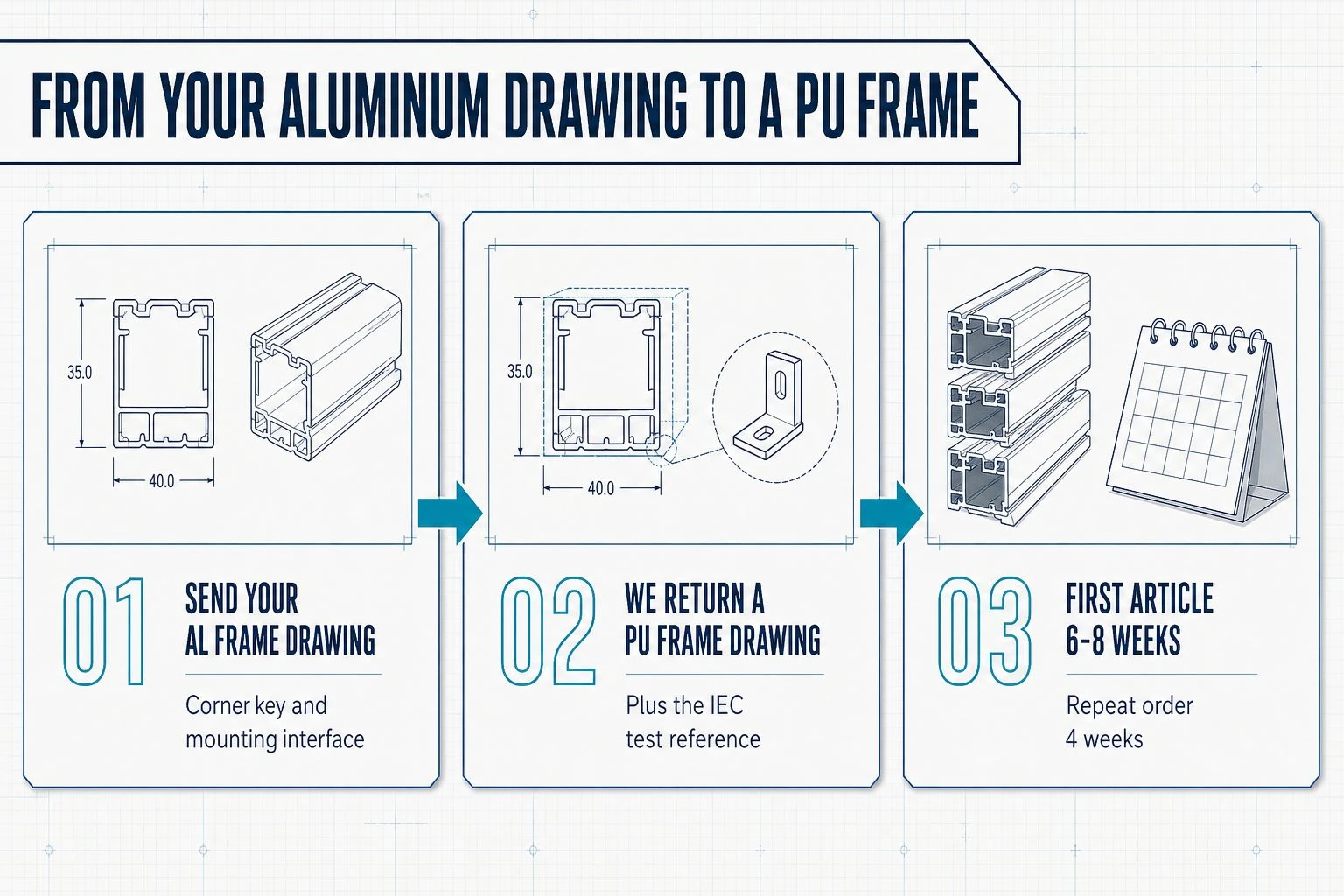
Module makers buy from a profile drawing. Send your existing Al frame drawing and we return a PU frame drawing with the same corner-key and mounting interface, plus the IEC test report. First article {{6–8}} weeks; repeat {{4}} weeks. OEM kitting by project available.
Frequently asked questions
What is the typical lead time for an evaluation kit?
Evaluation kit (10 frames in your chosen module size) ships in {{3–4}} weeks. Production order lead time {{6–8}} weeks for first article, {{4}} weeks for repeat.
Does the PU frame pass IEC 61215 mechanical load testing?
Yes, when the frame is part of the module assembly that has been IEC-tested. We provide the frame-level test reports and the module-level test results from our reference module partners; final IEC 61215 / 61730 qualification of the assembled module is the module maker's responsibility.
How does the PU frame behave at end of life?
PU composite can be shredded and used as filler in non-structural concrete, or chemically recycled through glycolysis to recover polyol. We offer a take-back program in pilot regions.
Is the PU frame compatible with bifacial modules?
Yes. The same PU profile works with bifacial glass-glass modules. The frame edge geometry is the same.
What about grounding?
PU is non-conductive. Grounding must use a separate bonding clip (WEEB or equivalent). We supply a bonding-clip-compatible geometry on request. Project grounding path is engineered by the electrical designer.
Can the PU frame be supplied in custom color?
Yes, full RAL range on the visible topcoat. Black standard for shipping. Other RALs add {{2}} weeks to first article.
How is the frame inspected in service?
Visual at annual maintenance. Any visible crack, fiber exposure, or UV chalking deeper than cosmetic is grounds for replacement. The failure mode is mechanical, not chemical.
What is the warranty?
10 years on the PU frame against material failure, separate from the module warranty. Specific terms depend on module size and site class.
Send your aluminum frame drawing
Send the existing Al frame drawing with the corner-key and mounting interface. We return a PU frame drawing, the IEC test reference, and a fixed quote for an evaluation kit.
