

Composite structural envelope, fill support, water distribution, and louver wall for industrial induced-draft cooling towers. Sized for utility, chemical, power, and steel-mill applications where the alternative - concrete + coated steel - fails inside the asset life.
What the buyer is trying to solve
Why plant owners specify FRP cooling towers.
The buyers who arrive at this page are plant managers, EPC contractors, and water-system engineers specifying a new cooling tower or replacing a concrete-and-steel one that has reached end of life. Their existing tower has one or more of: concrete shell spalling from sulfate attack, coated steel structural members rusting beneath the failed coating, FRP fill support cracking, water distribution system corroding at the pipework. They want a tower where the envelope, the structure, and the water-contact surfaces all survive the chemistry of the cooling water and the surrounding atmosphere for the next 25 years.
Industries where FRP cooling towers are the standard answer
Chemical & petrochemical
Acid mist, salt, and process-water carryover - concrete shell degrades within {{10–15}} yr.
Power generation
FGD absorber service platforms, cooling-water makeup, high-temperature plume.
Steel & metallurgical
Mill service water, acid pickling line cooling, sulfate- and chloride-laden.
Pulp & paper
Chemical pulping line cooling, bleach plant effluent, high-TDS water.
Coastal / salt-air sites
Salt-spray plume; concrete shell suffers chloride attack; FRP is the standard answer.
Desalination plants
Brine and concentrate cooling; high-TDS, high-chloride; FRP envelope is typical.
WHAT WE SUPPLY
The cooling tower, component by component
Enbuss supplies the FRP parts; the fill, fan, and motor are sourced to your specification.
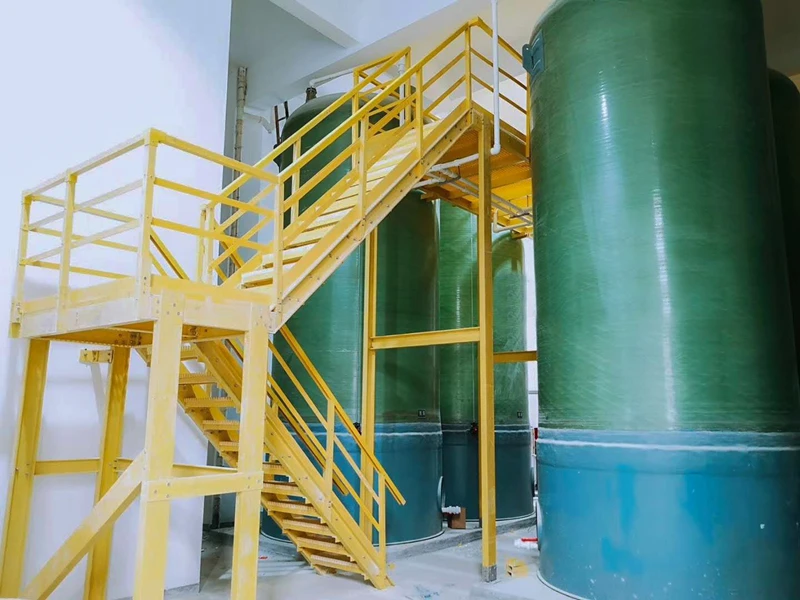
Enbuss is the FRP structural supplier. We design and manufacture the parts where FRP is the answer: the envelope, the structural frame, the fill support, the water distribution system, and the louver wall. The fan, gearbox, motor, drift eliminator, and fill media are typically supplied to your specification by the project mechanical engineer. We coordinate the FRP package with those suppliers on the project drawing.
FRP envelope / casing
Pultruded or hand-laid FRP panels, in standard widths. Integral color; UV-stable; chemical-resistant.
01
Structural frame
Pultruded FRP I-beams, columns, and bracing sized to the wind and seismic load case.
02
Fill support
FRP grating or pultruded bar grid sized to the fill-media load and access requirements.
03
Water distribution piping
FRP header and branch piping for water distribution above the fill; chemical-resistant.
04
Louver wall
FRP louvers for the air-inlet face; see the FRP louver product page for the geometry options.
05
Fan stack & cylinder
FRP fan cylinder with integral stiffeners, sized to the fan geometry.
06
Drift eliminator support
FRP support frame for the drift eliminator; standard configurations.
07
Access ladder & platform
FRP internal ladder and service platform; ties in to the FRP industrial ladder and platform pages.
08
Size envelope
The size envelope below is what Enbuss currently supplies. Outside this envelope we are happy to talk, but lead time grows and tooling cost may apply.
|
Tower size class |
Approx. cooling duty |
Cell footprint |
Tower height |
Lead time |
|
Small industrial (single cell) |
{{500 kW – 2 MW}} |
≤ 4 × 4 m |
≤ 6 m |
{{12–16}} weeks |
|
Mid industrial (single or twin cell) |
{{2 – 10 MW}} |
≤ 6 × 6 m |
≤ 8 m |
{{14–20}} weeks |
|
Large industrial (multi-cell) |
{{10 – 50 MW}} |
≤ 10 × 10 m per cell |
≤ 12 m |
{{18–28}} weeks |
|
Utility mechanical-draft |
{{50 – 200 MW}} |
Outside current envelope |
Outside current envelope |
Project basis - please call |
|
Natural-draft hyperbolic |
{{200 MW+}} |
Outside current envelope |
Outside current envelope |
Specialized supplier required |
When we are not the right supplier
Cases where a different cooling-tower specialist is correct.
Three cases where Enbuss redirects
- Utility-scale mechanical-draft above {{50 MW}} per cell. These projects are typically engineered, procured, and constructed by a dedicated cooling-tower OEM that supplies the whole package including the fan, gearbox, and motor. We can name two or three suppliers if needed.
- Natural-draft hyperbolic towers. Concrete hyperbolic cooling towers are built by a specialized civil contractor; FRP is not the structural envelope choice. This is a different industry.
- Induced-draft towers above {{12}} m tall in seismic zone. Beyond this height, the seismic analysis requires a dedicated structural PE and the FRP package becomes one component of a larger engineering effort. We supply the FRP parts; the structural PE is by the project team.
Specifications (FRP parts)
|
Envelope |
Pultruded FRP panels, {{3–6}} mm wall thickness; integral RAL color |
|
Structural frame |
Pultruded FRP I-beam, channel, and angle; vinyl-ester resin for chemical atmosphere |
|
Fill support |
FRP molded grating or pultruded bar grid; sized to the fill-media type |
|
Water distribution |
FRP header and branch piping, DN{{50–300}} mm range, flanged connections |
|
Louver wall |
FRP louvers, see FRP louver product page |
|
Fan stack |
Hand-laid FRP fan cylinder, integral stiffeners, flange to fan hub |
|
Resin system |
Vinyl-ester (FR), isophthalic (economy); phenolic (HL3-rated) on request |
|
UV package |
UV-9 inhibitor integral + UV-stable topcoat |
|
Operating temperature |
{{−50}} °C to {{+90}} °C continuous (resin dependent) |
|
Volume resistivity |
> 10⁸ Ω·cm (non-conductive) |
|
Wind / seismic |
Designed to project wind and seismic load case; project-specific |
|
Design life |
{{25}} years in chemical atmosphere |
Material comparison (envelope & structure)
|
Property |
Concrete shell |
Coated steel |
Enbuss FRP envelope |
|
Mass per m² |
~ {{250}} kg/m² |
~ {{30}} kg/m² |
~ {{8}} kg/m² |
|
Coating cycle |
Re-seal every {{5–8}} yr |
Re-paint every {{2–4}} yr |
None |
|
Sulfate attack |
Spalling at year {{8–12}} |
N/A |
None |
|
Chloride attack |
Reinforcement corrosion |
Rust |
None |
|
Construction time |
{{16–24}} weeks on site |
{{10–16}} weeks on site |
{{4–8}} weeks on site |
|
25-yr cost (chemical atmosphere) |
2 recoat cycles |
5 repaint cycles |
No recoat |
Customization & OEM
EPC and cooling-tower OEMs typically need a complete FRP package: envelope panels, structural frame, fill support, water distribution, louver wall. Send the project specification and we return a kit BOM. First article per project; lead time on first cell {{12–16}} weeks, repeat cells {{6–10}} weeks.
Frequently asked questions
What is the typical lead time for a single-cell cooling tower?
From PO to first delivery, typically {{12–16}} weeks for a small industrial single-cell tower. Mid and large industrial towers are project-basis; lead time is sized to the design.
Does the FRP envelope meet CTI (Cooling Tower Institute) standards?
Yes, on request. We design the FRP envelope to CTI STD-137 for structural loads and CTI STD-119 for FRP components. Project-specific certification pack on request.
Can the envelope be supplied in custom color?
Yes, full RAL range on the integral color. Standard grey RAL {{7035}} for chemical plants; other RALs on request.
How is the tower shipped?
Envelope panels ship flat-packed on standard 40 ft containers; structural members ship as cut lengths; water distribution pre-assembled where practical. On-site assembly by the EPC contractor or by a local crew we can coordinate.
What about the fan, gearbox, and motor?
Enbuss supplies the FRP structural package. The fan, gearbox, motor, fill, and drift eliminator are typically supplied by the project mechanical engineer or by a dedicated cooling-tower OEM. We coordinate on the project drawing.
Can the tower be designed for seismic zone 4?
Yes, with project-specific structural analysis. The FRP structural frame is sized to the seismic load case; the analysis is by our structural PE or by your project's structural engineer.
How is the envelope inspected in service?
Visual at annual walk-around; look for surface damage, UV chalking, or impact cracks. Any visible crack or fiber exposure is grounds for repair. Inspection interval typically annual.
What documentation comes with each tower?
Per tower: dimensional inspection, resin lot certificate, structural PE stamp (on request), ASTM E84 (if specified), CTI compliance reference, installation drawing.
Send your cooling duty
Send the cooling duty (kW or kCal/h), the inlet / outlet temperature, the air wet-bulb, the water chemistry, and the cell footprint if known. We return a feasibility response within {{10}} working days and a fixed quote shortly after.