

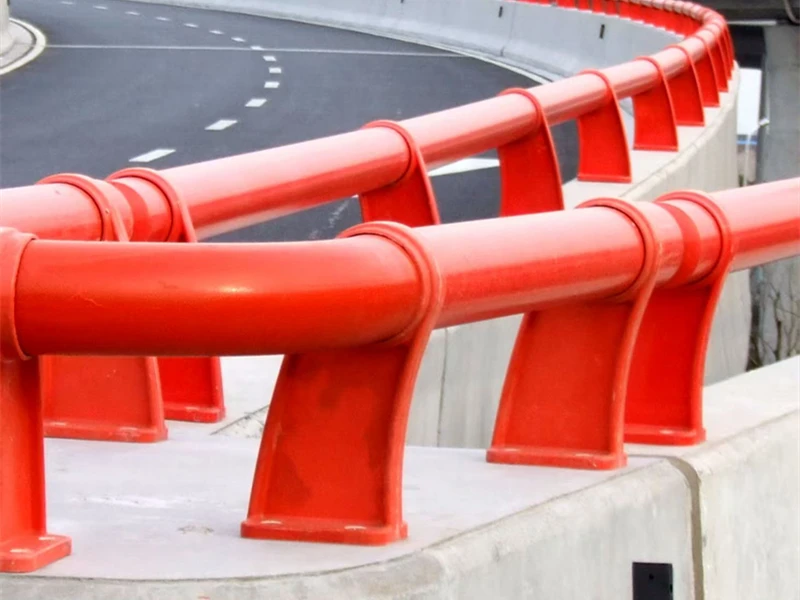
A two-rail pultruded FRP handrail with integral yellow color and resin-rich surface, designed for chemical, acid, alkali, and salt-spray industrial environments. No painting cycle. OSHA-compliant geometry out of the catalog.
Request layout quote Download spec sheet (PDF)
FRP HANDRAIL AT A GLANCE
Standard top-rail profile: 2" (50.8 mm) round; 1.5" × 1.5" square also available
Standard post section: 2" × 2" (50.8 × 50.8 mm) pultruded tube
Top-rail height: 42" (1067 mm) OSHA / IBC default
Mid-rail: 21" (533 mm) mid-rail between top and kick plate
Kick plate (toe board): 4" (100 mm) integral
Standard post spacing: 6 ft (1.83 m); 8 ft (2.44 m) option
Integral color: RAL {{1023}} traffic yellow top-rail; grey posts on request
What the buyer is trying to solve
Why the page exists.
The buyers who arrive at this page are plant maintenance engineers and asset managers who have just been told by their EHS team that the existing painted-steel handrail is no longer safe - either because the steel has thinned beneath the failed paint, or because the annual repaint has been deferred so many times that the inspector's next visit will shut the line. They want a handrail that does not need to be repainted, that holds its color in the chemical atmosphere, and that ships in the same geometry OSHA already accepts for steel.
Atmospheres where FRP handrail is the right answer
- Sulfuric acid mist
- Hydrochloric acid
- Sodium hydroxide (caustic)
- Chloride splash
- Chloride splash
- Electrolyte mist (electroplating)
- Chlorine contact (water / wastewater)
- Bleaching chemicals
Specifications
|
Profile family |
Pultruded FRP tube and square section; round top-rail 2″ (50.8 mm) OD standard |
|
Top-rail height |
42″ (1067 mm) OSHA / IBC default; 36″, 39″, 48″ on request |
|
Mid-rail |
21″ (533 mm) between top-rail centerline and walking surface; dual mid-rail on request |
|
Kick plate / toe board |
4″ (100 mm) high; integral on the post or separate clip-on |
|
Post spacing |
6 ft (1.83 m) standard; 8 ft (2.44 m) option; corner post pre-fabricated |
|
Post base |
Surface-mount base plate or embedded footing; stainless A4 anchor bolts isolated from rebar |
|
Top-rail color |
RAL {{1023}} traffic yellow integral in resin; RAL {{7035}} grey option |
|
Post color |
RAL {{7035}} grey standard; yellow option |
|
Resin system |
Vinyl-ester (FR), isophthalic (economy); phenolic (HL3-rated) on request |
|
Glass schedule |
Continuous roving + mat, balanced orthogonal |
|
Handrail load |
{{890}} N (200 lbf) concentrated at top rail, per OSHA 1910.29 |
|
Fire performance |
ASTM E84 Class A on request; ASTM D635 self-extinguishing |
|
UV package |
UV-9 inhibitor integral + UV-stable topcoat on visible surfaces |
|
Operating temperature |
{{−50}} °C to {{+90}} °C continuous (resin dependent) |
|
Volume resistivity |
> 10⁸ Ω·cm (non-conductive) |
|
Design life |
{{25}} years in chemical atmosphere |
|
Site fabrication |
PCD diamond blade; no welding, no painting |
When not to specify FRP handrail
Cases where steel or aluminum is still correct.
Three cases where we redirect you back to steel
- Vehicle-rated barrier (TL-2 or higher). FRP handrail is for pedestrian fall protection. If the line needs vehicle impact rating, FRP is the wrong material. Use a tested steel or concrete barrier.
- Architectural metal finish required. If the owner has specified a polished stainless or galvanized visual in the procurement spec, FRP cannot match it visually. Specify the metal and budget for the paint cycle.
- Operating temperature above {{+90}} °C continuous. Above this temperature, vinyl-ester FRP loses stiffness; phenolic grades extend the range but at capex premium. For high-heat service, steel with the right coating is the correct answer.
Material comparison
|
Property |
Painted carbon steel |
Galvanized steel |
Aluminum 6063 |
Enbuss FRP handrail |
|
Mass per metre (top-rail) |
~ {{1.6}} kg/m |
~ {{1.6}} kg/m |
~ {{0.5}} kg/m |
~ {{0.7}} kg/m |
|
Coating cycle in chemical atmosphere |
{{12–24}} months |
{{24–36}} months |
Pitting at welds |
None - integral color |
|
Yellow safety color life |
{{1–2}} yr (paint chalk) |
{{3–4}} yr (galv + paint) |
Anodize {{5–8}} yr |
{{10}}+ yr integral |
|
25-yr replacement cycle |
{{2–3}} replacements |
{{1–2}} replacements |
Some replacement |
No replacement |
|
Electrical isolation |
Conductive |
Conductive |
Conductive |
Non-conductive |
|
Site fabrication |
Weld + paint |
Weld + paint |
Weld |
PCD cut + bolt |
|
Cost per metre over 25 years |
Reference |
+ {{10–30}}% |
+ {{20–40}}% |
Approx. parity or lower |
Customization & OEM
Standard handrail ships as cut lengths with pre-drilled post bases and connector sleeves. OEM customers (industrial fabricators, plant EPCs) typically need a kit-of-parts: top-rail, posts, mid-rails, kick plates, base plates, anchors. We ship the kit labelled to your drawing. First article {{6}} weeks; repeat {{3}} weeks.
Frequently asked questions
What is the typical lead time for a 2 km order?
From PO to first delivery, typically {{8–10}} weeks for standard yellow RAL {{1023}} handrail in 6 ft post spacing. Custom color adds {{2}} weeks; special post spacing adds {{1}} week.
Is the handrail OSHA-compliant out of the catalog?
Yes. The standard 42″ top-rail, 21″ mid-rail, 4″ kick plate, and {{890}} N (200 lbf) concentrated load at the top rail satisfy OSHA 1910.29 and IBC 1015. Project-specific loads and jurisdictions verified on first article.
How is the handrail anchored to the existing slab?
Surface-mount base plate with chemical anchor or mechanical anchor to the existing slab. Stainless A4 anchor bolts isolated from the slab rebar. Base plate supplied with the kit.
Can the handrail be supplied with a removable section for crane access?
Yes. Specify on RFQ; we supply a removable top-rail coupling that maintains the line of the handrail without tools.
Does the FRP hold a chemical splash?
Yes for the chemical families listed in the atmospheres tags above. Concentrated sulfuric and hydrochloric acid - verify on first article. Solvents that attack vinyl-ester are not in scope; we will redirect if the chemical is incompatible with FRP.
How is the handrail cut and drilled on site?
Diamond or PCD blade, dust extraction, edge sealer kit supplied. Cut-and-drill does not void the warranty if the cut edge is sealed with the kit.
How is the handrail inspected in service?
Visual at plant walk-around; look for surface damage, UV chalking, or impact cracks. Any visible crack or fiber exposure is grounds for replacement. Inspection interval typically annual.
What documentation comes with each shipment?
Per shipment: dimensional inspection, resin lot certificate, ASTM E84 (if specified) certificate, OSHA geometry compliance reference, installation drawing.
Send a handrail layout
Send the plant layout (DWG or PDF), the atmosphere class, and the post spacing. We return a handrail kit BOM, a fixed quote, and the certification pack your inspector will ask for.