

A drainage channel that does not spall after the third winter of de-icing salt
Composite road gutter for bridge decks, cut-and-cover tunnels, and elevated highway sections. Monolithic pultrusion with no joints to leak, no rebar to corrode, and no concrete to crack under chloride attack.
30 yr
Design life in chloride exposure
EN 1433
Load classes A–F
< 1‰
Linear water absorption
5× lighter
vs equivalent concrete channel
What the buyer is trying to solve
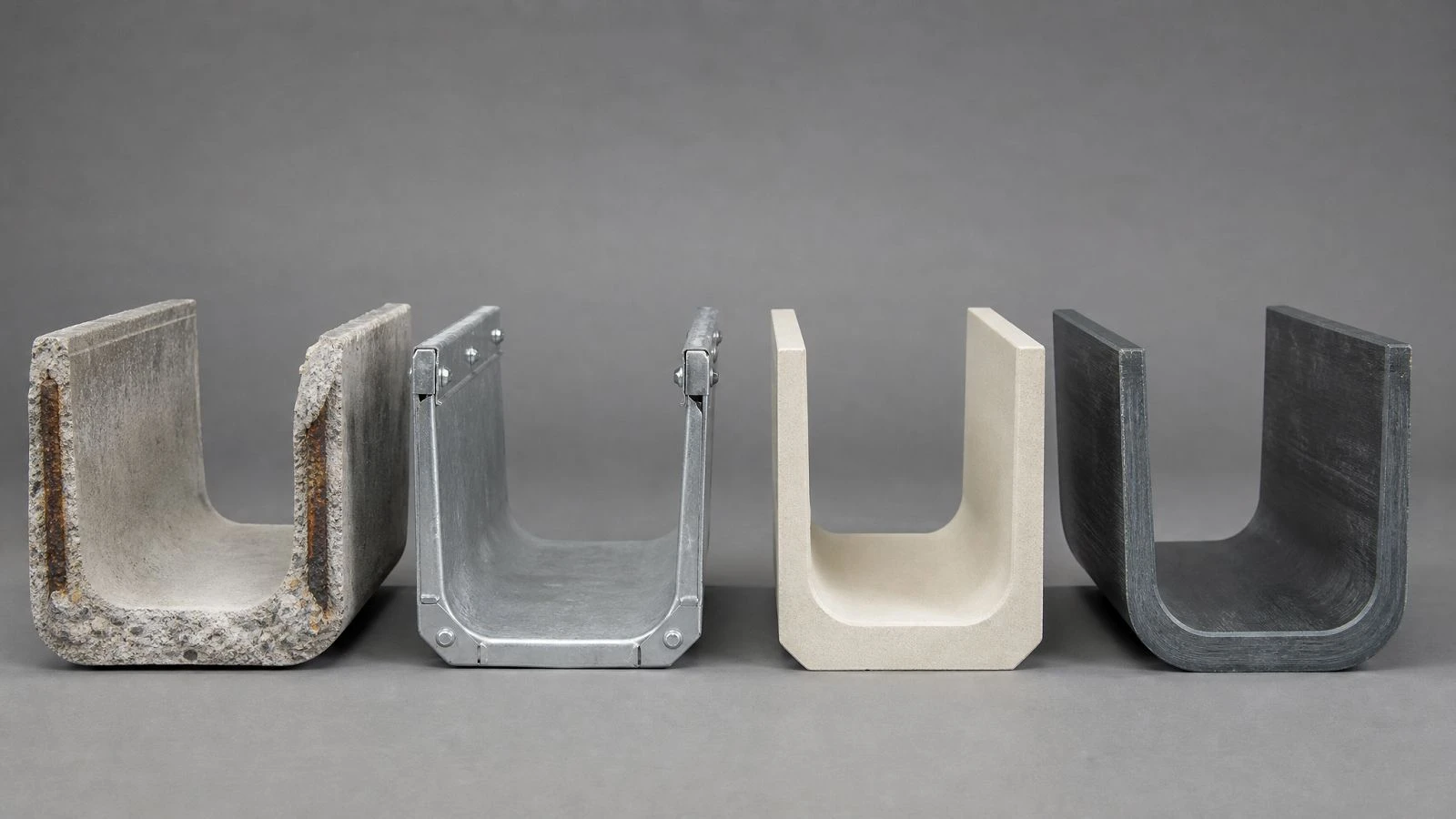
The engineering case for a composite gutter on a chloride-exposed bridge or highway.
Most of the engineers who arrive at this page are bridge-rehab program managers, highway asset engineers, or cut-and-cover tunnel civils engineers. The common pain point is concrete drainage that spalls within 8–12 years of commissioning, especially on coastal viaducts or anywhere that uses de-icing salt. The replacement cycle is becoming the dominant line item on the maintenance budget. They want a corrosion-proof alternative that costs the same as concrete once you count access, traffic management, and disposal.
What is wrong with concrete
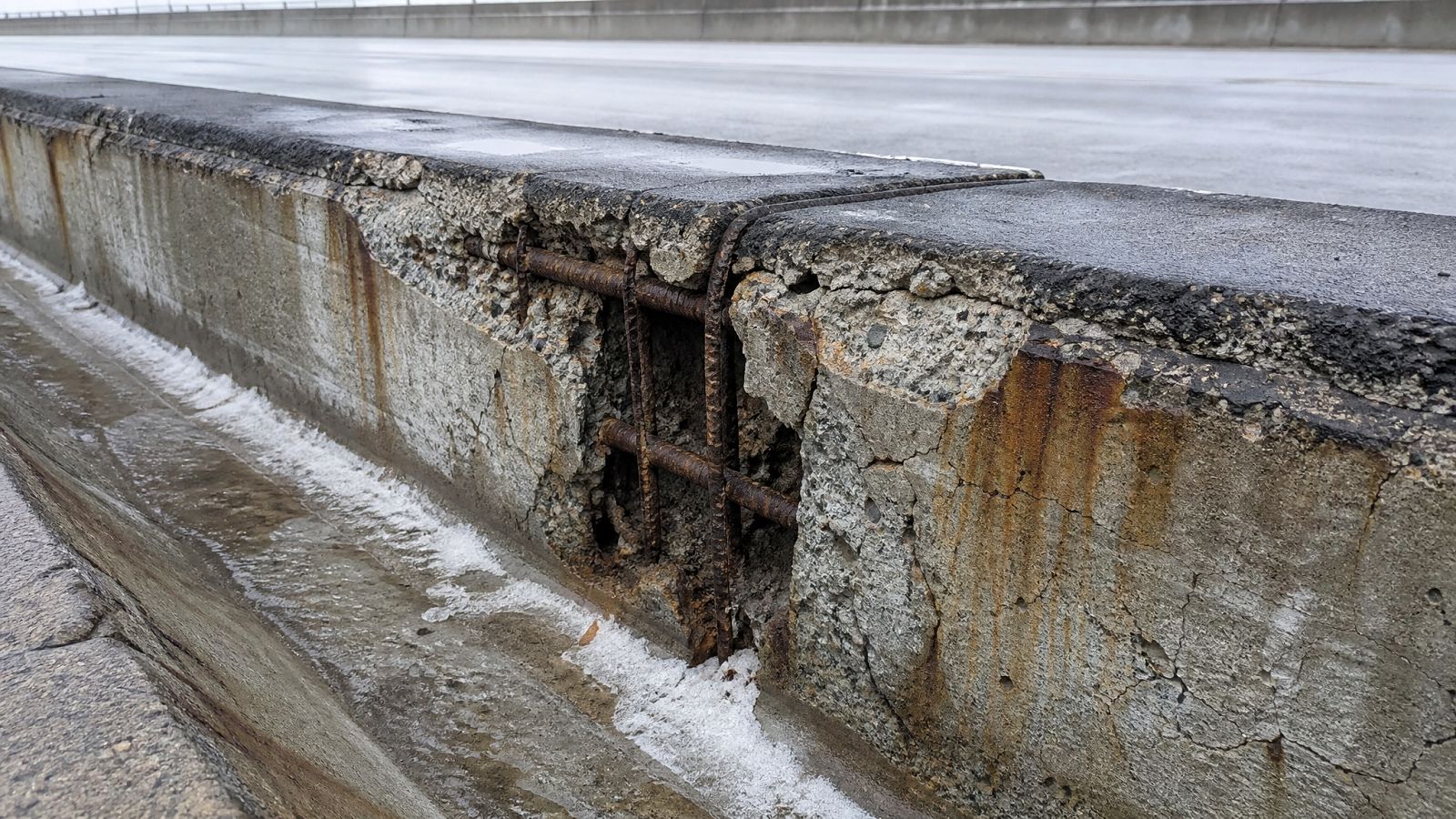
Chloride ion and water reach the rebar through micro-cracks at the joint line. Once they do, the rebar rusts, expands, and bursts the surrounding concrete. The repair is patch → patch → patch → full replacement at year 18–22. Each repair requires lane closure and traffic management.
What FRP changes
No rebar. No joint line. The channel itself is non-reactive to chloride; the surface is resin-rich and absorbs under 1‰ water by mass. Maintenance shifts from "patch concrete every five years" to "pressure-wash annually and inspect visually."
Chloride proof
Vinyl-ester resin system is rated for continuous chloride exposure at the levels seen on coastal or de-iced bridges.
Monolithic
Single pultruded channel length up to 6 m; joint couplers include a sealing bead and a continuous gradient.
Lightweight
~ {{12}} kg/m vs ~ {{60}} kg/m for the equivalent concrete trough. Reduces bridge dead load by tens of tonnes per kilometer.
Sizing and hydraulic capacity
Standard sections and the flow rate each handles at 80 % fill.
The numbers below are for the most common stand-alone highway channel sections. We also produce custom geometry for sub-station drainage and tunnel invert applications. Hydraulics follow the standard Colebrook-White approximation; complete calculation pack on request.
|
Section |
Internal width × depth |
Channel mass |
Flow at 80 % fill (n = 0.011) |
Load class (EN 1433) |
Typical use |
|
D150 |
150 × 200 mm |
{{11}} kg/m |
~ 22 L/s @ 1 % |
A15 / B125 |
Footway, verge |
|
D200 |
200 × 250 mm |
{{14}} kg/m |
~ 38 L/s @ 1 % |
B125 / C250 |
Side-of-carriageway |
|
D300 |
300 × 300 mm |
{{19}} kg/m |
~ 70 L/s @ 1 % |
C250 |
Highway hard shoulder |
|
D400 |
400 × 400 mm |
{{27}} kg/m |
~ 140 L/s @ 1 % |
D400 |
Bridge deck main run |
|
D500 |
500 × 500 mm |
{{36}} kg/m |
~ 230 L/s @ 1 % |
D400 / E600 |
Industrial access, port approach |
|
D600 |
600 × 600 mm |
{{48}} kg/m |
~ 340 L/s @ 1 % |
E600 / F900 |
Heavy bridge, airport taxiway approach |
Flow rates are computed at 1 % longitudinal gradient; n = 0.011 is the published Manning coefficient for FRP channels. Concrete comparison uses n = 0.013. The difference is real but not the headline; chloride durability is.
When not to specify FRP drainage
Three cases where we redirect you back to concrete
Three cases where we redirect you back to concrete
- You need a V-shaped invert. FRP channels are typically V-bottom or U-bottom; if the project requires a flat-bottom shallow invert for silt control, concrete can be easier to form to the geometry.
- Aircraft-rated F900 with very long unsupported span. F900 is rated for occasional heavy aircraft. For sustained port operations we publish special-design geometry; expect a 10-week lead time and a custom price.
- You must embed the channel in a single-pour concrete deck. FRP channels need composite or stainless anchor pockets; embedment in the structural deck still works but the engineering package changes.
Material comparison
|
Constraint |
Reinforced concrete channel |
Stainless / galvanized steel |
Polymer concrete |
Enbuss FRP |
|
Mass per metre (400 × 400) |
~ 60 kg/m |
~ 25 kg/m |
~ 28 kg/m |
~ {{27}} kg/m |
|
Design life in chloride |
10–18 yr before rebar attack |
15–20 yr if coating holds |
20 yr (resin-dominated) |
30 yr |
|
Joint integrity |
Failure mode at year 3–8 |
Bolted seams - periodic re-seal |
Bonded, mostly OK |
Bonded with sealing bead |
|
Repair |
Patch or full replace |
Weld or replace |
Patch |
Cut-out and splice with coupler kit |
|
Cost over 30 yr (incl. install & access) |
Reference |
+ {{20–40}}% |
+ {{10–20}}% |
Approx. parity or lower |
What you send us for an order
PROJECT INFORMATION FOR QUOTATION
√ Run length total and the typical straight length per piece
√ Required load class A15 / B125 / C250 / D400 / E600 / F900
√ Required hydraulic capacity (estimated peak runoff or required gradient)
√ Chloride exposure category (coastal / de-icing / both / neither)
√ Slot/grating requirement - heel-safe, lock-down, ductile iron, etc.
√ Required gradient (channels are typically installed at 0.5–2 %)
√ Anchor method and substrate (concrete deck, asphalt, slab)
Customization & OEM
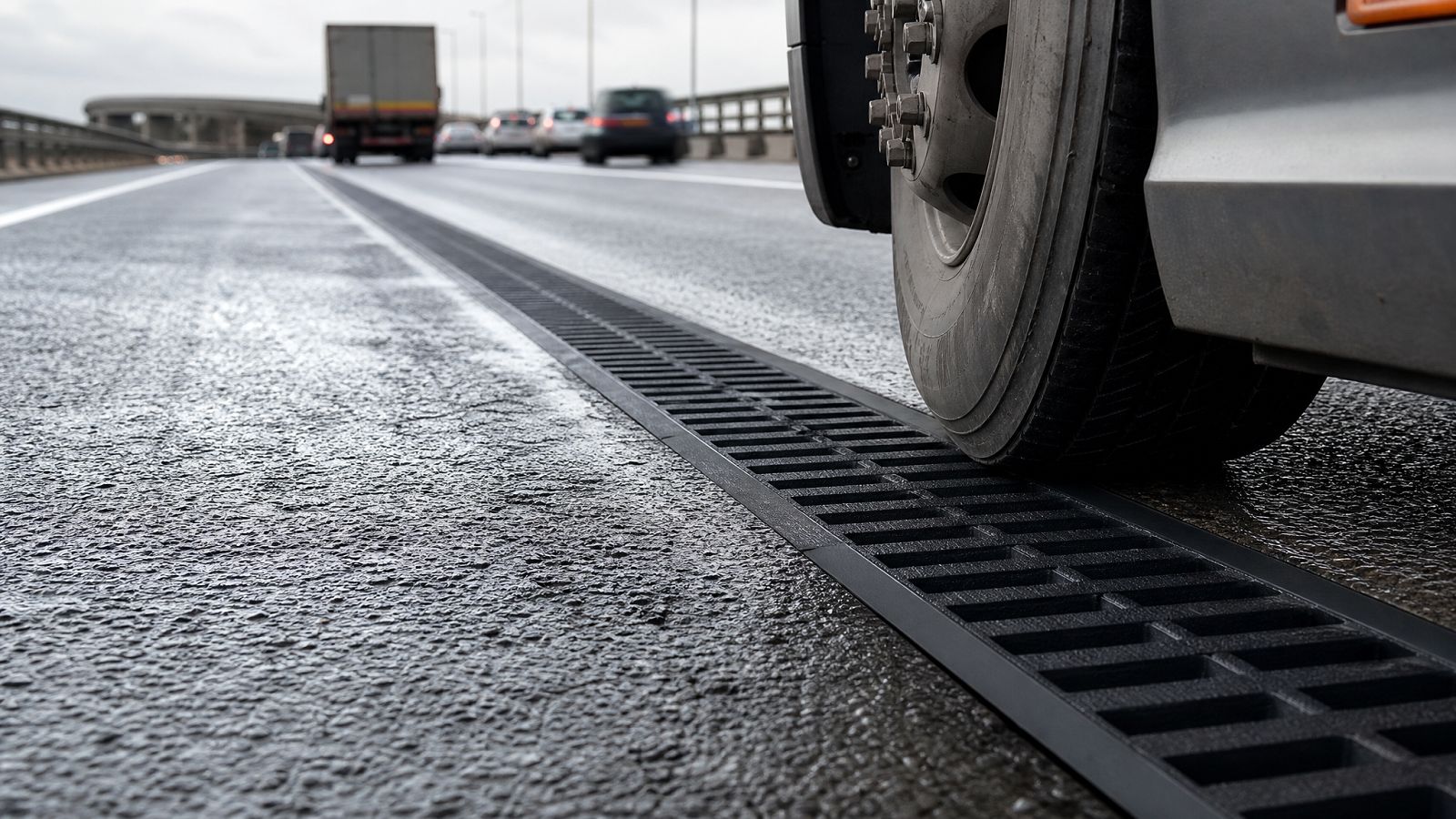
Bridge OEMs and drainage subcontractors often need a complete kit: channel + grating + frames + outlets + sump units + locking details. We supply the kit as a single BOM against your project drawing list. Custom geometry (extra-deep invert, slot widths outside the table) is built to order; expect {{6}} weeks on first article.
Frequently asked questions
What is the typical lead time for a 2 km order?
From PO to first delivery, typically {{6–8}} weeks for D200–D400 in vinyl-ester. Larger D500/D600 sections add {{2–3}} weeks. We hold forecast slots for major bridge programs - talk to us early.
How does the channel handle freeze-thaw cycling?
Vinyl-ester pultrusions are rated to {{−40}} °C without embrittlement. Water absorption is under 1 ‰ by mass; freeze-thaw damage mechanism does not apply.
What about vehicle braking torque over the grating?
Gratings are ductile iron (default) or composite (option), both sized to the EN 1433 load class. Ductile iron gratings are lock-down for highway-speed sections; composite gratings are heel-safe for footway applications.
Can the channel be installed in a single-shift possession?
Typical installation rate is {{30–40}} m per shift for a 4-person crew on bridge deck. We will provide a recommended installation sequence on first article.
Does the channel require a sump?
We recommend a composite sump unit every {{80–120}} m of channel, depending on slope and expected silt load. Sump units have the same resin schedule as the channel; baskets are stainless steel.
How is the channel joint sealed?
Composite coupler with EPDM gasket and a continuous sealing bead. The joint is rated to IP68 at {{1}} bar water pressure.
Can the channel be supplied cut to length for shipping?
Yes, channel comes in 3 m or 6 m standard lengths; we cut-to-length to reduce on-site waste. Standard tolerance is ± 5 mm; tighter tolerances available.
What is the warranty?
25 years against material failure and corrosion; separate warranty on gratings (per grating material).
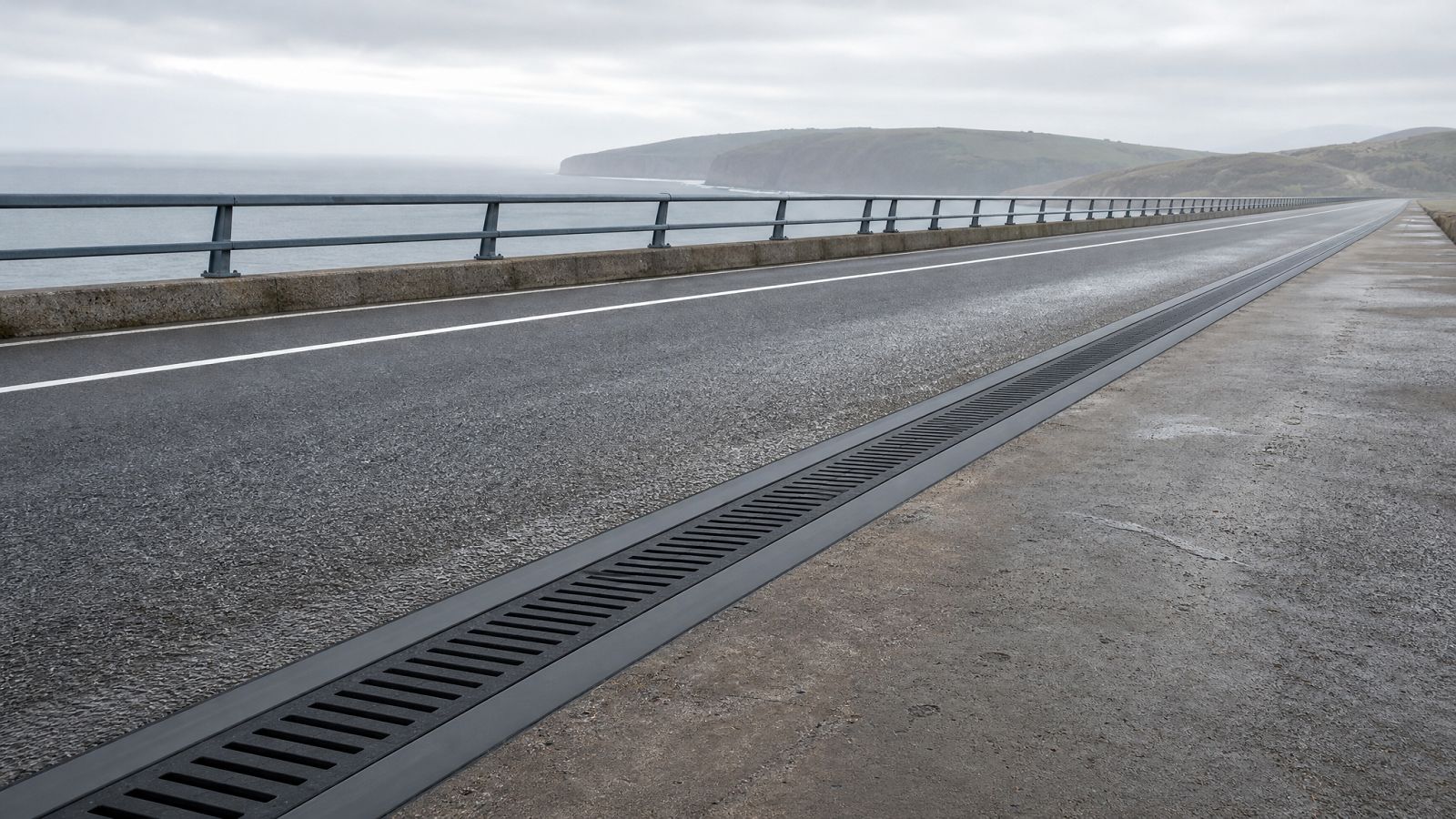
Send a deck drawing and a runoff calc
Send your bridge deck drainage drawing and the peak runoff value. We return a layout, the hydraulic calculation, and a fixed quote.