

BRIDGE GUARDRAIL · PEDESTRIAN BARRIER
A bridge guardrail that stops painting cycles, drops deck dead load, and stays non-conductive
Composite parapet and pedestrian railing for highway and pedestrian bridges, elevated corridor edges, and station approaches. Replaces galvanized steel where weight, corrosion, and the next 30 years of maintenance all matter at once.
Request project reference list See recent project references
REFERENCE PROJECTS · SELECTED
Where Enbuss bridge rail is in service today
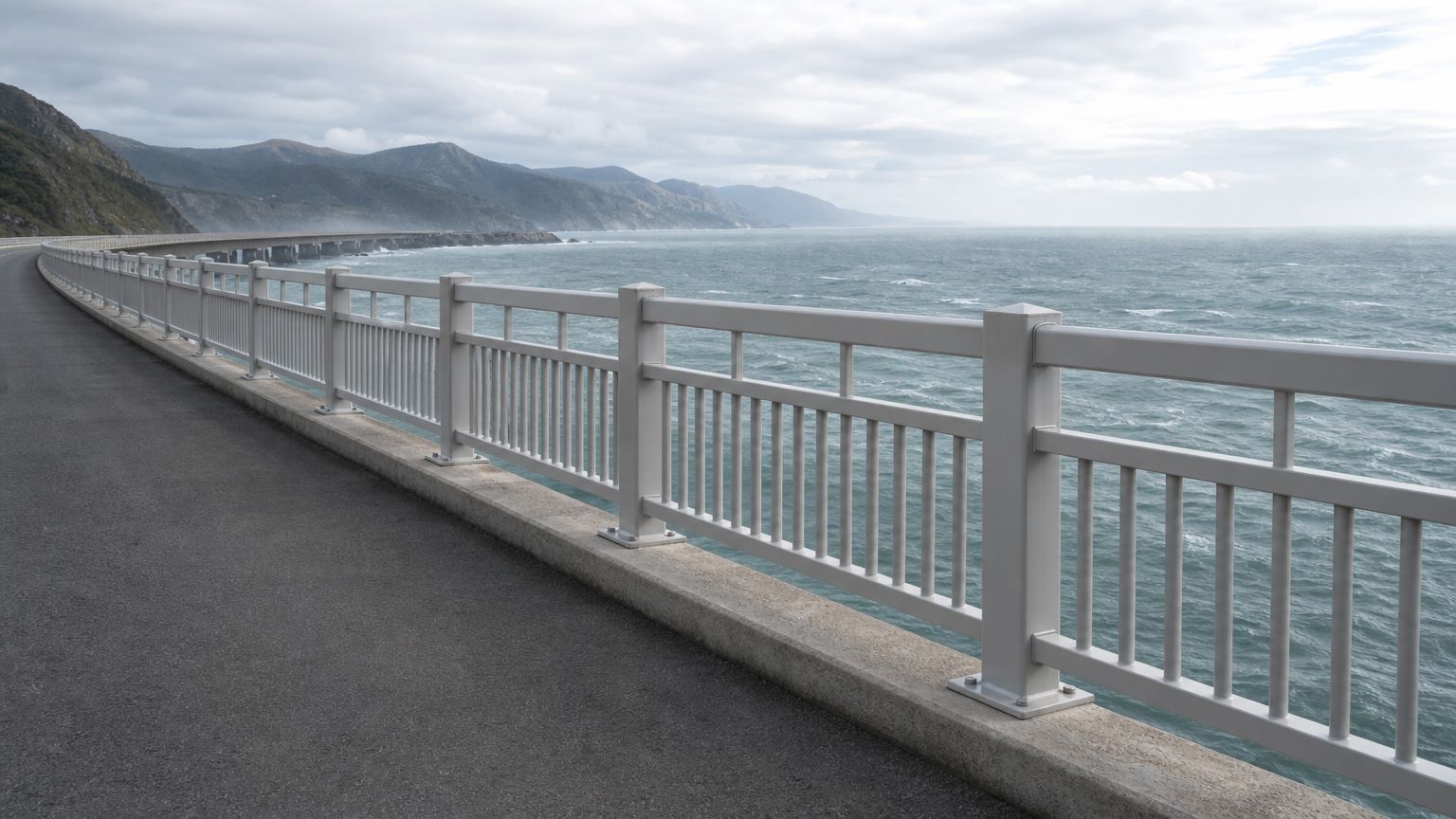
Coastal viaduct parapet replacement
Composite pedestrian / vehicle parapet replacing rusted galvanized steel on a {{3.4}} km viaduct. Chloride-driven spalling eliminated. Maintenance cycle zero.
COASTAL VIADUCT · {{Region}} · {{Year}}
2.8 km
Elevated expressway pedestrian rail
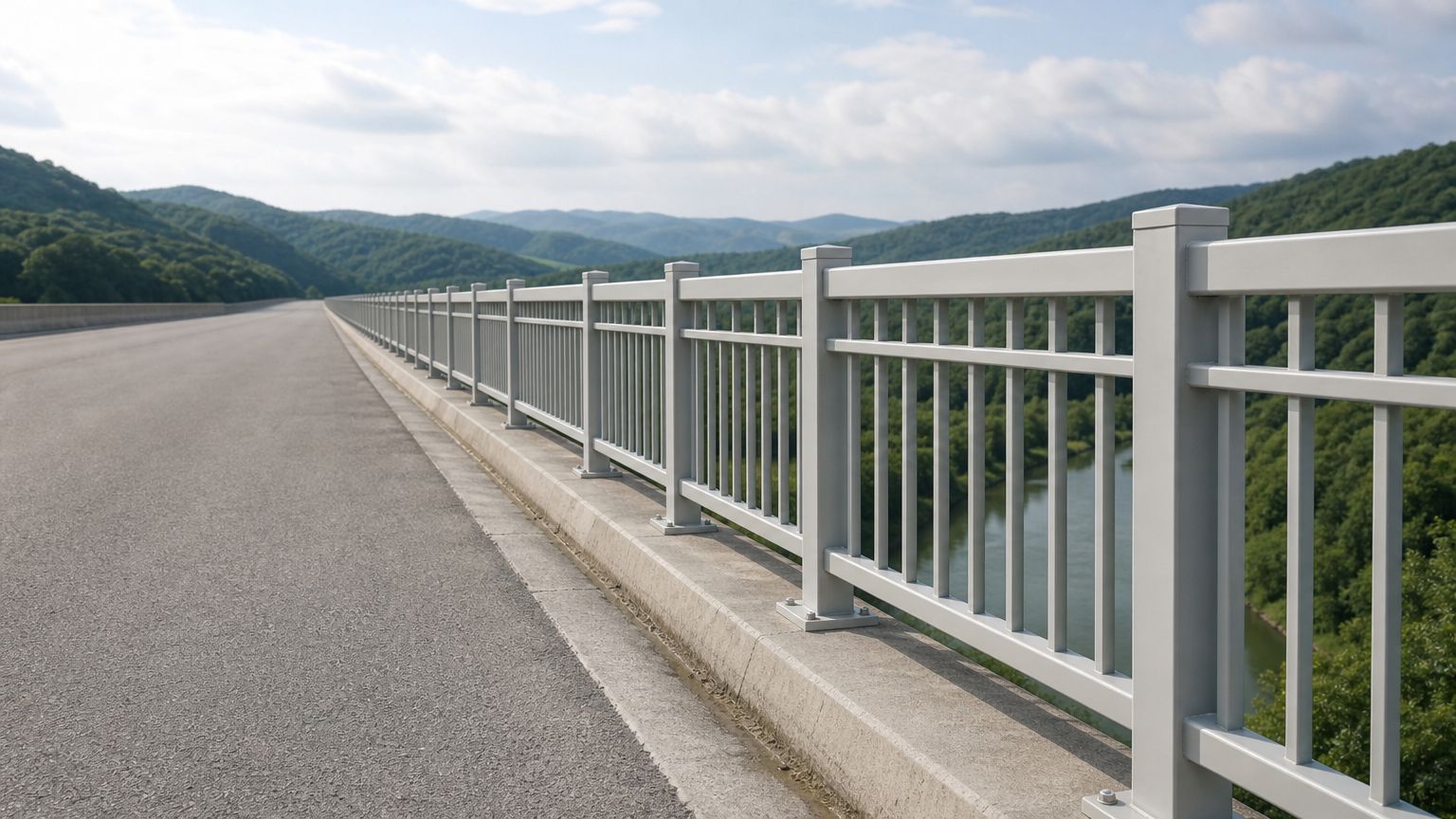
Pedestrian-only barrier with sight-line-true geometry; reinforced where mopeds are admitted. Weight saving redistributed to longer main span.
ELEVATED EXPRESSWAY · {{Region}} · {{Year}}
1.6 km
Station approach railing
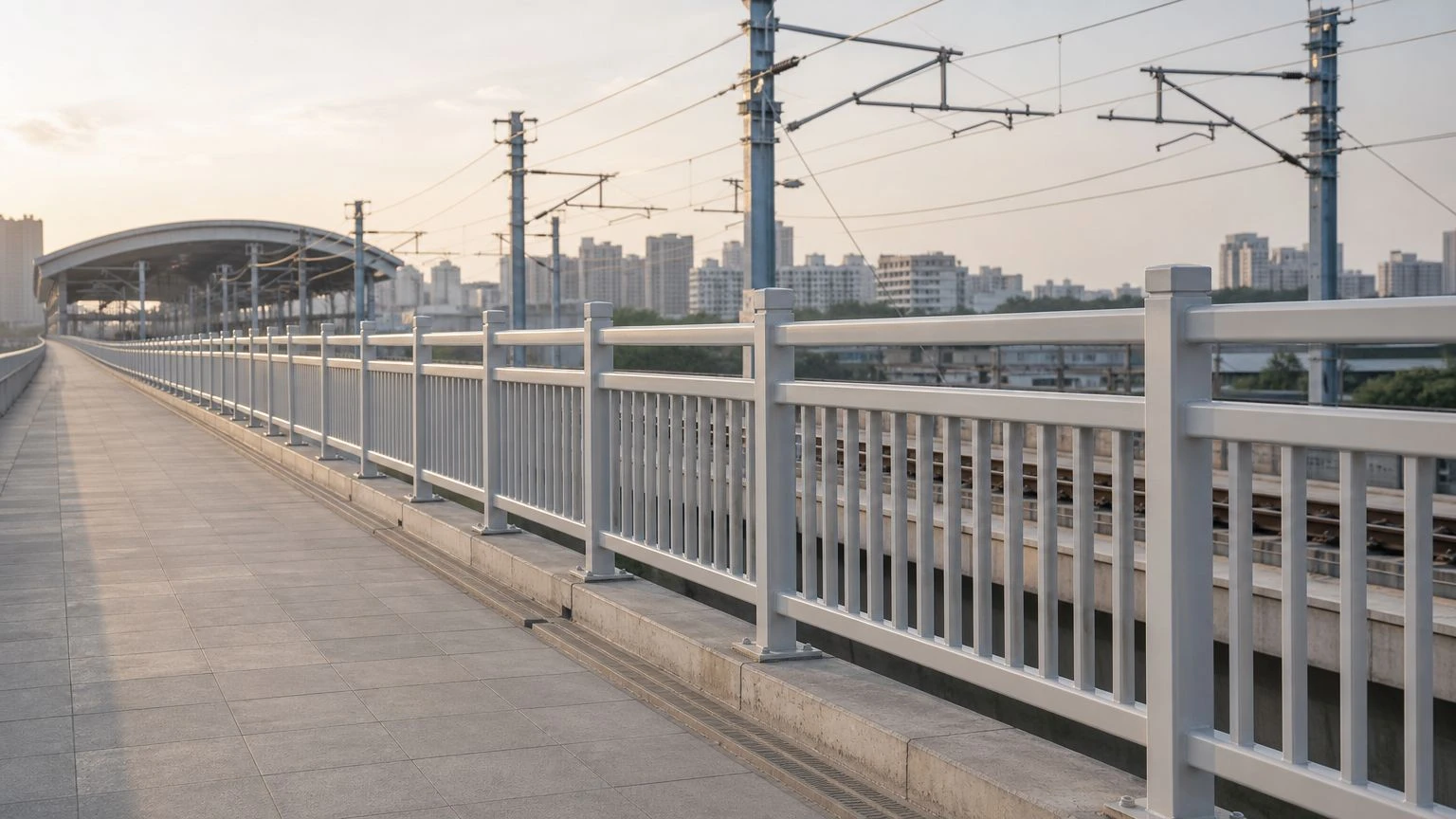
Combination pedestrian / service-rail at a metro station approach. Non-conductive near OCS; tested to EN 1991-1-1 crowd loads.
METRO APPROACH · {{Region}} · {{Year}}
4.2 km
Pedestrian-only footbridge
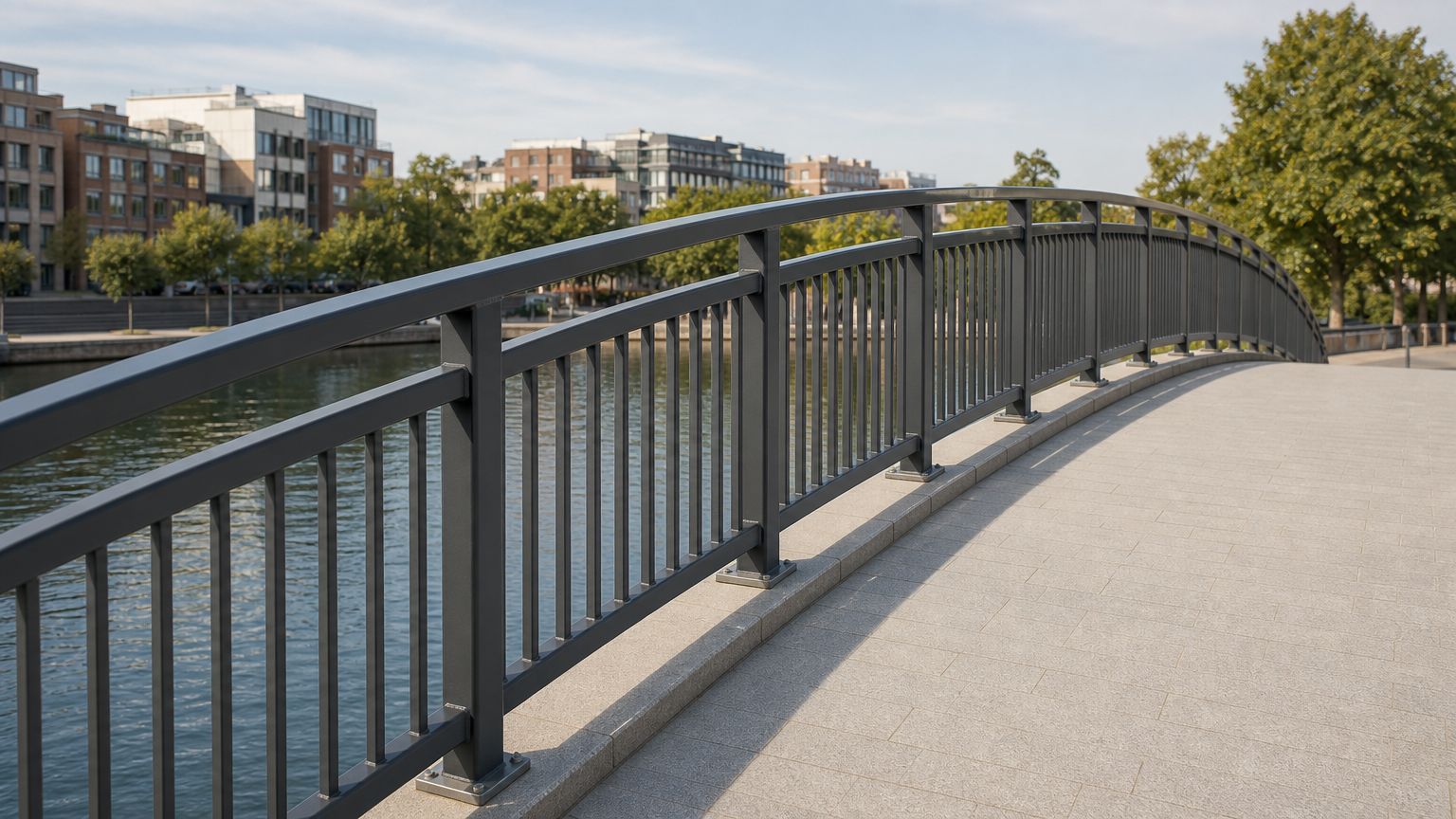
Aesthetic-grade railing with custom RAL nosing; bowed geometry over the central span. Visual reference under contract.
FOOTBRIDGE · {{Region}} · {{Year}}
780 m
Why highway engineers specify composite rail
The four reasons most cited in the bid documents we review.
1. Dead load on the deck
A 1 m galvanized steel parapet rail with posts runs ~ {{38}} kg/m. The same geometry in Enbuss FRP runs ~ {{12}} kg/m. On a 2 km bridge, that is ~ 52 tonnes of structural demand that the engineer can spend on span, slab thickness, or column spacing instead. The math usually decides the project before the maintenance case is even opened.

2. No painting cycles
A steel parapet that spans a chloride-exposed bridge has a paint cycle of {{5–7}} years, with a full re-paint in {{12–15}} years. The lane-closure cost of repainting routinely exceeds the original installation cost. FRP has no paint cycle. After 30 years the surface is in the same condition as at installation (gelcoat may chalk cosmetically; structural performance unaffected).
3. Non-conductive where it matters
On OCS-route approach structures, FRP eliminates the rail-as-ground-path fault that occasionally shows up on steel pedestrian barriers near {{25}} kV OCS. We have reports of {{0}} fault recurrences on installations recorded {{10}}+ years.
4. Field-friendly fabrication
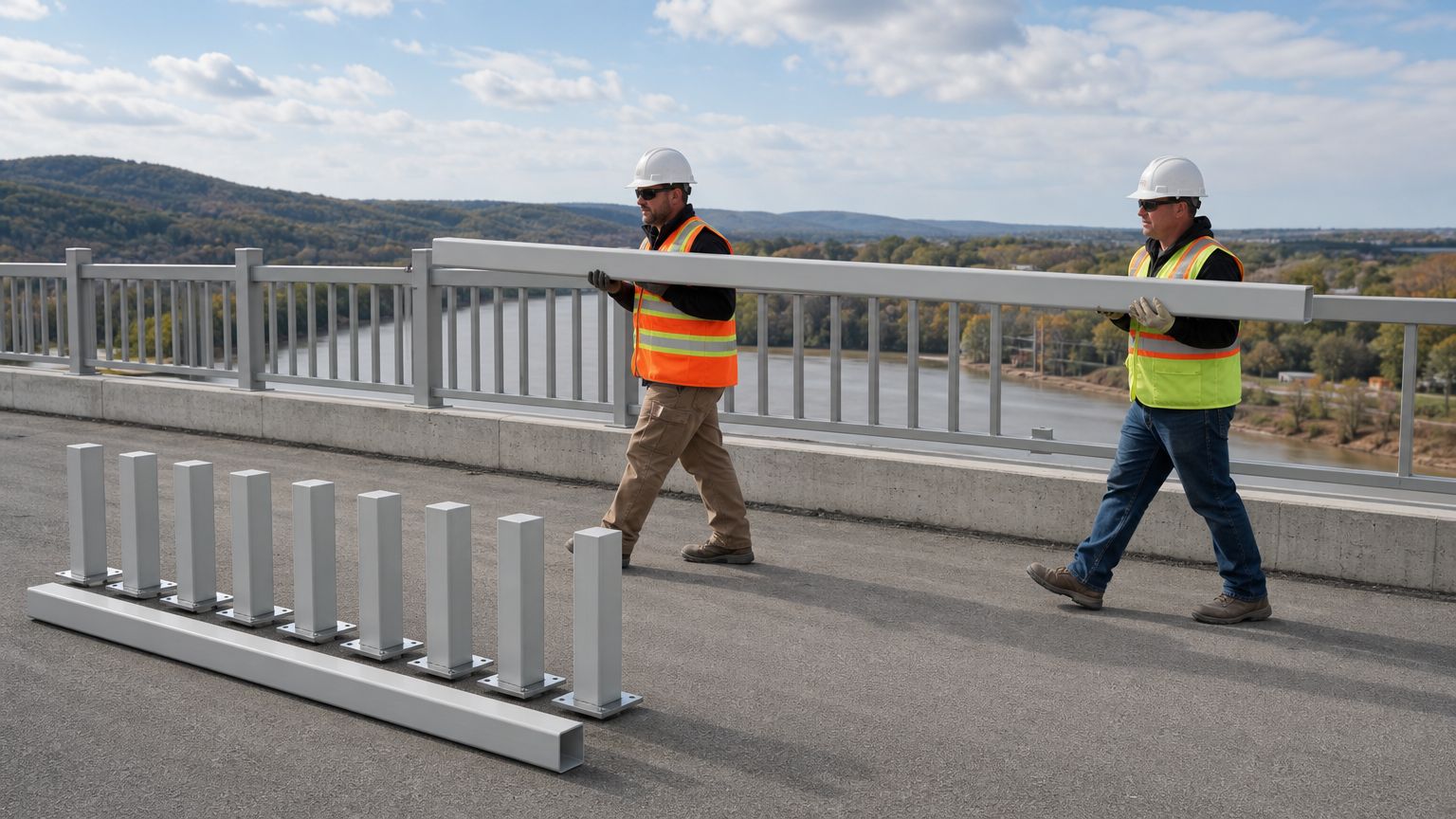
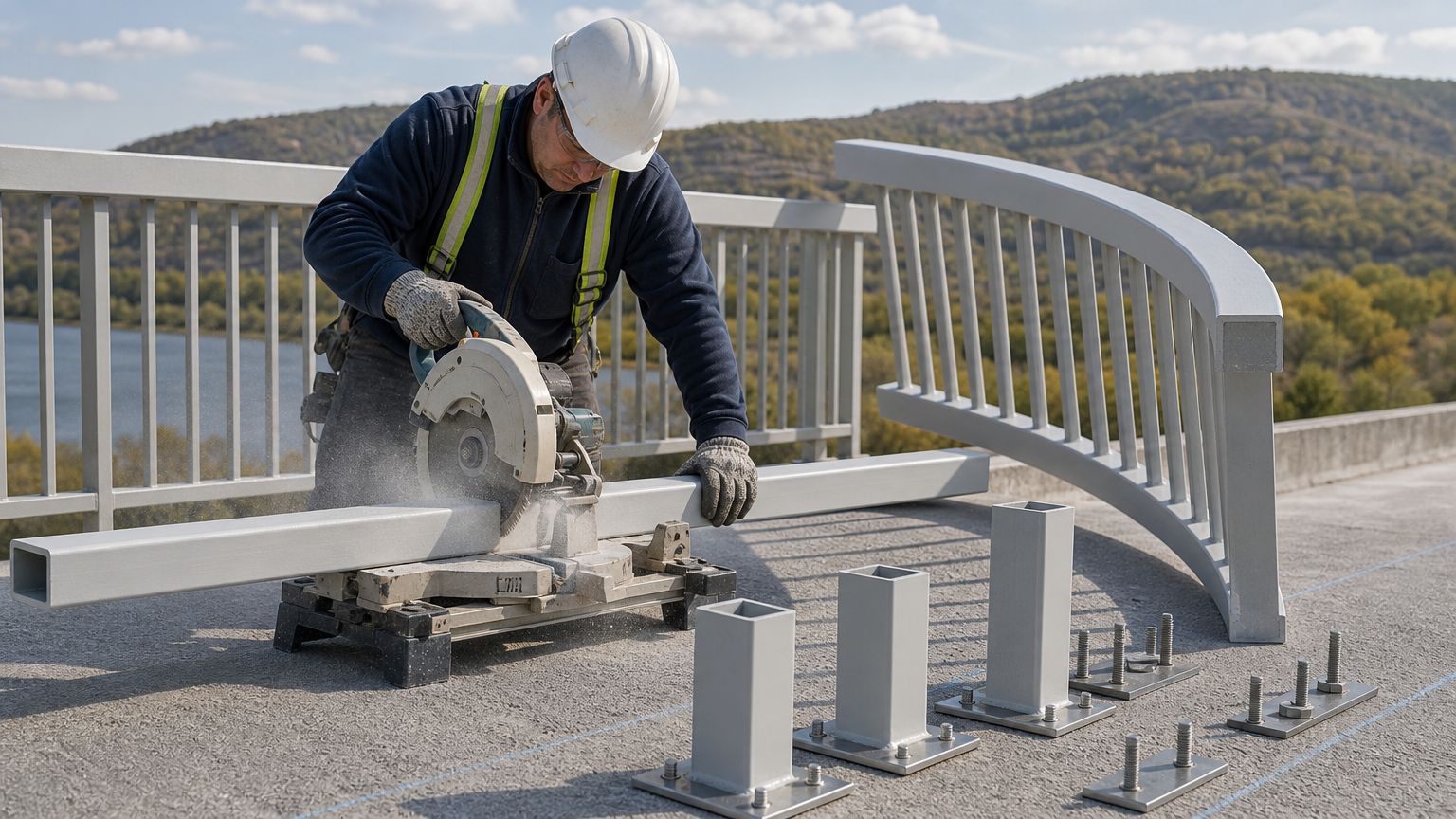
Pultruded rails and pultruded posts cut and drill on site using standard tools. Long sweeping curves are available as factory-bent sections to a {{5 m}} radius or as straight sections bonded in the field with a custom-radius template.
When not to specify FRP bridge rail
Four cases where steel or concrete remains correct
- TL-4 or higher crash-rated vehicle barrier. FRP is rated for pedestrian and TL-1/TL-2 vehicle loads. TL-3 and above on a high-speed corridor still want a tested steel or concrete profile. We can supply hybrid: a steel vehicle rail with composite pedestrian rail inboard.
- Architectural metal finish required. If the rail needs to read as cast iron or wrought iron, FRP is the wrong material. We can dress FRP in metallic finish coat; from 2 m it reads as painted steel. Up close it does not.
- Very high aesthetic tolerance on tight curvature. Pultruded rails come straight or factory-bent to {{5 m}} radius; for tight sweeping curves, custom hand-laid laminate is required - we do this, but expect longer lead time.
- Owner-mandated steel spec for visual consistency with existing rail. On a bridge with all-steel rail historically, the owner sometimes dictates steel for whole-corridor uniformity. We have done hybrid retrofits (composite pedestrian rail inboard, steel vehicle rail) - call us for the detail.
Specifications
|
Post-and-rail system height |
1100 mm pedestrian / 1300 mm vehicle (AASHTO-referenced) / custom |
|
Post section |
FRP pultruded {{80}} × {{80}} mm or {{100}} × {{100}} mm; stainless or composite baseplate |
|
Rail section |
FRP pultruded rectangular or arched; multi-rail or solid infill |
|
Infill |
Vertical balusters, horizontal mid-rail, or solid laminate |
|
Resin system |
Vinyl-ester (standard), fire-retardant vinyl-ester (FR), isophthalic (economy) |
|
Fire performance |
ASTM E84 Class A on FR; EN 13501-1 B-s1, d0 on request |
|
UV package |
Gelcoat + UV-9 stabilizer; UV-stable topcoat available |
|
Color |
Grey RAL {{7035}} standard; full RAL range on request |
|
Operating temperature |
−40 °C to +80 °C continuous |
|
Crowd load |
Designed to EN 1991-1-1 (1.5 kN/m horizontal at handrail); AASHTO LRFD HL-93 pedestrian loads |
|
Vehicle load reference |
AASHTO LRFD TL-1 / TL-2 for vehicle-rated systems; TL-3+ on hybrid systems |
|
Anchor |
Stainless A4 mechanical anchor or chemical anchor to deck; isolated from rebar per project spec |
|
Design life |
30 years (FR); 25 years (standard) |
Material comparison
|
Property |
Galvanized steel |
Stainless 316 |
Aluminum 6061 |
Enbuss FRP |
|
Mass per metre (1.1 m height) |
~ {{38}} kg/m |
~ {{30}} kg/m |
~ {{13}} kg/m |
~ {{12}} kg/m |
|
Coating cycle |
5–7 years |
None |
Anodize 10–15 yr |
None |
|
Crash rating max (publishable) |
TL-4 with proper anchorage |
Same |
Limited by elastic buckling |
TL-1/TL-2 pedestrian-rated |
|
Conductivity |
Conductive; grounds OCS |
Conductive |
Conductive |
Non-conductive |
|
Cost over 30 years (with painting) |
Baseline (highest) |
+ {{30}}% |
+ {{15}}% |
Approx. parity or lower |
Customization & OEM
Owner-driven projects often need a custom aesthetic - curve profile, color, RAL-matched nosing, sight-line-true geometry. We supply drawings for architect review and acceptance. OEM customers (bridge fabricators) typically need full kit-of-parts: rail, posts, base plates, anchors, caps. We deliver the kit labelled to your run-list. First article {{6}} weeks, repeat {{3}} weeks.
Frequently asked questions
Can the rail be supplied in a custom RAL color?
Yes, full RAL range on the gelcoat. Custom RAL adds {{2}} weeks to first article. Standard RAL 7035 grey and RAL {{7032}} are held in stock for fast repeat.
How is the rail rated for vehicle load?
Composite parapet is published at TL-1 / TL-2 to AASHTO LRFD; for higher TL we supply a hybrid with a tested steel vehicle rail inboard of the pedestrian rail. Talk to the account engineer before specifying a higher TL.
What test data backs the crowd-load claim?
We have tested to EN 1991-1-1 and AASHTO LRFD for both infill and post-rail systems; full test report available to qualified specifiers under NDA.
Can the railing be dismantled for re-use after a bridge deck rehab?
Yes. Anchors are removable with a standard chemical-anchor extraction tool. The composite rail itself is undamaged. Compare to steel, which is usually scrap after first dismantlement.
What is the typical lead time for a {{2}} km order?
From PO to first delivery, {{6–8}} weeks for RAL {{7035}} in standard geometry. Custom RAL adds {{2}} weeks; custom geometry adds {{3–4}} weeks.
Is the rail reflective for night use?
Yes - reflective strip applied during manufacture at the rail top, or upgrade to reflective nosing for high-speed vehicle sections. We use {{3 M}} Diamond Grade or equivalent; specify in your RFQ.
How is the railing disposed of at end of life?
Vinyl-ester pultrusions can be shredded and used as filler in non-structural concrete. We run a take-back program in pilot regions.
Does the railing sag between posts over time?
No. Creep-rupture is a structural-design criterion and our posts / rail schedule are designed for {{30}}-year deflection limits. Test reports on creep performance available.
Send a bridge cross-section
Send the deck detail, the required rail height, and the chloride-exposure category. We return a layout drawing, an anchor pattern, and a fixed quote - including against your existing steel parapet baseline if helpful.