

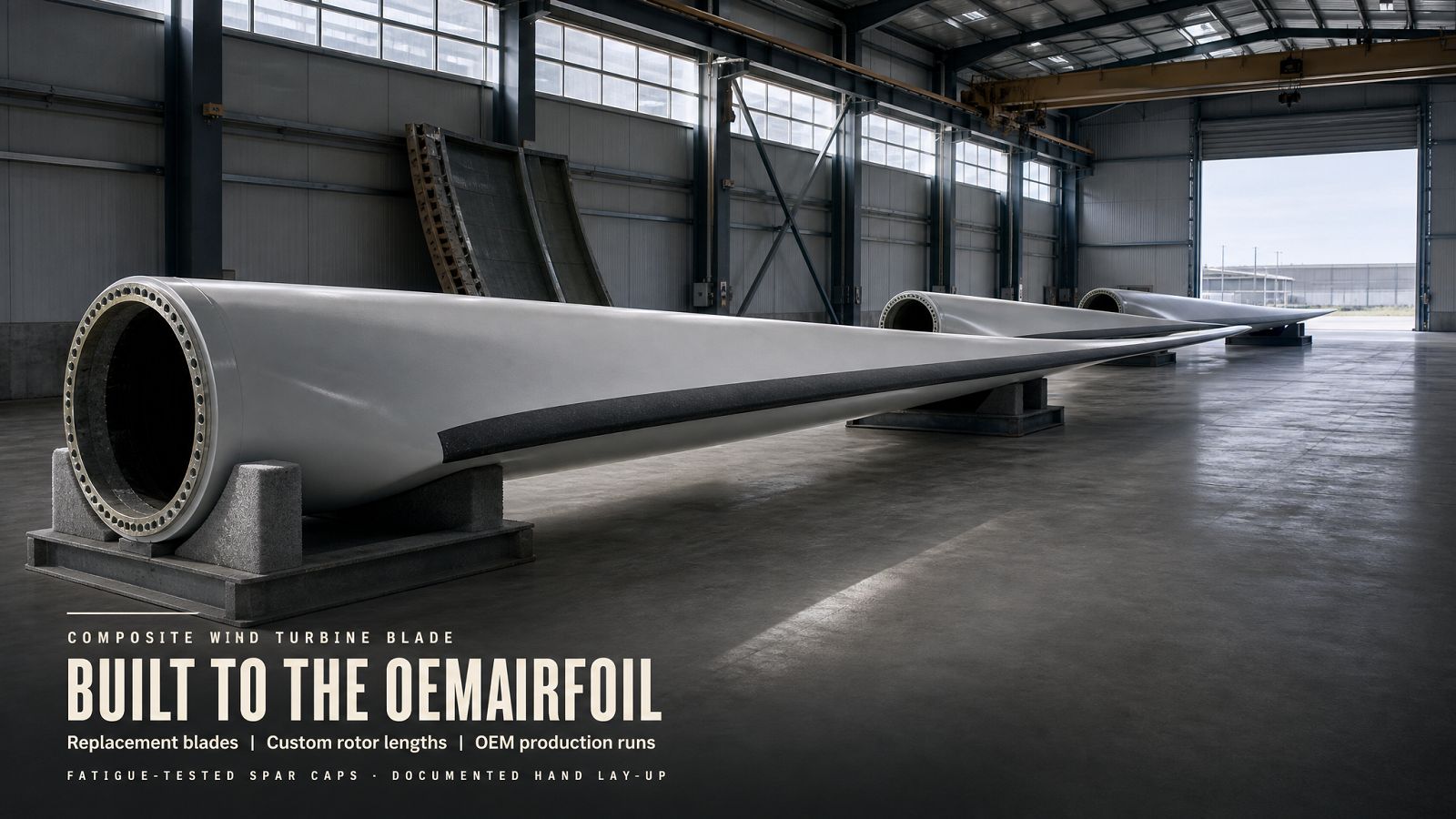
Replacement blades for installed fleets, custom rotor lengths for new turbine installations, and OEM production runs for the small-utility and industrial wind market. Each blade is built to the OEM's geometry and qualified against the project's IEC 61400 class.
Send your turbine spec See size envelope
What the buyer is trying to solve
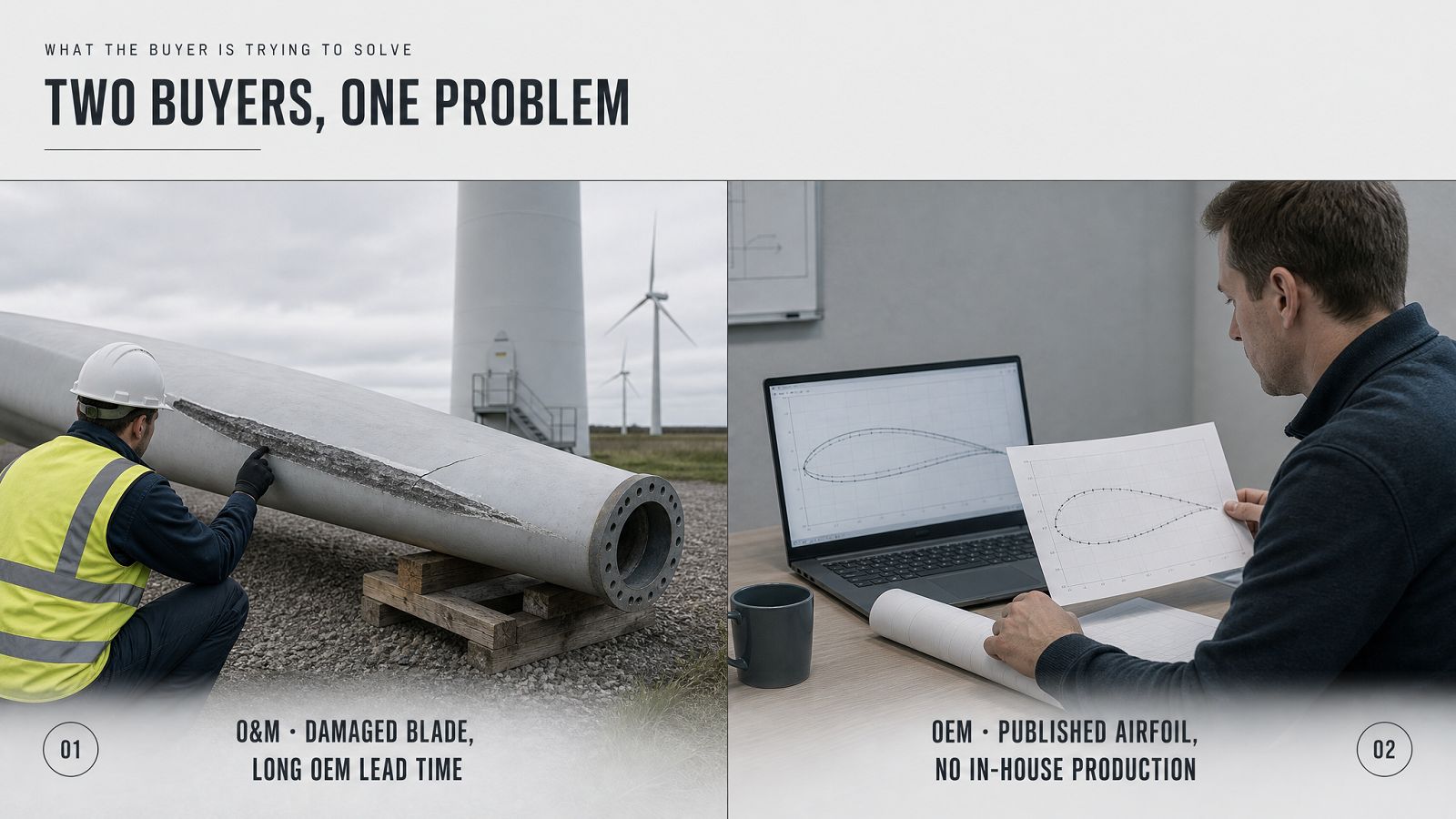
The two buyers who arrive here.
Two buyer types land on this page. The first is an O&M team at a small-utility or industrial wind farm with a damaged blade and a long lead time from the original OEM. They need a replacement blade that fits the existing hub and matches the published aerodynamic profile, in a timeframe that lets the turbine come back online this season. The second is a turbine OEM or developer evaluating a composite supplier for a new small-utility model, with a published airfoil but no in-house blade production.
In both cases, the buyer needs a blade supplier with a documented layup process, a fatigue test on the spar cap, and the willingness to work to the OEM's published geometry rather than a generic profile.
How we build a blade
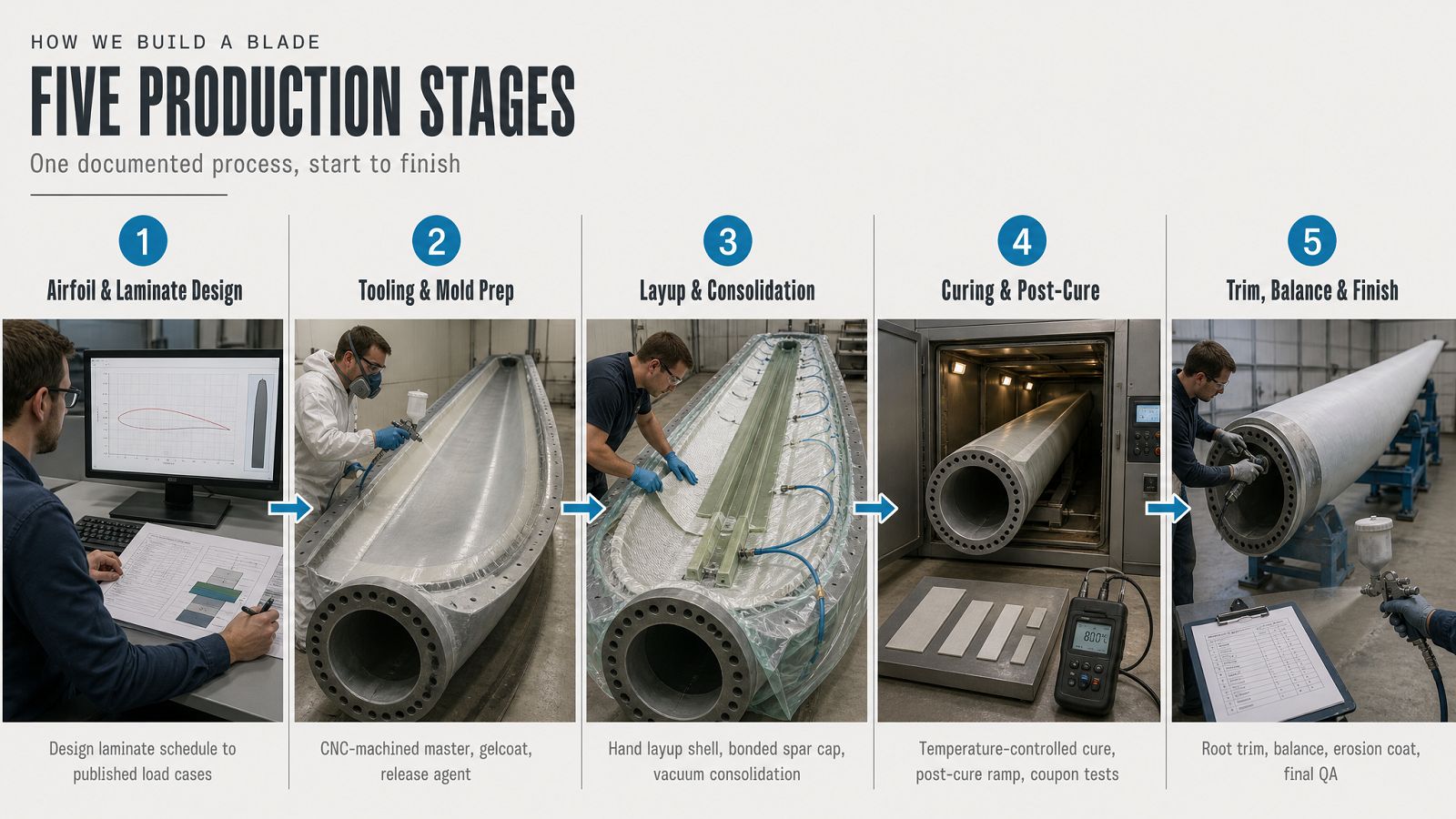
The manufacturing process, in five steps.
Airfoil review and laminate design
We receive the OEM's airfoil coordinates, root geometry, and pitch range. Our engineer designs the laminate schedule against the published load cases.
01
Tooling and mold prep
Mold from CNC-machined master; gelcoat applied; release agent and layup preparation. Molds are owned by Enbuss for the published blade family and supplied by the customer for custom blades.
02
Layup and consolidation
Hand layup of the fiberglass / basalt-FRP shell, with pultruded spar caps bonded into the shear webs. Vacuum consolidation per laminate schedule.
03
Curing and post-cure
Curing in temperature-controlled shop per resin system; post-cure ramp where the resin system requires it. Coupon-level mechanical tests during the run.
04
Trim, balance, finish
Root trimming to OEM bolt pattern; static and dynamic balancing; leading-edge erosion coat; tip finishing; final QA against the OEM's drawing.
05
Size envelope
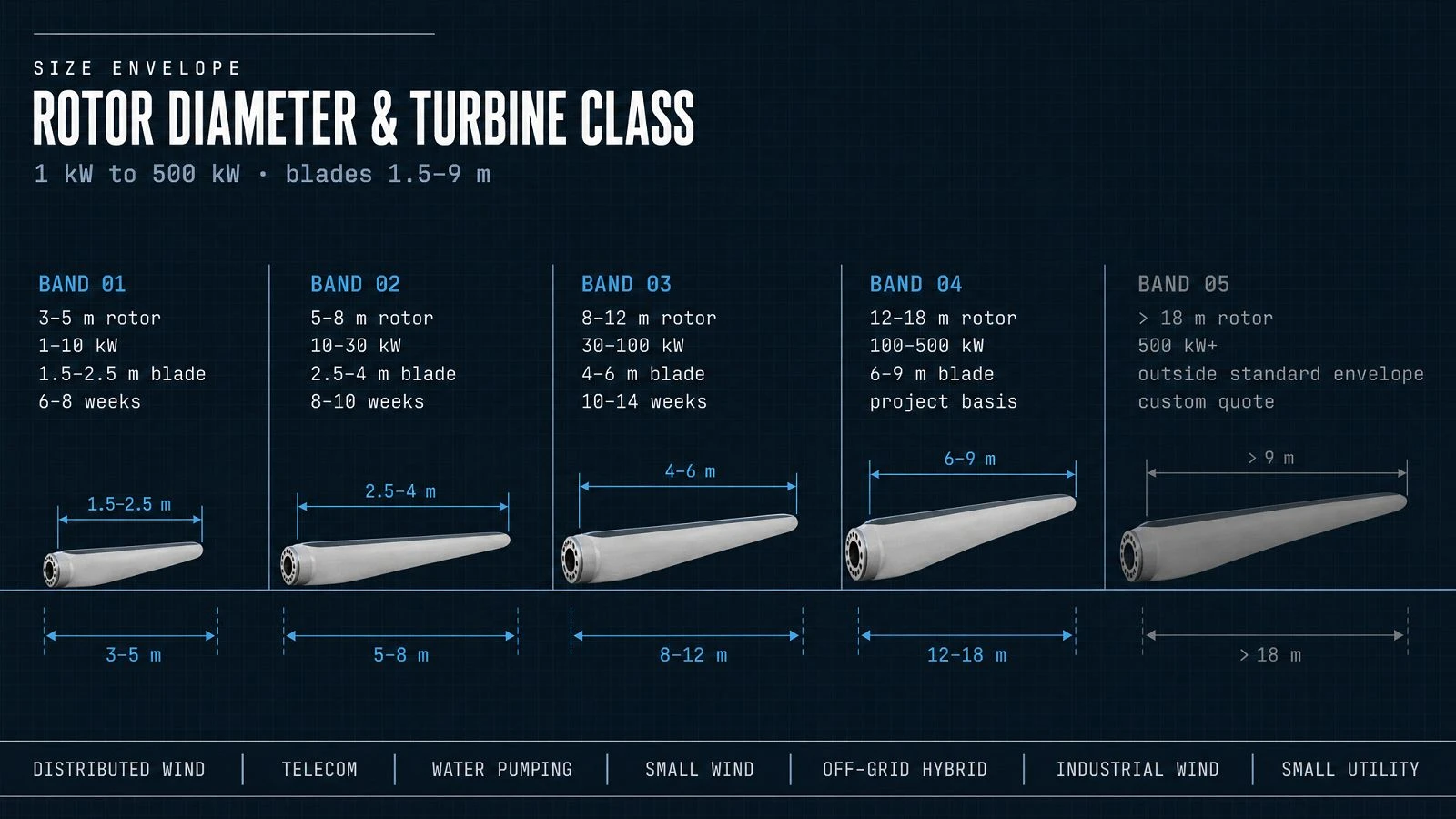
Our production is set up for the rotor diameter and turbine class below. Outside this envelope we are happy to talk, but lead time and tooling cost grow.
|
Rotor diameter |
Rated turbine power |
Typical application |
Standard blade length |
Lead time |
|
3–5 m |
1–10 kW |
Distributed wind, telecom, water pumping |
1.5–2.5 m |
{{6–8}} weeks |
|
5–8 m |
10–30 kW |
Small wind, off-grid hybrid |
2.5–4 m |
{{8–10}} weeks |
|
8–12 m |
30–100 kW |
Industrial wind, small utility |
4–6 m |
{{10–14}} weeks |
|
12–18 m |
100–500 kW |
Small-utility wind (verify project feasibility) |
6–9 m |
Project basis |
|
> 18 m |
500 kW+ |
Outside our standard envelope |
> 9 m |
Custom quote |
When we are not the right supplier
Cases where you should call a larger blade maker.
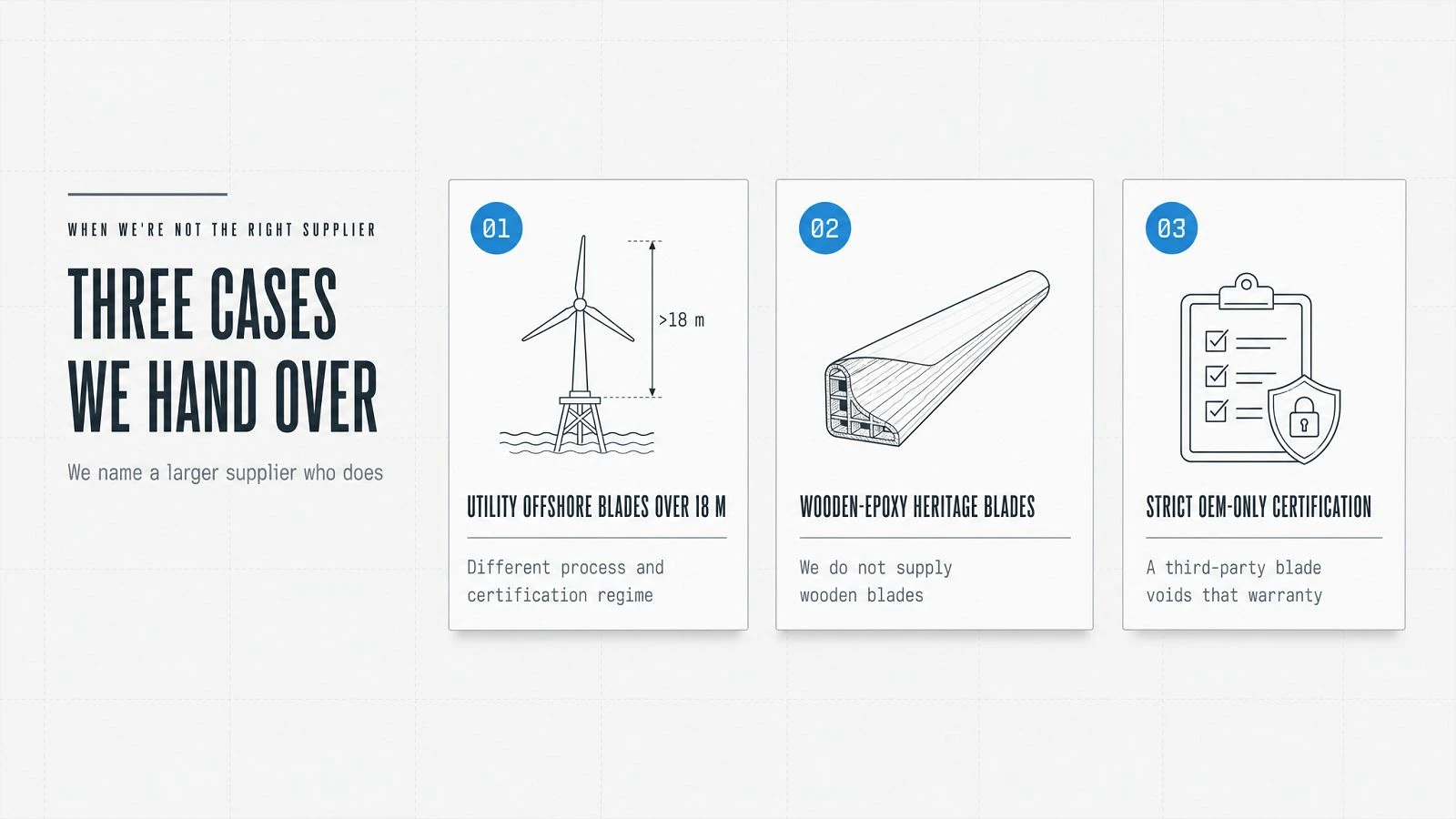
Three cases where Enbuss redirects you
- Utility-scale offshore blades over 18 m rotor diameter. Offshore utility blades are a different process and certification regime (DNV, IEC 61400-3-1) that we do not currently serve. We can name two or three larger suppliers that do - please ask.
- Wooden-epoxy blades for heritage turbines. Some vintage small turbines were built with wooden blades. We do not supply wooden blades. A heritage specialist does.
- Strict OEM-only certification on the original blade. If the turbine OEM requires their own brand of replacement blade to keep the warranty in force, a third-party blade will void that warranty regardless of how well it is built. Check with the OEM before commissioning a third-party replacement.
Material comparison
|
Component |
Standard construction |
Heavy-duty option |
|
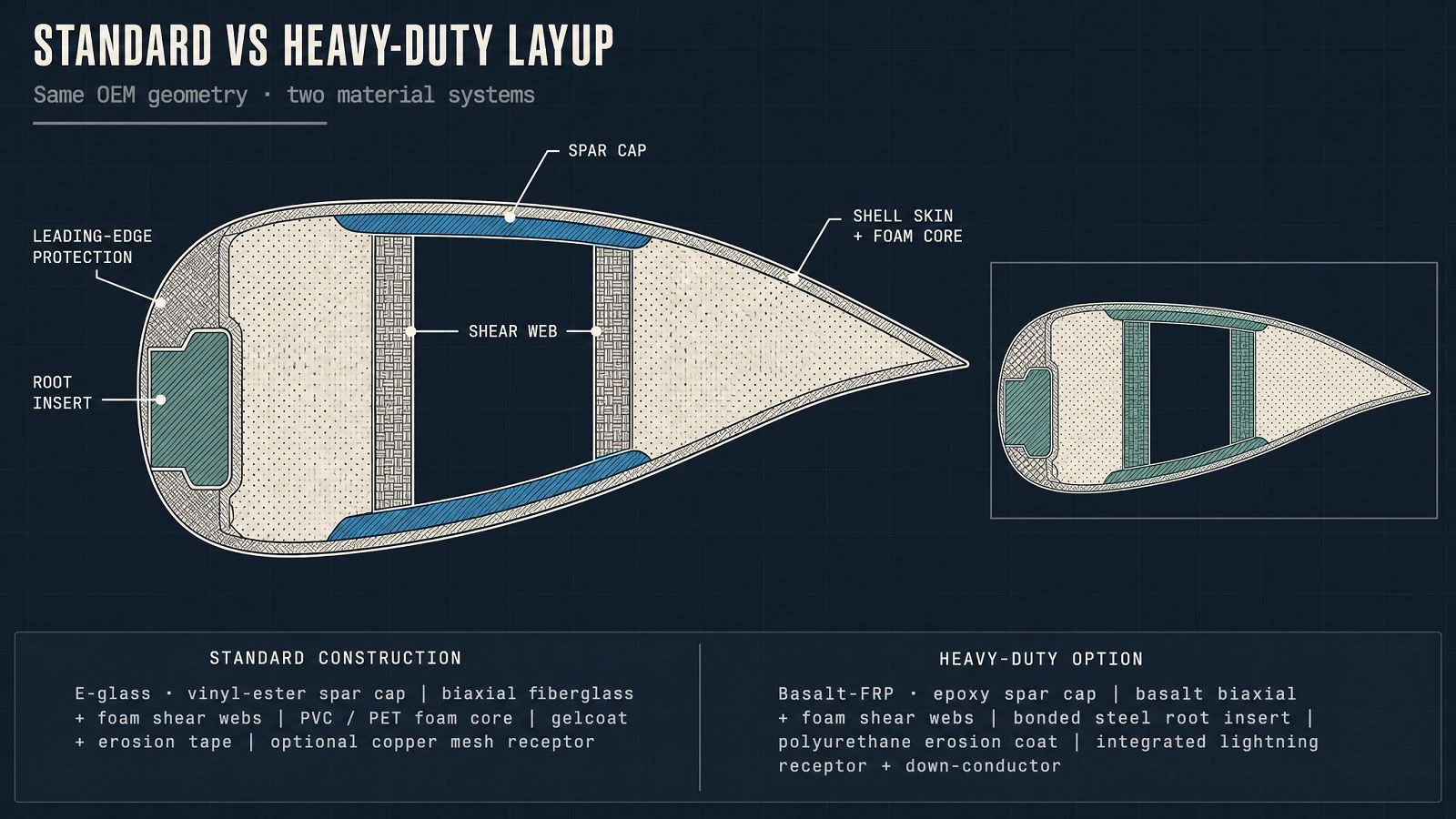
Spar cap |
Pultruded E-glass / vinyl-ester unidirectional |
Pultruded basalt-FRP / epoxy unidirectional |
|
Shear webs |
Hand-laid biaxial fiberglass + foam core |
Hand-laid basalt biaxial + foam core |
|
Shell skins |
Hand-laid biaxial / quad fiberglass + PVC / PET foam core |
Hand-laid basalt biaxial + foam core |
|
Root fitting |
Bonded stainless bushing or T-bolt pattern |
Bonded steel root insert, fully encapsulated |
|
Surface |
Gelcoat with leading-edge erosion tape |
Polyurethane leading-edge erosion coat |
|
Tip |
Tip brake or tip fin per OEM design |
Lightning receptor integrated |
|
Lightning protection |
Optional copper mesh receptor |
Receptor and down-conductor integrated |
Fatigue and qualification
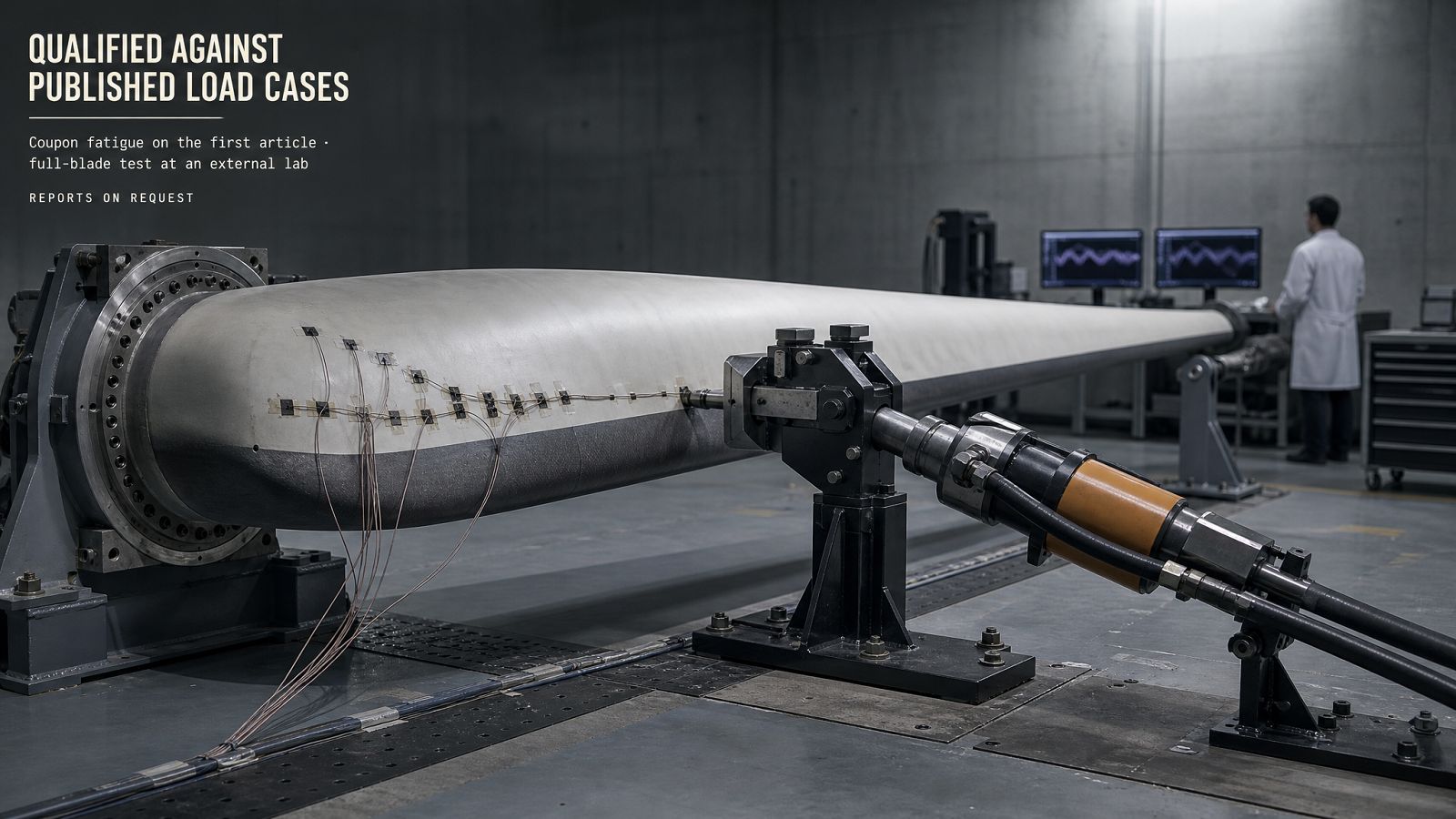
We qualify each new blade geometry against the OEM's published load cases. Coupon-level fatigue tests are run during the layup of the first article; full-blade fatigue tests are run at an external lab for new blade families. Reports on request.
Customization & OEM
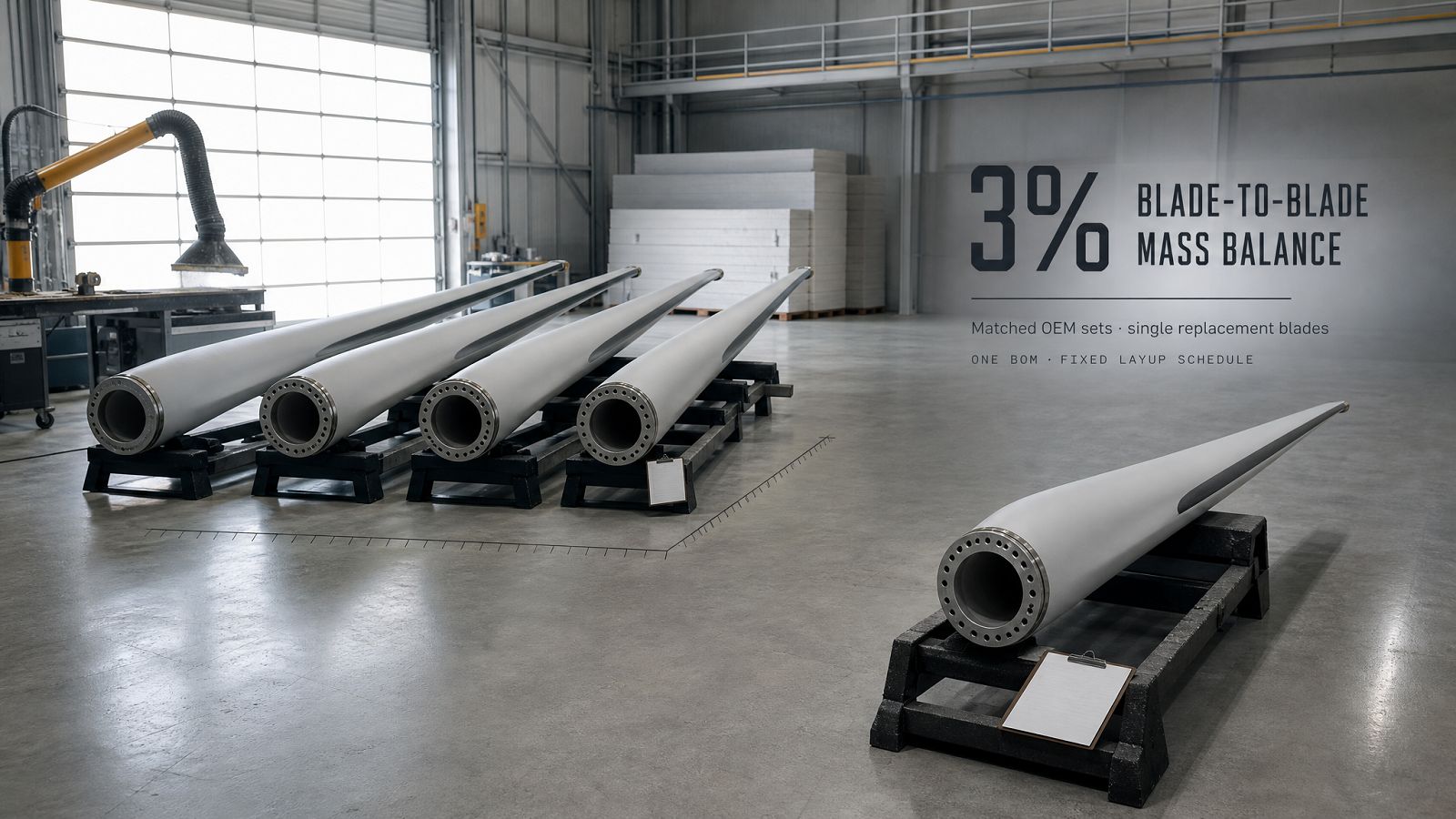
OEM customers often need a multi-blade production order at fixed layup schedule, with blade-to-blade mass balance and a published laminate specification. We supply the kit as a single BOM. Replacement blade customers typically need a single-blade order against the OEM geometry. Both are normal business for us; send the drawing and we will quote.
Frequently asked questions
Send your turbine spec
Can you build to my OEM airfoil coordinates?
Yes. Send the OEM's airfoil file (typically .dat or .txt coordinates), the root bolt pattern, and the rated rotor speed. We return a laminate design and a fixed quote.
What resin systems do you use?
Vinyl-ester standard for cost-effective small wind; epoxy for higher fatigue and longer blade life; basalt-FRP reinforcement available with either resin system.
Do you supply lightning protection?
Yes, integrated lightning receptor and down-conductor. Specify on RFQ. Standard lightning protection is optional.
Can you match the existing blade mass and balance?
Yes. Static and dynamic balancing is part of the production process; blade-to-blade mass difference typically below {{3}} percent for a matched set.
Is the blade Type-Certified?
We supply blades that pass type testing against the OEM's published load case. Full IEC 61400 type certification of the turbine is the OEM's responsibility; we provide the blade-level documentation pack.
How is the blade shipped?
Standard 20 ft or 40 ft container; root end protected with foam cradle. Larger blades up to 9 m may require flat-rack. Shipping cost depends on destination; we quote including shipping on request.
What documentation comes with each blade?
Per blade: dimensional inspection, mass, balance report, laminate schedule, coupon fatigue test reference, surface finish report, lightning protection test (if specified), installation manual excerpt.
What about field repair if the blade is struck by debris?
Composite blades can be field-repaired for leading-edge erosion and minor impact damage using our repair kit. Major structural damage requires a factory evaluation; contact us for return assessment.
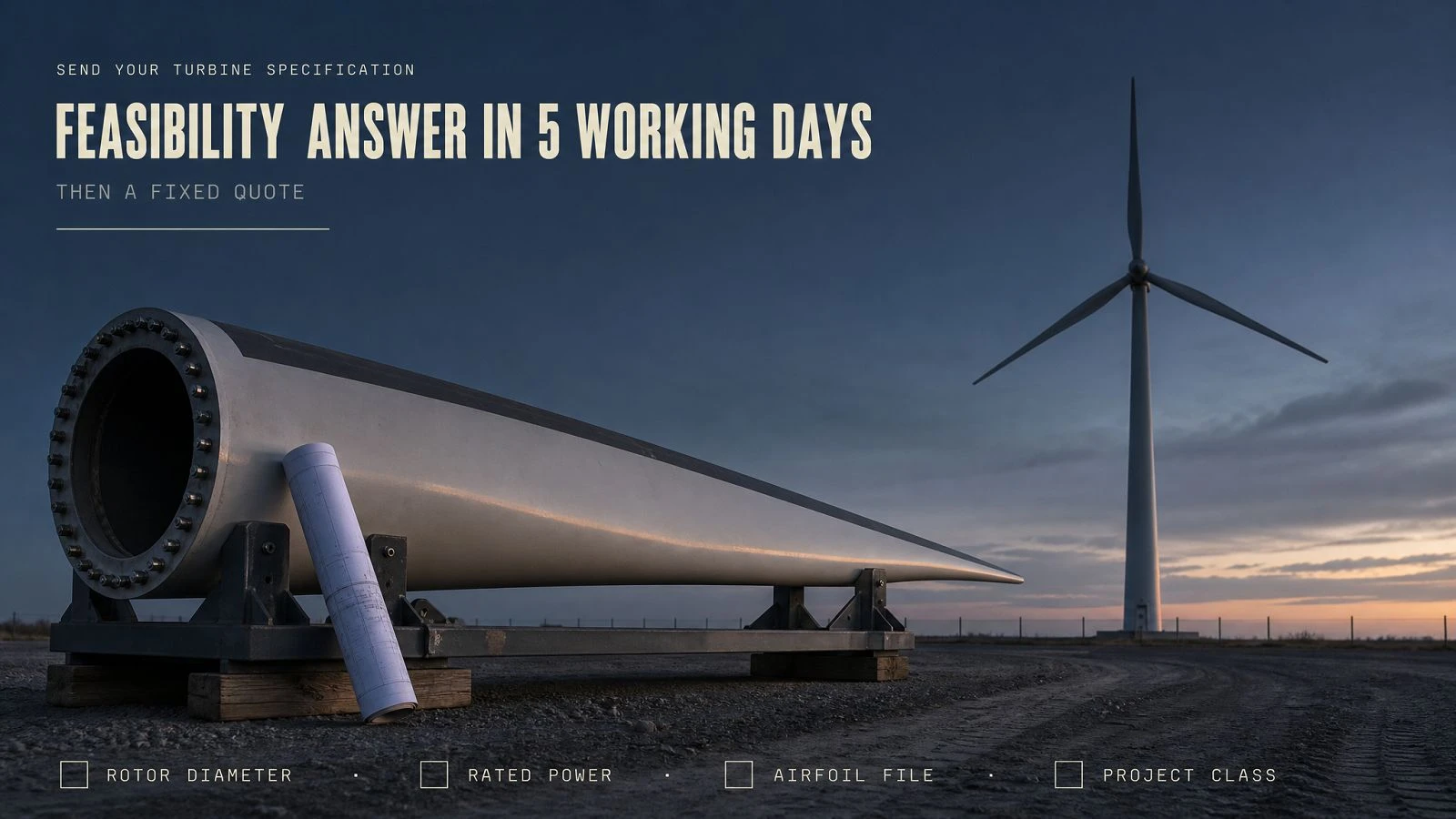
Send your turbine specification
Send the rotor diameter, the rated power, the airfoil file (if you have it), and the project class. We return a feasibility response within {{5}} working days and a fixed quote shortly after.